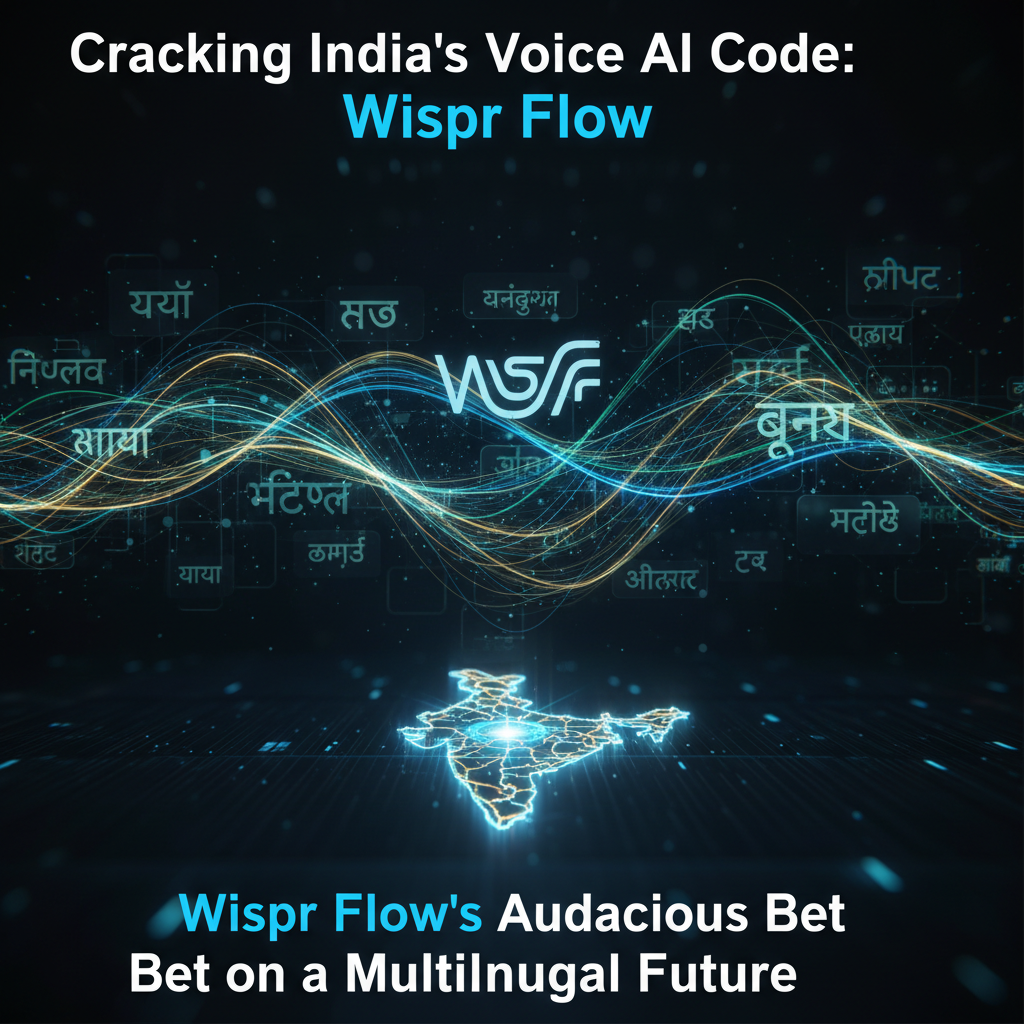
India, a land of unparalleled diversity, presents both a colossal opportunity and a daunting challenge for artificial intelligence, particularly in the realm of voice. With hundreds of languages and thousands of dialects, building truly inclusive voice AI that caters to 1.4 billion people is, to put it mildly, hard. Yet, as of May 2026, one startup is not just acknowledging this difficulty but is actively betting its future on overcoming it: Wispr Flow.
The Unique Labyrinth of Voice AI in India
The global voice AI market has surged, with solutions like Alexa and Google Assistant becoming ubiquitous in English-speaking nations. However, transplanting these models directly to India is akin to fitting a square peg in a round hole. The challenges are multifaceted and deeply rooted in India’s linguistic and socio-economic fabric:
- Multilingualism & Code-Switching: An average Indian often converses in a mix of English and one or more regional languages, sometimes within the same sentence (code-switching). Existing models struggle with this fluidity.
- Lack of Data: While English datasets are abundant, high-quality, diverse, and large-scale datasets for most Indian languages (especially regional dialects) are scarce, hindering model training.
- Accent & Pronunciation Variations: Even within a single language, accents vary significantly across states and regions, adding another layer of complexity for accurate speech recognition.
- Low Digital Literacy: Many potential users in rural or semi-urban areas are new to digital interfaces, making intuitive voice interaction even more critical for adoption.
- Computational Resources: Training and deploying models for such a vast linguistic landscape require immense computational power, a significant barrier for many local players.
Wispr Flow’s Audacious Strategy: Betting on Localized Innovation
Defying conventional wisdom, Wispr Flow has emerged as a beacon of innovation, developing its proprietary ‘Flow’ engine specifically tailored for the Indian context. Their strategy isn’t about adapting global models; it’s about building from the ground up, embracing India’s complexities as features, not bugs.
Sources close to the company indicate Wispr Flow’s approach focuses on:
- Hybrid AI Architectures: Combining advanced neural networks with traditional linguistic rule-based systems to handle the nuances of Indian grammar and phonetics.
- Community-Driven Data Collection: Engaging local communities and leveraging crowdsourcing to build extensive, diverse, and authentic datasets for underserved languages and dialects.
- Focus on Use Cases: Instead of a generalized assistant, Wispr Flow is targeting specific, high-impact sectors first, such as vernacular e-commerce, regional banking services, and local government citizen services, where the need for voice interaction is most acute.
- Leveraging Local Talent: Investing heavily in Indian linguists, AI researchers, and data scientists who possess an inherent understanding of the linguistic landscape.
Their early pilots in states like Uttar Pradesh and Maharashtra have shown promising results in processing mixed-language queries and understanding localized accents, hinting at a scalable solution.
Why the Bet is Worth Taking: The Untapped Potential of India’s Voice AI Market
Despite the hurdles, the potential rewards for cracking India’s voice AI code are staggering. An accessible voice interface could be the key to true digital inclusion for millions:
- Bridging the Digital Divide: For non-English speakers or those with limited literacy, voice AI can be the most natural and intuitive gateway to digital services, bringing vast new populations online.
- Economic Empowerment: Voice-enabled e-commerce and financial services in regional languages can open up new markets for businesses and provide financial access to underserved communities.
- Enhanced Public Services: Government initiatives, healthcare information, and educational content can reach citizens more effectively through voice, especially in remote areas.
- Massive Market Size: A successful voice AI solution could tap into a market of hundreds of millions, potentially unlocking economic value far exceeding current estimates.
Navigating the Road Ahead: Challenges Remain, but Optimism Prevails
Wispr Flow’s journey is far from over. Scaling their data collection efforts, refining their models for even greater accuracy, and securing significant investment to match their ambitious vision will be critical. Competition from global tech giants, even those struggling with India’s unique challenges, will also intensify.
However, the startup’s unwavering commitment to solving a profoundly local problem with deeply localized solutions positions it uniquely. Their audacious bet on India’s voice AI future isn’t just about building a successful company; it’s about pioneering a path towards a more inclusive, accessible, and digitally empowered India.
The world is watching to see if Wispr Flow can truly whisper to India in its myriad voices.
Leave a Reply