
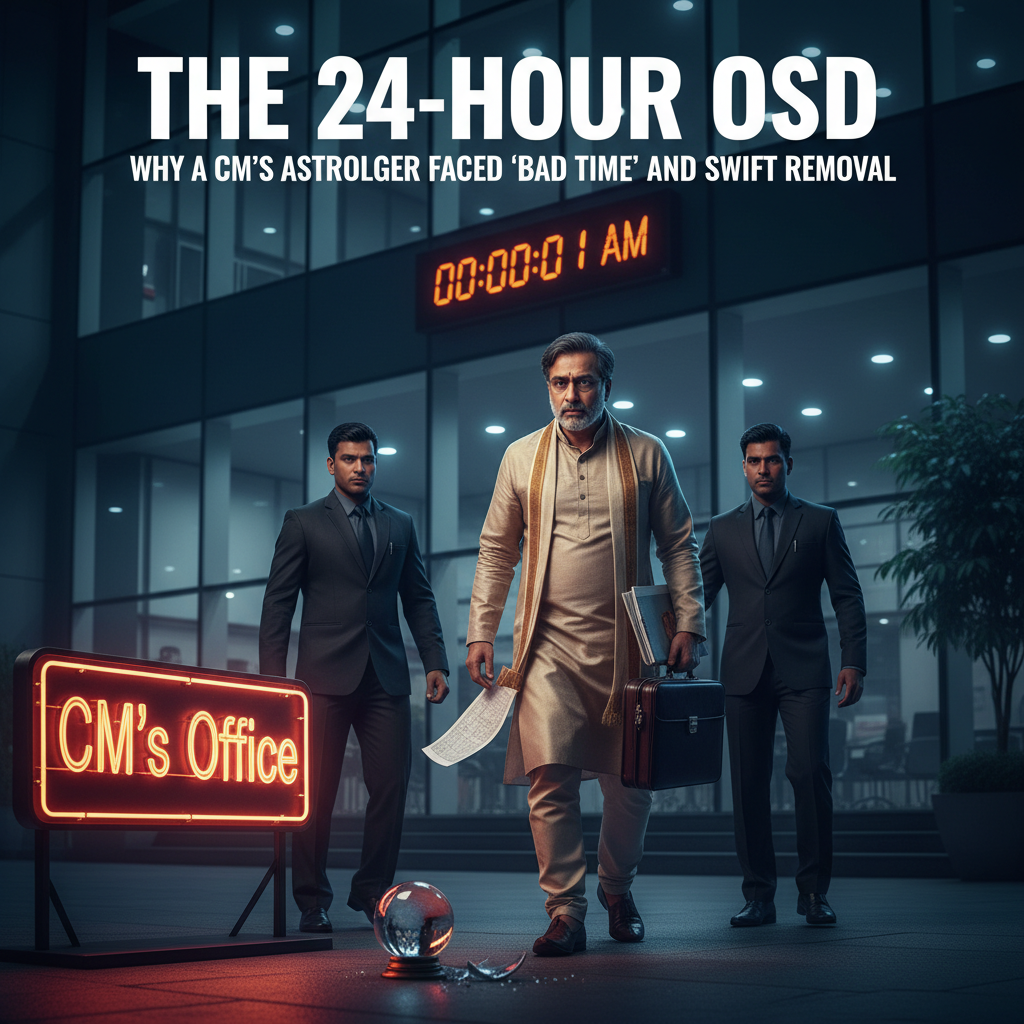
In a dramatic turn of events that captured national attention, an astrologer appointed as an Officer on Special Duty (OSD) to a Chief Minister found his tenure cut short within a staggering 24 hours. What began as a seemingly innocuous, if unconventional, appointment quickly spiraled into a political maelstrom, forcing a swift retraction and highlighting the delicate balance between personal beliefs, public office, and political accountability. This incident, centered around astrologer Pandit Vettrivel, serves as a poignant reminder that in the realm of governance, even a trusted advisor can face a sudden ‘bad time’.
The Appointment That Stirred the Political Pot
The controversy ignited with the news of Pandit Vettrivel’s appointment as an OSD to the Chief Minister. While the specific CM was not explicitly named in some reports (the original source mentioned “CM Vijay”), this event is widely associated with the office of Tamil Nadu Chief Minister M.K. Stalin, to whom Vettrivel was briefly attached. The role of an OSD is generally to assist the Chief Minister with various duties, often requiring administrative or policy expertise. However, Vettrivel’s identity as a prominent astrologer immediately raised eyebrows.
In a secular democratic framework, the appointment of an individual primarily known for their astrological prowess to a governmental administrative post sparked widespread debate. Critics questioned the appropriateness of such a move, arguing it blurred the lines between state affairs and personal belief systems, potentially undermining the principles of rational governance.
A ‘Bad Time’ Indeed: The Swift Reversal
The backlash was immediate and fierce. Social media platforms buzzed with discussions, opposition parties seized the opportunity to lambast the government, and the public expressed a mix of surprise, skepticism, and outright criticism. The core of the objection wasn’t necessarily to astrology itself, which holds a significant place in many Indian households, but rather to its perceived official integration into the machinery of state administration.
Within a mere 24 hours of the announcement, facing intense pressure and public outcry, the Chief Minister’s office rescinded the appointment order. The swiftness of the decision underscored the government’s recognition of the controversy’s potential to escalate further and damage its image. For Pandit Vettrivel, it was indeed a rapid ‘bad time’ – an official role that vanished almost as quickly as it appeared.
Beyond the Astrologer: The Broader Political Fallout
This incident resonated far beyond the individual appointment. It ignited crucial discussions about:
- Transparency in Appointments: The need for clear criteria and justification for key governmental roles.
- Secular Governance: The importance of maintaining a clear separation between personal faith and public administration in a diverse nation.
- Public Accountability: How quickly public opinion and media scrutiny can force a government to reconsider its decisions.
- Political Opportunism: The readiness of opposition parties to capitalize on perceived missteps to gain political mileage.
The episode served as a stark reminder that in the hyper-connected age, every governmental decision, no matter how minor, is subjected to intense public scrutiny, and misjudgments can have rapid and significant political consequences.
Astrology and Indian Politics: A Complex Relationship
The influence of astrologers and spiritual advisors in the lives of political leaders is not new in India. Many politicians, cutting across party lines, are known to consult astrologers for auspicious dates, electoral predictions, and personal guidance. However, officially integrating such roles into the government’s structure remains a highly contentious issue.
While personal belief is a fundamental right, the public expects governmental functions to be driven by rational decision-making, policy expertise, and transparent processes. The Vettrivel episode highlighted this tension, reiterating the public’s demand for a clear delineation between personal faith and the official duties of state.
Conclusion: A Cautionary Tale
The abrupt removal of an astrologer from an OSD post within 24 hours stands as a significant political cautionary tale. It demonstrates the power of public opinion, the ever-present scrutiny on political appointments, and the imperative for governments to align their decisions with public expectations and the principles of secular governance. For Pandit Vettrivel, it was a ‘bad time’ that ended a governmental stint before it truly began, but for the political landscape, it was a moment that underscored the evolving dynamics of power, perception, and accountability.
Leave a Reply