
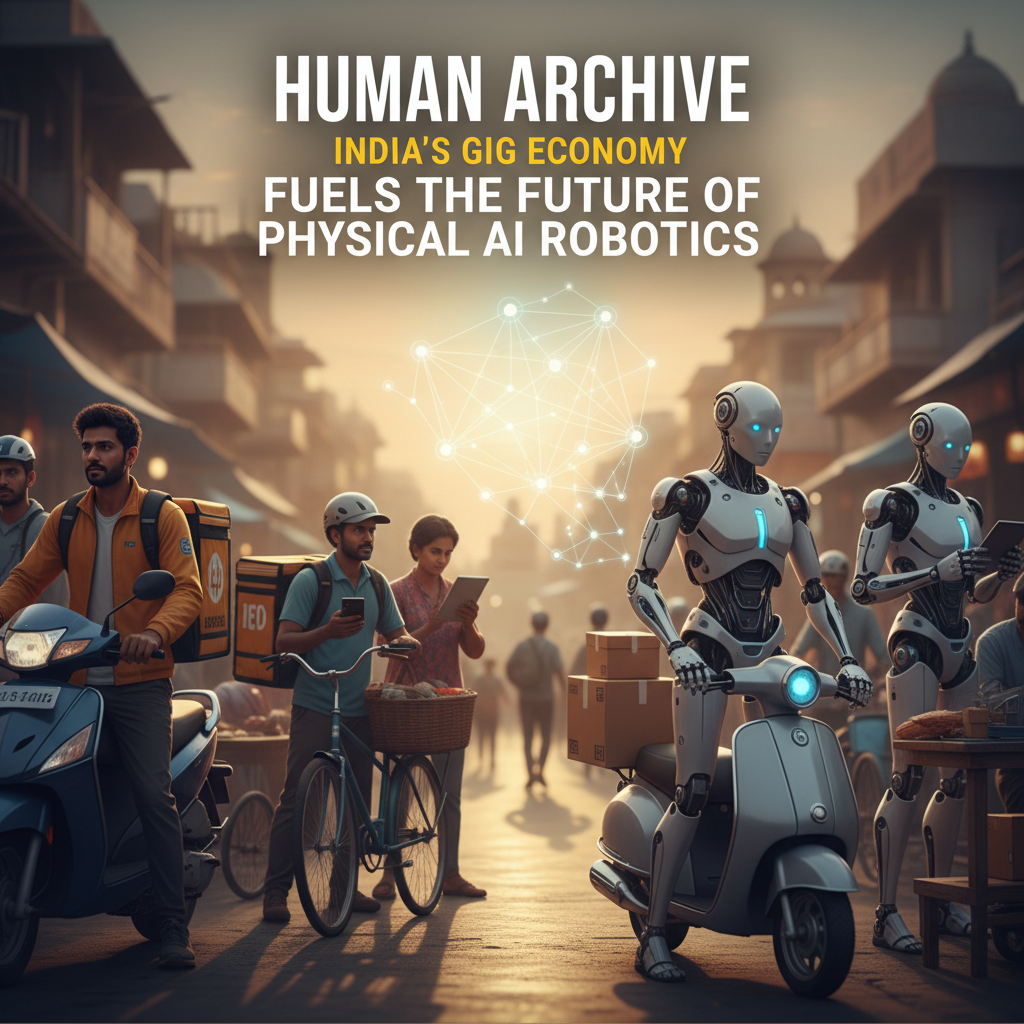
Human Archive: India’s Gig Economy Fuels the Future of Physical AI Robotics
The relentless march of Artificial Intelligence continues to reshape our world, but for all its advancements, one frontier remains particularly challenging: Physical AI. These are the robots, autonomous vehicles, and intelligent systems that interact directly with our physical environment, requiring an unprecedented level of real-world, nuanced data to learn and operate effectively. Enter Human Archive, a visionary startup making headlines with its groundbreaking approach, betting on India’s vast and dynamic gig economy to train the world’s next generation of robots.
The Data Chasm: Why Physical AI Needs a Human Touch
Unlike purely digital AI, which thrives on vast datasets of text, images, and code, physical AI needs to understand the messy, unpredictable realities of our world. A robot arm needs to grasp objects of varying textures and weights; an autonomous car needs to navigate diverse road conditions and human behaviors. Traditional synthetic data often falls short, lacking the subtle contextual cues and real-world variability that only human experience can provide. This creates a massive data chasm, slowing the development of truly intelligent physical systems.
Human Archive’s Innovative Solution: Tapping India’s Gig Economy
Human Archive recognized this critical gap and devised an ingenious solution: leverage India’s burgeoning gig economy. With its immense talent pool, digital literacy, and entrepreneurial spirit, India presents an unparalleled opportunity for scalable, high-quality data collection. Human Archive isn’t just crowdsourcing simple labels; they’re engaging a diverse network of skilled individuals to perform complex, nuanced data generation tasks for physical AI models.
Their strategy involves a unique partnership with India’s vibrant ecosystem of services startups. Instead of building their own massive workforce from scratch, Human Archive collaborates with existing local businesses and platforms, integrating their data collection needs into established operational flows. This symbiotic relationship ensures:
- Authenticity: Data is collected in real-world scenarios by individuals deeply familiar with local contexts.
- Scalability: Access to millions of potential gig workers allows for rapid expansion and diverse datasets.
- Quality & Nuance: Human annotators and data collectors provide the detailed contextual understanding essential for complex physical AI tasks.
- Economic Empowerment: It creates new revenue streams and upskilling opportunities for India’s gig workers.
India: The Unsung Hero of Future AI Development
India’s role in this revolution cannot be overstated. Beyond just a large population, the country boasts a demographic dividend of young, tech-savvy individuals eager to participate in the global digital economy. Human Archive’s model taps into this potential, transforming data collection into a meaningful, well-paying gig that contributes directly to cutting-edge AI research and development.
This isn’t merely about cheap labor; it’s about intelligent, contextual understanding. Imagine a gig worker documenting the subtle ways people interact with objects in a market, or recording variations in human gait. This human-centric data is invaluable for training robots to behave more naturally, safely, and effectively in human environments.
The Impact and Future Implications
Human Archive’s approach has profound implications for the future of AI. By providing high-quality, diverse, and ethically sourced data, they are accelerating the development of robust physical AI systems across industries, from logistics and manufacturing to healthcare and autonomous robotics. India stands to emerge as a critical hub for AI data solutions, further solidifying its position in the global tech landscape.
This venture underscores a crucial paradigm shift: the future of advanced AI isn’t solely about algorithms; it’s equally about the quality and breadth of the data it learns from. And in this new era, the human element – particularly the vast, skilled human capital of economies like India’s – becomes an indispensable asset.
Driving Innovation, Empowering Communities
Human Archive’s bet on India’s gig economy is more than just a smart business move; it’s a vision for collaborative innovation. It demonstrates how global technological advancements can be intertwined with local economic empowerment, creating a win-win scenario where robots learn from humanity, and humanity gains new opportunities in the digital age.
As physical AI continues its inevitable march, companies like Human Archive, powered by the ingenious application of human intelligence from corners of the world like India, will be the architects of a truly intelligent future.