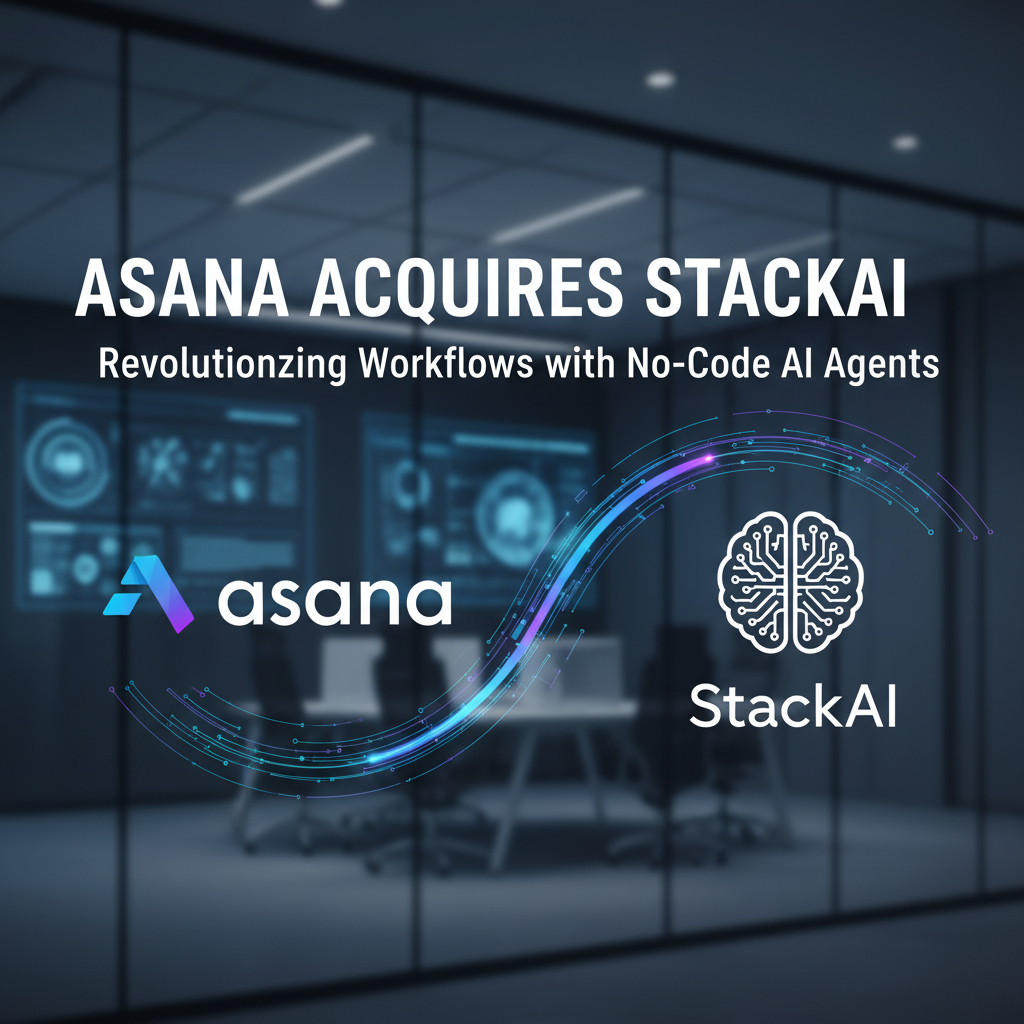
In a strategic move set to redefine the landscape of work management and productivity, Asana, a leading platform for orchestrating work, has announced its acquisition of StackAI, an innovative no-code agent-builder. This acquisition, as reported by TechCrunch, signals Asana’s deep commitment to embedding advanced artificial intelligence and automation directly into the fabric of project and workflow management, making sophisticated AI tools accessible to everyone.
What is StackAI? Empowering No-Code AI
At its core, StackAI is a pioneering platform that enables users to build powerful AI agents without writing a single line of code. It empowers business users, project managers, and even non-technical professionals to create custom AI-driven solutions that can automate tasks, process data, generate insights, and respond intelligently to various triggers. Think of it as a toolkit for crafting your own digital assistants, smart data processors, or automated workflow supervisors tailored to specific needs.
- No-Code Accessibility: Democratizes AI creation, removing the barrier of coding expertise.
- AI Agent Building: Allows the creation of custom AI entities that can perform specific functions.
- Workflow Automation: Integrates AI capabilities into existing processes to enhance efficiency.
- Data Intelligence: Enables automated data extraction, analysis, and report generation.
This capability to build custom, intelligent agents is a game-changer, moving beyond generic automation to truly personalized and adaptive workflow enhancements.
Why Asana Acquired StackAI: A Vision for Intelligent Work
Asana’s acquisition of StackAI is not merely an expansion; it’s a strategic leap towards a future where project management is inherently more intelligent, automated, and proactive. The synergy between Asana’s robust work orchestration platform and StackAI’s no-code AI agent building capabilities is immense:
1. Supercharging Workflow Automation
While Asana already offers powerful automation rules, StackAI brings a new dimension: intelligent automation. This means workflows that can understand context, make decisions, and adapt dynamically. Imagine an AI agent automatically prioritizing tasks based on real-time project risks, or generating summary reports from ongoing discussions.
2. Democratizing AI for Every Team
Asana’s mission has always been to make work easier and more efficient for teams. By integrating StackAI, Asana is extending this mission to AI. Project managers, marketers, HR professionals, and even small business owners will be able to leverage AI to solve their unique challenges without relying on developers.
3. Enhancing Data-Driven Decision Making
AI agents built with StackAI can process vast amounts of project data, identify patterns, and surface critical insights that might otherwise be missed. This capability will empower teams using Asana to make more informed, data-driven decisions, anticipate roadblocks, and optimize resource allocation.
4. Competitive Edge in the AI-First Era
The productivity software market is increasingly competitive, with AI at the forefront of innovation. This acquisition positions Asana as a leader in delivering practical, user-friendly AI solutions directly integrated into daily work, differentiating it from competitors.
What This Means for Asana Users: The Future of Project Management
For current and prospective Asana users, the acquisition of StackAI promises a transformative experience. While specific integrations and features will unfold over time, we can anticipate several exciting possibilities:
- Custom AI Assistants for Projects: Imagine an AI agent that monitors project progress, flags potential delays, suggests resource reallocations, or even drafts initial project briefs.
- Intelligent Task Management: Tasks could be automatically enriched with relevant information, assigned based on skill and availability, or even broken down into sub-tasks by an AI.
- Automated Reporting and Analytics: Generate sophisticated, real-time reports on project health, team performance, and budget utilization with just a few clicks, or even automatically on a schedule.
- Personalized Workflow Enhancements: Users could build their own micro-AI agents to handle repetitive tasks, manage notifications, or integrate with other tools in a highly customized way.
- Smarter Communication: AI agents could summarize lengthy discussion threads, extract action items, or even draft responses, streamlining team communication.
The goal is clear: to empower teams to achieve more by offloading cognitive and repetitive tasks to intelligent agents, allowing humans to focus on creative problem-solving and strategic initiatives.
The Broader Implications: No-Code AI and the Future of Work
Asana’s acquisition of StackAI is a microcosm of a larger trend in the tech industry: the convergence of no-code development with powerful AI capabilities. This movement is rapidly lowering the barrier to entry for advanced technology, making sophisticated tools accessible to a wider audience.
It highlights a future where:
- Citizen Developers Flourish: More non-technical users will be able to build and deploy custom solutions.
- Work is More Automated & Intelligent: Routine tasks will increasingly be handled by AI, freeing up human potential.
- Productivity Platforms Evolve: Expect other work management tools to follow suit, integrating deeper AI functionalities.
Conclusion: A Smarter Asana on the Horizon
The acquisition of StackAI marks a pivotal moment for Asana, signaling a bold step into the era of pervasive, user-friendly AI. By combining its robust work management platform with StackAI’s innovative no-code agent-building technology, Asana is not just adding features; it’s reimagining how teams will work in the future.
As the integration unfolds, Asana users can look forward to a more intelligent, automated, and efficient project management experience, propelling teams towards unprecedented levels of productivity and strategic focus. The future of work, powered by no-code AI, is here, and Asana is leading the charge.
Leave a Reply