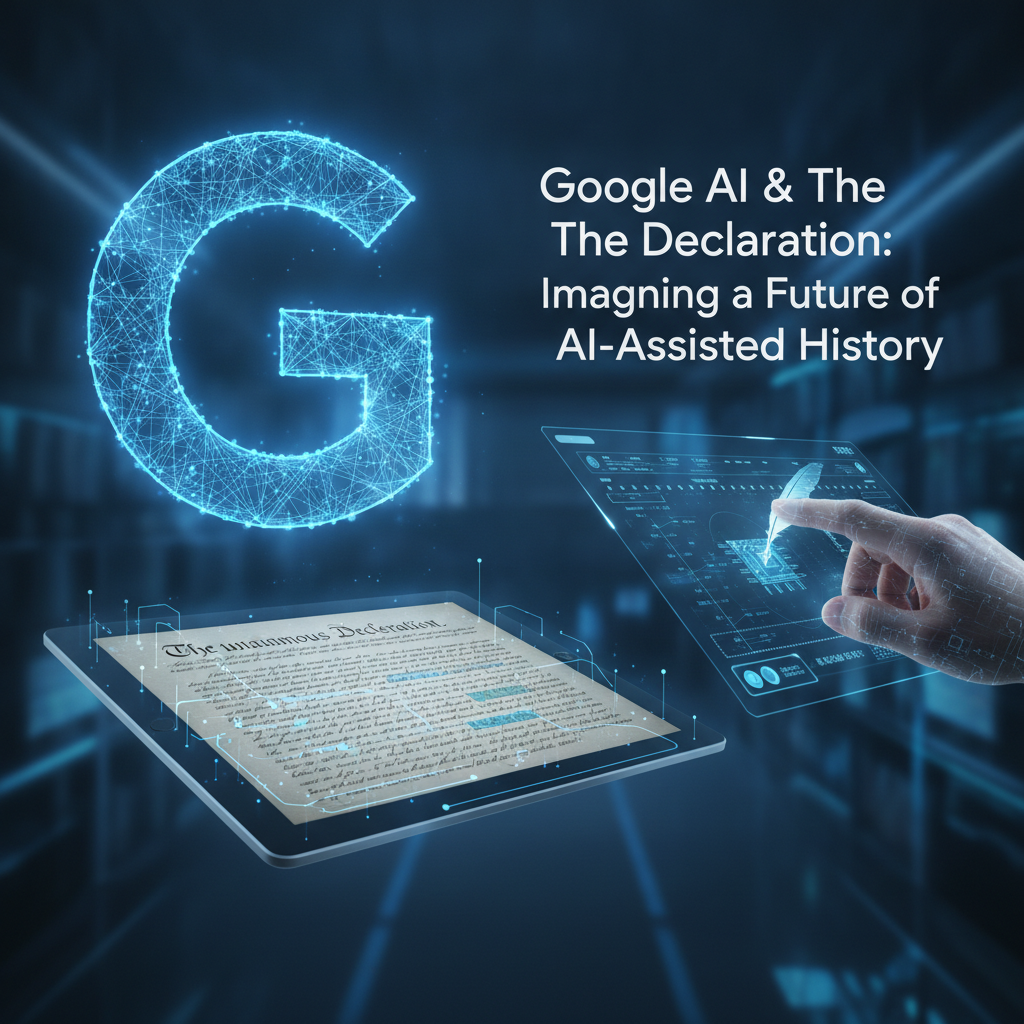
Close your eyes and transport yourself back to the sweltering summer of 1776. Imagine Thomas Jefferson, John Adams, Benjamin Franklin, and their peers huddled, not just with quill and parchment, but with a holographic interface projected by a powerful AI. This isn’t a forgotten chapter from history; it’s the captivating premise of a new hypothetical Google commercial that brilliantly imagines the Declaration of Independence being drafted with the assistance of artificial intelligence.
As TechCrunch reports, this ingenious concept from Google isn’t just a marketing ploy; it’s a profound thought experiment. What if the very foundations of nations, the most pivotal documents defining human rights and governance, could be crafted, refined, and analyzed with the lightning-fast capabilities of modern generative AI? It opens a fascinating dialogue about the intersection of history, human ingenuity, and the accelerating power of AI.
The Vision: AI-Assisted Founding Fathers
The hypothetical commercial paints a vivid picture: our Founding Fathers, faced with the monumental task of articulating a nation’s birthright, leveraging AI as a powerful collaborative partner. How might this unfold?
- Instantaneous Research: An AI could instantly scour vast libraries of Enlightenment philosophy, historical grievances against the Crown, and precedents from other declarations, presenting summarized insights in seconds.
- Rhetorical Refinement: The AI could suggest alternative phrasing to enhance impact, analyze the tone for persuasive power, and even identify potential ambiguities in language that might weaken the argument.
- Contextual Understanding: Imagine the AI offering data on public sentiment in various colonies or forecasting potential responses from the British monarchy, allowing the drafters to tailor their message with unprecedented precision.
- Identifying Precedents & Counter-Arguments: The AI could cross-reference legal doctrines and help anticipate royal rebuttals, allowing the signers to craft a document that was not only aspirational but also strategically robust.
This isn’t about AI writing the Declaration entirely, but rather acting as an unparalleled research assistant, an indefatigable editor, and a strategic consultant, amplifying the human intellect behind the quill.
More Than a Pen: AI’s Role in Creative & Historical Writing
The Google commercial transcends mere historical reimagining; it’s a powerful statement about the future of AI in writing and content creation across all sectors. Google, with its continued investment in large language models like Gemini, is clearly positioning AI as an indispensable tool for human endeavor.
Empowering Human Authorship
From students researching term papers to journalists drafting complex reports, and even novelists overcoming writer’s block, generative AI offers a suite of powerful benefits:
- Efficiency and Speed: AI can process and synthesize information at speeds unimaginable for humans, accelerating the initial drafting and research phases.
- Enhanced Accuracy: By cross-referencing vast datasets, AI can help verify facts and ensure consistency.
- Overcoming Barriers: AI can assist non-native speakers, provide synonyms, and suggest stylistic improvements, democratizing powerful writing tools.
- Idea Generation: AI can brainstorm concepts, offer different perspectives, and help explore new creative avenues.
The Challenge of Authenticity & The Human Touch
Yet, the commercial also implicitly raises crucial questions. While AI can assist, the soul of a document like the Declaration of Independence lies in authentic human intent, shared values, and profound emotional conviction. Can AI truly capture the spirit of rebellion, the yearning for liberty, or the moral outrage that fueled such a declaration?
The debate around AI historical documents will inevitably center on authorship and the ethical line between AI assistance and outright AI generation. The human element – the moral compass, the creative spark, the lived experience – remains paramount.
Navigating the Ethical Landscape of AI Writing
This Google thought experiment underscores the ongoing need to navigate the ethical considerations of AI. When AI helps draft pivotal documents, questions arise about:
- Attribution: How do we acknowledge AI’s contribution without diminishing human authorship?
- Bias: Is the AI trained on biased data, and could this subtly influence the historical narrative or legal phrasing?
- Manipulation: Could AI be used to craft persuasive documents that mislead rather than inform?
Ultimately, the commercial suggests that AI functions best as a sophisticated tool in the hands of informed and ethically conscious humans, amplifying their capabilities rather than replacing their core intellect or moral judgment.
Beyond the Scroll: What This Means for the Future
The implications of this hypothetical commercial stretch far beyond 1776. It hints at a future where AI isn’t just for trivial tasks, but a serious partner in:
- Education: Helping students understand complex historical periods and literary styles.
- Law and Governance: Assisting in drafting legislation, legal briefs, and policy papers with greater precision and comprehensive background research.
- Journalism: Supporting investigative reporting and the creation of detailed, context-rich articles.
The Google commercial serves as a powerful reminder that AI tools are rapidly evolving, and their potential to reshape how we interact with information, history, and creativity is only just beginning to unfold.
A Declaration for the AI Age?
The idea of AI assisting in the creation of the Declaration of Independence is a compelling blend of past and future. It’s a testament to how far AI has come and how Google envisions its role in our lives – not just as a search engine, but as an intelligent partner in our most significant endeavors.
While the Declaration of Independence was a product of purely human genius, the commercial invites us to imagine a future where humanity, empowered by AI, can reach new heights of clarity, insight, and impact in defining the next great chapters of our shared history. What monumental document will humanity write next, with AI by its side?
Leave a Reply