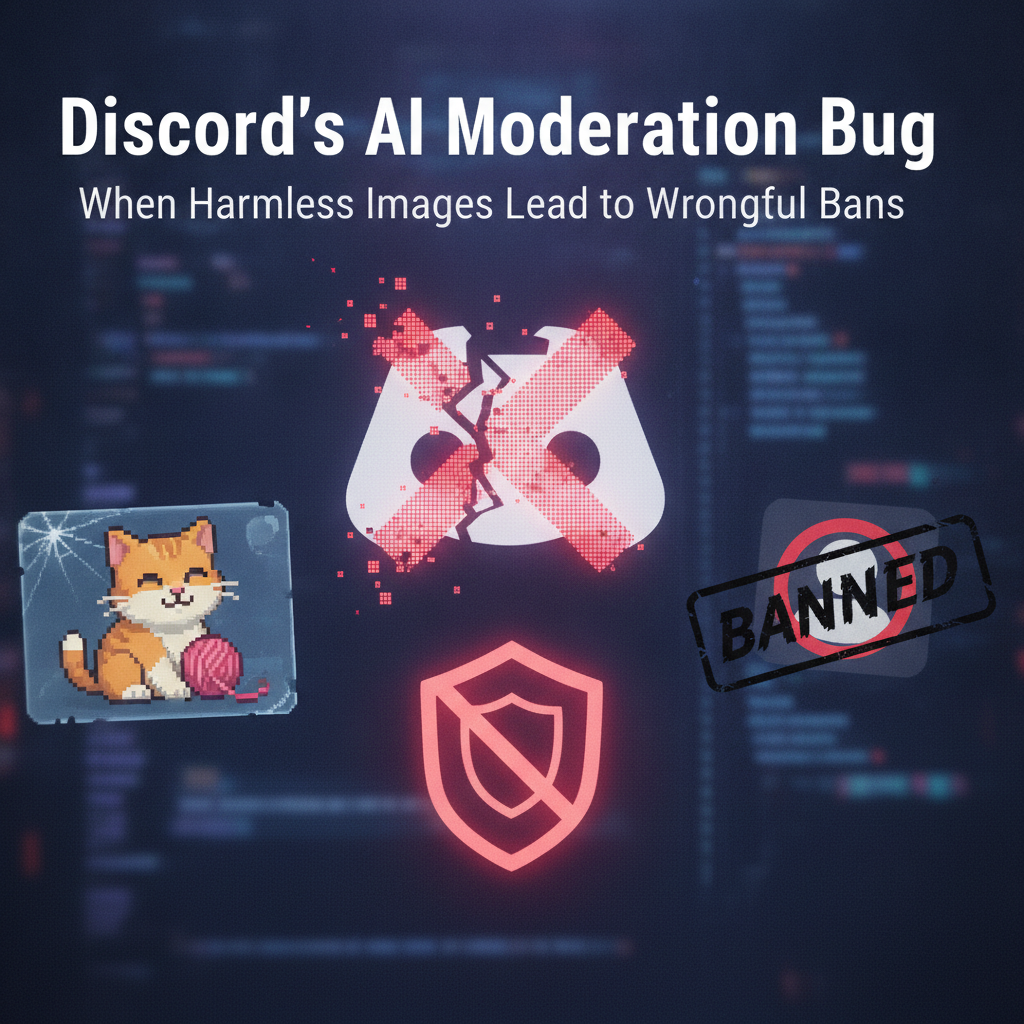
In the rapidly evolving landscape of online communities, Artificial Intelligence (AI) has emerged as a powerful tool for maintaining order and safety. However, a recent admission from Discord, one of the world’s most popular communication platforms, serves as a stark reminder of AI’s limitations and the critical need for human oversight. Discord has publicly acknowledged an AI moderation bug that led to numerous users being wrongfully banned for sharing what should have been considered harmless images.
This incident, impacting countless users, highlights the complex challenges of relying solely on algorithms to interpret the nuances of human communication and content. It raises crucial questions about accuracy, user trust, and the future of AI in content moderation.
The Glitch in the System: What Happened with Discord’s AI Moderation?
According to Discord’s July 7, 2026, announcement, an internal investigation revealed a flaw within its automated content moderation system. This advanced AI, designed to swiftly detect and remove problematic content like hate speech, harassment, or explicit material, mistakenly flagged a significant volume of innocuous images as violations. The result? A wave of wrongful bans for users who were simply sharing memes, personal photos, or other benign visual content.
The core of the problem appears to lie in the AI’s inability to accurately contextualize visual data. While powerful for identifying clear-cut violations, the algorithm struggled with ambiguous or abstract imagery, leading to false positives. This meant that images intended to be lighthearted or completely harmless were misinterpreted, triggering automated bans that disrupted user experiences and sowed frustration across the platform.
Why AI Struggles with “Harmless” Content
The incident on Discord underscores a fundamental challenge in AI development: teaching machines to understand nuance, irony, and cultural context. Unlike humans, who rely on a vast reservoir of shared experiences and emotional intelligence, AI systems are built on patterns and data. When confronted with images that fall outside its trained parameters, or that carry subtle meanings, an AI can:
- Misinterpret patterns: A shadow might be mistaken for a prohibited object, or an innocent gesture for something offensive.
- Lack contextual understanding: An image that is harmless in one context (e.g., a medical diagram) might be flagged in another if the AI isn’t trained to differentiate.
- Over-generalize: To err on the side of caution, AI might be programmed to flag anything remotely similar to forbidden content, leading to a higher rate of false positives.
This Discord AI ban bug is a vivid illustration of these limitations.
Discord’s Response and What Wrongfully Banned Users Should Do
Discord’s admission is a critical first step towards addressing the issue. The company has stated its commitment to refining its AI models and implementing safeguards to prevent such widespread errors in the future. While specific details on the corrective measures are still emerging, transparency and a robust appeal process are paramount.
If you or someone you know was affected by this AI moderation error and believe you were wrongfully banned, here’s what you should do:
- Utilize the Appeal Process: Discord, like most major platforms, has an appeal system. Submit a detailed appeal explaining your situation, attaching any relevant screenshots or evidence of the harmless nature of your content.
- Be Specific: Clearly state the date and time of your ban, and if possible, refer to the specific content that was flagged.
- Be Patient: Due to the potential volume of appeals related to this bug, it might take time for customer support to review your case.
The Future of Trust: Balancing Automation and Accountability
The Discord AI moderation bug serves as a crucial lesson for all platforms relying on automated systems. While AI offers unparalleled speed and scale in content moderation, it cannot fully replace human judgment, especially in subjective areas. The path forward involves a hybrid approach:
- Enhanced AI Training: Continuous refinement of AI models with more diverse and nuanced datasets to reduce false positives.
- Robust Human Oversight: A dedicated team of human moderators to review flagged content, particularly in ambiguous cases, and to handle appeals effectively.
- Increased Transparency: Platforms should be more open about how their moderation systems work, especially when errors occur, to rebuild and maintain user trust.
- Clearer Communication: Providing users with specific reasons for bans and clear pathways for recourse.
Conclusion
Discord’s admission about its AI ban bug is a significant moment in the ongoing conversation about artificial intelligence and its role in managing online communities. It underscores the powerful potential of AI, but also its inherent fallibility when confronted with the complexities of human expression. As platforms continue to integrate AI into their moderation strategies, the focus must remain on creating systems that are not only efficient but also fair, transparent, and ultimately, human-centric.
Have you been affected by this Discord AI moderation error? Share your experiences in the comments below.
Leave a Reply