
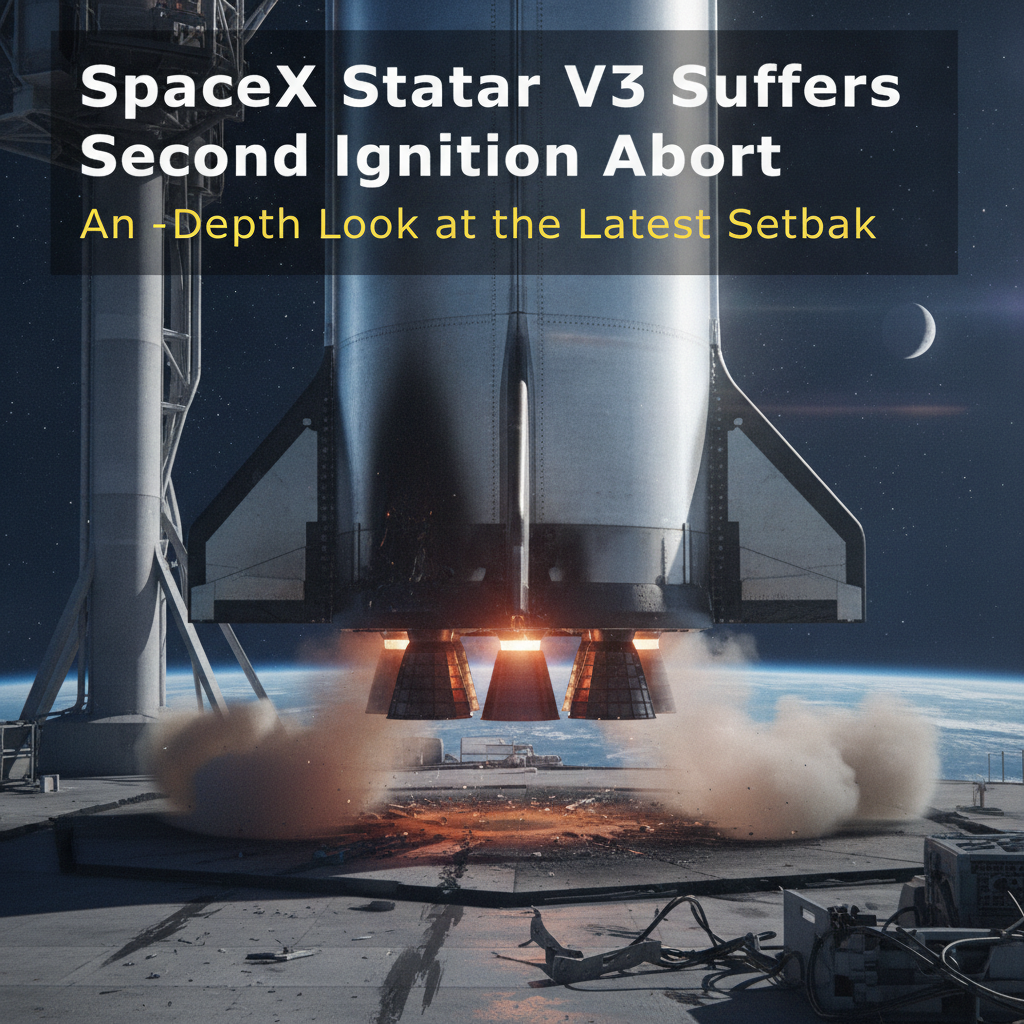
Boca Chica, Texas – July 16, 2026 – SpaceX faced another significant challenge today in its ambitious Starship development program. The second full-stack Starship V3 prototype, poised for its inaugural orbital flight test from Starbase, Texas, unexpectedly aborted its launch attempt moments after engine ignition. This marks the second such ignition-phase abort for the cutting-edge V3 iteration of the massive Starship rocket, prompting a renewed focus on the complexities of super heavy-lift rocket development.
The Incident: A Sudden Silence After the Roar
Excitement was palpable at Starbase as the 120-meter-tall Starship V3 stood ready on the orbital launch mount. The countdown proceeded smoothly, with all systems reported green. As the clock ticked past T-0, the thunderous roar of Starship’s Raptor engines began to fill the South Texas air, plumes of exhaust billowing from beneath the Super Heavy booster. However, just seconds into the ignition sequence, and before the vehicle had visibly lifted off the pad, the engines abruptly shut down, plunging the scene into a sudden, eerie silence. Mission control quickly confirmed an automatic abort had occurred, with the vehicle remaining safely secured on the launch mount.
While SpaceX has yet to provide specific details on the cause, the abort after ignition suggests a critical anomaly was detected by the ship’s onboard systems, or by ground support equipment, triggering an immediate shutdown to ensure safety and prevent potential damage. This precision, though frustrating for observers, is a testament to the sophisticated safety protocols built into modern rocketry.
Starship V3: The Next Frontier in Space Exploration
The Starship V3 variant represents a crucial evolution in SpaceX’s quest to make humanity a multi-planetary species. Building on lessons learned from the successful orbital tests and subsequent re-entries of earlier prototypes, Starship V3 features several key enhancements:
- Improved Raptor Engine Performance: Optimized for greater thrust and reliability, particularly during the critical ignition phase.
- Enhanced Structural Integrity: Designed to withstand the immense stresses of atmospheric re-entry and deep-space missions.
- Advanced Avionics & Control Systems: Further refined for autonomous flight and precision landing maneuvers.
- Increased Payload Capacity: Aiming to significantly boost the amount of cargo and crew that can be delivered to orbit, the Moon, and Mars.
This iteration is pivotal for several upcoming missions, including NASA’s Artemis program human lunar lander and the expanded deployment of SpaceX’s Starlink Gen2 satellites.
A History of Iterative Development: Learning from Setbacks
For those familiar with SpaceX’s development philosophy, today’s abort, while a disappointment, is not entirely unexpected. The company, led by Elon Musk, famously embraces a rapid, iterative development approach, where failures are viewed as invaluable learning opportunities rather than terminal setbacks. From the early days of Falcon 9 landing attempts to the numerous Starship prototype tests, this method has consistently led to breakthroughs.
Previous Starship versions have experienced everything from rapid unscheduled disassemblies (RUDs) to engine issues and landing mishaps. Each incident, however, has provided crucial data that engineers meticulously analyze to refine designs and improve performance. The fact that this is the second ignition abort for the V3 model suggests a persistent, albeit likely subtle, challenge within the complex propulsion system that engineers are now racing to identify and resolve.
What Happens Next? The Investigation and The Road Ahead
Immediately following the abort, SpaceX teams will begin a thorough investigation. This process typically involves:
- Telemetry Data Review: Scrutinizing millions of data points from sensors across the booster and ship.
- Physical Inspection: Examining the engines, plumbing, and launch infrastructure for any visible anomalies.
- Software and Hardware Analysis: Deep diving into control algorithms and component performance.
- Regulatory Reporting: Liaising with the Federal Aviation Administration (FAA) and other agencies, who must sign off on any subsequent launch attempts.
Given the nature of the abort – after ignition but before lift-off – engineers will likely focus on aspects like propellant flow, igniter performance, engine health monitoring, and the interplay of the multiple Raptor engines during startup. This could lead to software tweaks, component replacements, or even minor design modifications.
While today’s event will undoubtedly cause a delay, SpaceX’s history suggests they will address the issue with characteristic speed and determination. The goal of reaching Mars and establishing a permanent human presence remains firmly on the horizon, and each test, successful or not, brings them closer to that monumental achievement.
SpaceX has not yet announced a new target date for Starship V3’s orbital flight, but the world will be watching closely for updates on their progress.