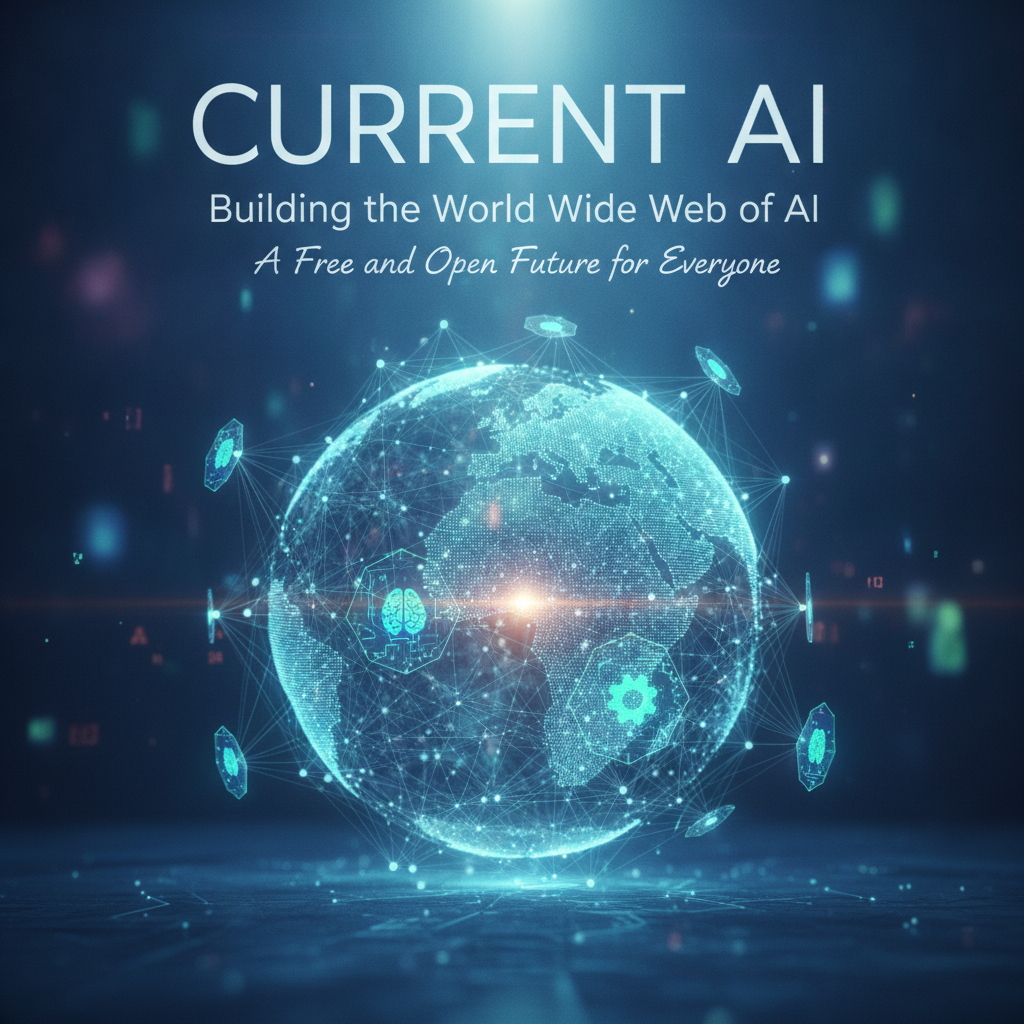
In an era where artificial intelligence is rapidly reshaping our world, access to its power often remains confined within the walls of colossal tech corporations. Proprietary systems, exorbitant costs, and limited interoperability create a digital divide, leaving countless innovators and communities on the sidelines. But what if AI could be as universally accessible and interconnected as the internet itself? This is the ambitious vision driving Nonprofit Current AI, an organization racing against time to construct nothing less than the World Wide Web of AI – a free and open infrastructure for all.
The Vision: A Global, Interconnected AI Ecosystem
Imagine a digital landscape where AI models, datasets, computing power, and tools are not siloed but seamlessly interact across a vast, decentralized network. This is the essence of the World Wide Web of AI. Just as the original World Wide Web democratized information, Current AI aims to democratize intelligence, creating a global nervous system for AI development and deployment.
This isn’t just about sharing code; it’s about building an open-source AI infrastructure that supports:
- Interoperability: AI systems from different creators can easily communicate and collaborate.
- Shared Resources: Access to powerful models, vast datasets, and even distributed computational power.
- Universal Access: Removing financial and technical barriers for researchers, developers, startups, and even individuals worldwide.
- Collaborative Innovation: Fostering a community where ideas can be built upon, refined, and scaled collectively.
Why a Nonprofit Leads the Charge for Free AI?
The choice of a nonprofit model for such a monumental undertaking is crucial. While private companies are investing heavily in AI, their primary directive remains profit. This often leads to proprietary systems, data lock-ins, and a focus on lucrative applications rather than public good. Current AI, by contrast, operates with a singular mission: to ensure AI’s benefits are universally accessible and developed ethically.
As a nonprofit, Current AI can prioritize:
- Democratizing AI: Ensuring that advanced AI capabilities are not just for the privileged few.
- Ethical Development: Building transparency and accountability into the core infrastructure.
- Preventing Monopolies: Creating an alternative to centralized control over future AI systems.
- Long-term Sustainability: Focusing on the health and growth of the ecosystem over short-term gains.
Their commitment to making this infrastructure free for all is a game-changer, promising to unleash unprecedented innovation from every corner of the globe.
The Transformative Impact of a Free World Wide Web of AI
The implications of Current AI’s initiative are profound, promising to reshape industries, education, and even global society:
Democratizing Innovation and Entrepreneurship
With an open AI platform, the barrier to entry for AI development plummets. Small startups, independent researchers, and even students in developing nations can leverage state-of-the-art AI without massive upfront investment. This fosters an explosion of creativity and problem-solving, leading to a more diverse and impactful array of AI applications.
Accelerating Research and Development
Imagine researchers instantly sharing models, datasets, and discoveries in a standardized, accessible format. The World Wide Web of AI will act as a supercharger for scientific inquiry, allowing breakthroughs to propagate rapidly and collaboratively, accelerating progress in fields from medicine to climate science.
Ethical and Transparent AI Development
An open framework naturally encourages transparency. With shared standards and community oversight, it becomes easier to audit AI models for bias, ensure fairness, and address potential misuse. This moves us closer to a future where AI is not just powerful, but also responsible and trustworthy.
Bridging the Global Digital Divide
For regions with limited resources, access to cutting-edge AI can be transformative. The free AI infrastructure proposed by Current AI offers a pathway for nations to leapfrog developmental stages, utilizing AI for everything from improving agriculture and healthcare to enhancing education and infrastructure planning.
Challenges and the Road Ahead for Current AI
Building a global infrastructure of this magnitude is no small feat. Current AI faces significant challenges, including securing sustained funding, establishing universal technical standards, ensuring robust security, and fostering widespread adoption. However, their nonprofit status and community-driven approach position them uniquely to tackle these hurdles.
Their race to build this vital framework is not just a technological challenge but a societal one – a bold stride towards an equitable and empowered future where intelligence is truly a shared resource.
Join the AI Revolution: A Call to Action
The initiative by Nonprofit Current AI is more than just a project; it’s a movement towards a more inclusive and innovative AI future. As they work tirelessly to construct the World Wide Web of AI, the potential impact on every aspect of our lives is immeasurable. Keeping an eye on their progress is essential for anyone interested in the future of technology and its role in society.
This is a pivotal moment, promising an era where AI is not a luxury but a fundamental utility, free for all to harness, innovate with, and benefit from. The future of AI is being built, and Current AI is ensuring it’s built for everyone.