
Artificial intelligence is rapidly moving beyond smartphones and computers. After transforming how people search, write, code, and create content, AI is now expected to become a constant companion through wearable devices. Recent reports suggest that OpenAI is exploring deeper ChatGPT integration for smart glasses and other wearable technology, potentially changing how users interact with AI throughout the day.
Although OpenAI has not officially announced a consumer smart glasses product, industry insiders believe the company is actively working toward bringing ChatGPT into wearable experiences. Here’s everything we know so far.
Why Smart Glasses Are the Next Big AI Platform
The success of AI assistants has shown that users want instant access to information without constantly reaching for their phones. Smart glasses offer a natural solution by allowing users to interact with AI using voice commands while keeping their hands free.
Instead of opening an app, users could simply ask ChatGPT questions while walking, driving, shopping, or working.
This represents a significant shift from screen-based computing to ambient AI assistance.
What ChatGPT Integration Could Look Like
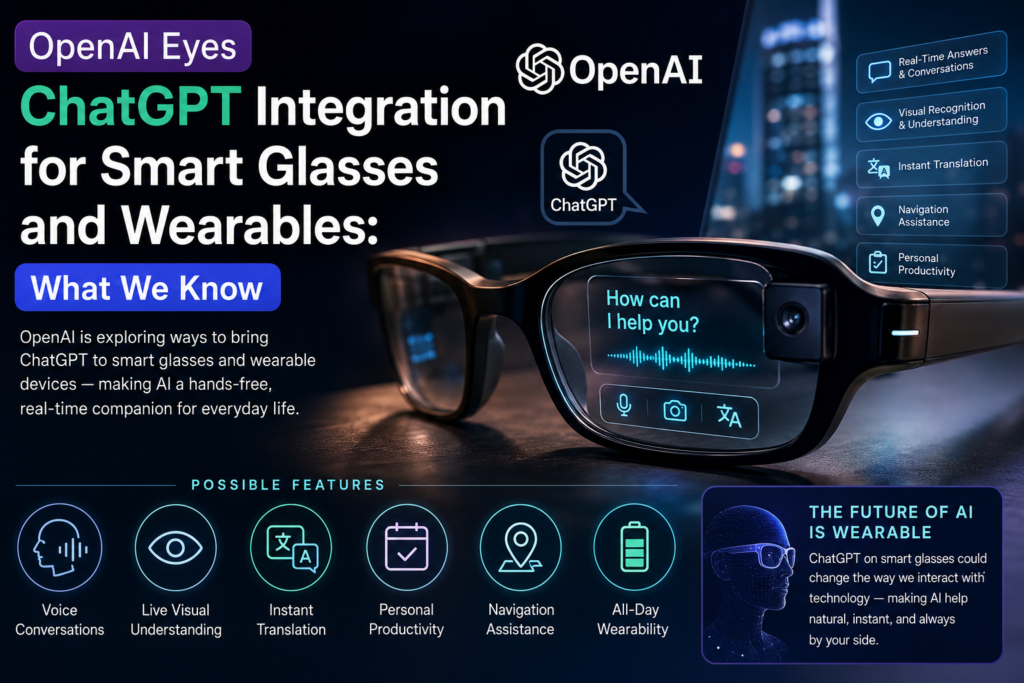
If OpenAI launches ChatGPT-powered smart glasses or partners with hardware manufacturers, users could expect features such as:
Real-Time Voice Conversations
Imagine speaking naturally with ChatGPT without pulling out your phone. The assistant could answer questions, summarize information, translate languages, or provide directions instantly.
Live Visual Understanding
Using built-in cameras, smart glasses may allow ChatGPT to analyze what users are looking at.
Possible examples include:
- Identifying landmarks
- Reading signs in foreign languages
- Explaining objects
- Solving math problems from a whiteboard
- Recognizing plants or products
This builds on ChatGPT’s existing multimodal vision capabilities.
Instant Translation
Travelers could benefit from real-time language translation displayed directly through smart glasses.
Users might hear translated speech or see translated text while reading menus, signs, or documents.
Personal Productivity
Wearable ChatGPT could help users:
- Manage calendars
- Read notifications
- Draft quick replies
- Create reminders
- Summarize meetings
- Take voice notes
This would reduce dependence on smartphones during busy schedules.
Navigation Assistance
Instead of checking maps repeatedly, users could receive:
- Walking directions
- Traffic alerts
- Nearby restaurant recommendations
- Transit information
Directions could appear naturally through augmented reality overlays.
Possible Hardware Partnerships
OpenAI has increasingly focused on software rather than manufacturing hardware itself.
Industry observers believe OpenAI could partner with major hardware companies rather than building smart glasses independently.
Potential partners often discussed include:
- Consumer electronics manufacturers
- Wearable technology companies
- AR/VR device makers
- Smartphone brands
Such partnerships could accelerate adoption while allowing OpenAI to focus on AI experiences.
How This Compares to Competitors
Several technology companies are already investing heavily in AI-powered wearables.
Meta
Meta has integrated AI into its Ray-Ban smart glasses, allowing voice conversations, photo capture, and AI assistance.
Google continues developing Android XR experiences and AI-powered wearable platforms.
Apple
Apple is expected to expand Apple Intelligence across future wearable devices and mixed reality products.
Samsung
Samsung is investing in AI experiences for future XR devices alongside Android XR development.
OpenAI entering this market would significantly increase competition.
Challenges OpenAI Must Solve
Building AI wearables isn’t only about adding ChatGPT to glasses.
Several challenges remain:
Privacy
Always-on cameras and microphones raise significant privacy concerns.
OpenAI would need transparent privacy controls and user protections.
Battery Life
Running AI continuously requires efficient hardware and optimized cloud processing.
Battery technology remains one of the biggest limitations for wearable devices.
Comfort
Smart glasses must remain lightweight, stylish, and comfortable enough for daily use.
Bulky hardware has limited previous generations of smart glasses.
Reliable Connectivity
Many AI features depend on internet access.
Future devices may combine on-device AI with cloud processing for faster responses.
When Could We See ChatGPT Wearables?
There is currently no official launch date for OpenAI-powered smart glasses.
However, increasing investment in wearable AI, multimodal models, and real-time assistants suggests that AI wearables could become a major focus over the next few years.
Whether through partnerships or original hardware, ChatGPT is likely to play a significant role in the next generation of wearable computing.
What This Means for Users
If ChatGPT becomes deeply integrated into wearable devices, everyday interactions with technology could become more natural.
Instead of typing prompts, users may simply speak, look, and receive contextual assistance in real time.
This could transform:
- Education
- Travel
- Healthcare
- Business productivity
- Accessibility
- Navigation
- Shopping
- Content creation
Wearable AI has the potential to make digital assistance almost invisible while remaining constantly available.
Final Thoughts
OpenAI’s reported interest in integrating ChatGPT with smart glasses and wearable devices signals the next evolution of artificial intelligence. While official details remain limited, the direction is clear: AI is moving beyond apps and into everyday life.
From voice conversations and visual recognition to real-time translation and productivity assistance, ChatGPT-powered wearables could redefine how people interact with technology. As competition intensifies among OpenAI, Meta, Google, Apple, and Samsung, consumers can expect rapid innovation in the coming years.
For now, we’ll have to wait for official announcements, but one thing is certain—the future of AI is becoming more wearable than ever before.