Artificial Intelligence (AI) is transforming industries at an unprecedented pace. From healthcare and finance to education and software development, AI is becoming a core part of everyday life. However, as AI adoption accelerates, so do concerns about security, privacy, transparency, and trust.
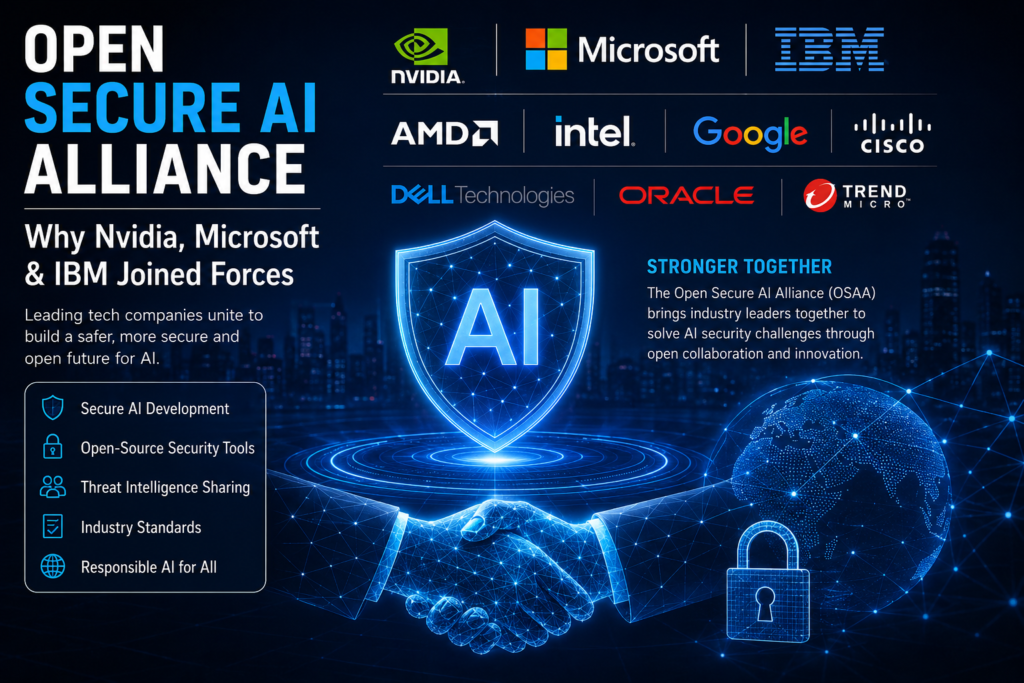
To tackle these challenges, some of the world’s biggest technology companies—including Nvidia, Microsoft, IBM, AMD, Intel, Google, Cisco, Dell Technologies, Oracle, and Trend Micro—have joined forces to create the Open Secure AI Alliance (OSAA).
This new initiative aims to build a safer AI ecosystem by encouraging open collaboration on AI security tools, standards, and best practices.
In this article, we’ll explore what the Open Secure AI Alliance is, why it matters, who joined it, and what it means for businesses, developers, and AI users worldwide.
What Is the Open Secure AI Alliance?
The Open Secure AI Alliance (OSAA) is an industry collaboration focused on improving AI security through open-source technologies and shared standards.
Rather than competing on security, leading technology companies have decided to work together to solve common AI security challenges.
The alliance promotes:
- Secure AI development
- Open-source security tools
- AI risk management
- Responsible AI deployment
- Collaboration between organizations
- Protection against AI-related cyber threats
Its mission is to ensure AI systems remain trustworthy, transparent, and resilient against evolving security risks.
Why Was the Alliance Created?
AI models are becoming larger, more powerful, and increasingly integrated into critical infrastructure.
Unfortunately, attackers are also becoming more sophisticated.
Some growing concerns include:
1. Prompt Injection Attacks
Hackers manipulate AI systems by crafting malicious prompts that bypass safety controls.
2. Data Poisoning
Attackers intentionally feed harmful data into AI training pipelines to influence future model behavior.
3. Model Theft
Organizations invest millions of dollars developing AI models.
Cybercriminals increasingly attempt to steal proprietary AI models.
4. Sensitive Data Leakage
AI assistants may accidentally expose confidential company information if not properly secured.
5. Supply Chain Risks
Many AI applications rely on open-source libraries, third-party models, and cloud infrastructure.
A single vulnerable component can affect thousands of AI deployments.
Why Are Nvidia, Microsoft, and IBM Involved?
These companies all have major investments in AI infrastructure.
Nvidia
Nvidia powers much of today’s AI computing through its GPUs.
As AI workloads grow, securing AI infrastructure becomes essential.
Microsoft
Microsoft integrates AI across Azure, Microsoft 365, Windows, GitHub, and Copilot products.
Strong AI security directly benefits millions of enterprise customers.
IBM
IBM has decades of cybersecurity and enterprise AI experience.
Its expertise helps develop trustworthy AI governance frameworks.
Other Companies Joining the Alliance
The alliance includes numerous major technology companies, including:
- AMD
- Intel
- Cisco
- Dell Technologies
- Oracle
- Trend Micro
- And several additional security and cloud providers
This broad participation demonstrates that AI security has become an industry-wide priority rather than a competitive advantage.
Key Goals of the Open Secure AI Alliance
1. Develop Open AI Security Tools
The alliance plans to create freely available security tools that organizations can adopt across different AI platforms.
2. Share Threat Intelligence
Members will collaborate on identifying emerging AI threats and vulnerabilities.
Sharing security knowledge enables faster responses to new attack techniques.
3. Improve AI Governance
The alliance seeks to establish practical frameworks for responsible AI deployment, helping organizations manage compliance and reduce operational risks.
4. Strengthen Open-Source AI
Many AI projects rely on open-source software.
The alliance aims to improve the security of these foundational technologies.
5. Encourage Industry Standards
Common security standards make AI systems more interoperable, reliable, and easier to audit.
Why Open Source Matters
Unlike closed ecosystems, open-source security allows researchers worldwide to inspect, test, and improve code.
Benefits include:
- Faster vulnerability detection
- Transparent security practices
- Community-driven improvements
- Greater trust
- Reduced vendor lock-in
This collaborative model has already proven successful in Linux, Kubernetes, and many cybersecurity projects.
Benefits for Businesses
Organizations deploying AI may gain several advantages from the alliance.
Better Security
Access to stronger AI security frameworks and tools.
Lower Costs
Shared open-source solutions reduce duplication of effort.
Faster Innovation
Companies can focus on building AI applications rather than reinventing security infrastructure.
Regulatory Readiness
Improved governance helps organizations prepare for evolving AI regulations worldwide.
Benefits for Developers
Developers can expect:
- Better security libraries
- Open testing frameworks
- AI vulnerability assessment tools
- Community best practices
- Easier secure AI deployment
This may significantly reduce development complexity while improving application security.
Challenges Ahead
Although the alliance is promising, several challenges remain.
Coordinating Large Organizations
Each company has different priorities, products, and customers.
Building consensus may take time.
Rapidly Changing Threats
AI attacks evolve quickly.
The alliance must continuously update tools and recommendations.
Global Regulations
Countries are introducing different AI laws.
Creating globally applicable security standards won’t be easy.
Balancing Openness and Security
While transparency is valuable, openly publishing certain security details could also help attackers.
Finding the right balance will be critical.
How This Could Shape the Future of AI
The Open Secure AI Alliance may become one of the most important collaborations in AI security.
As AI becomes embedded in banking, healthcare, transportation, education, manufacturing, and government services, security can no longer be treated as an afterthought.
Industry-wide cooperation can help:
- Build public trust in AI
- Improve cybersecurity resilience
- Accelerate responsible AI adoption
- Reduce security risks across the ecosystem
If successful, the alliance could establish the foundation for secure AI development over the next decade.
Final Thoughts
The launch of the Open Secure AI Alliance marks a significant milestone in the evolution of artificial intelligence. By bringing together industry leaders like Nvidia, Microsoft, IBM, AMD, Intel, Google, Cisco, Oracle, Dell Technologies, and Trend Micro, the alliance recognizes that AI security is a shared responsibility.
Instead of addressing threats in isolation, these companies are collaborating to create open standards, strengthen AI infrastructure, and develop tools that benefit the entire technology ecosystem.
As AI continues to power everything from personal assistants to enterprise platforms, initiatives like the Open Secure AI Alliance will play a crucial role in making AI safer, more transparent, and more trustworthy for businesses, developers, and users around the world.