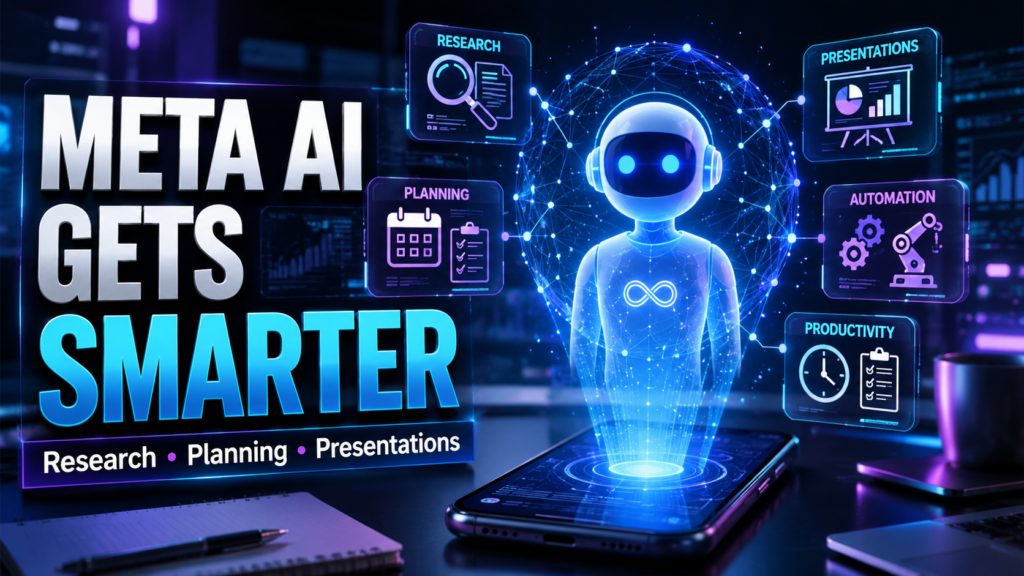
Artificial intelligence is evolving from a chatbot that simply answers questions into a true digital assistant capable of planning your day, conducting research, creating presentations, and automating repetitive tasks. Meta has taken a major step in that direction with its latest AI update.
Powered by the Muse Spark 1.1 model, the upgraded Meta AI introduces a range of productivity-focused features that move beyond casual conversations. Users can now ask Meta AI to perform complex, multi-step tasks such as organizing schedules, researching topics, generating presentation slides, summarizing information, and integrating with tools like calendars and email. Meta describes this as another step toward its vision of “personal superintelligence”—an AI assistant that understands context, anticipates needs, and proactively helps users complete work with minimal prompting.
In this article, we’ll explore everything you need to know about Meta AI’s latest features, how they compare with competing AI assistants, and what they mean for users, businesses, students, and creators.
Meta AI Is Evolving Into a Personal AI Assistant
For years, Meta AI mainly focused on answering questions, generating images, and assisting users inside Facebook, Instagram, Messenger, and WhatsApp. While useful, it often felt more like a chatbot than a productivity tool.
The latest update changes that dramatically.
Instead of simply responding to prompts, Meta AI is now capable of understanding larger goals and completing multiple connected actions on behalf of users. Whether you’re preparing a presentation, planning an event, researching a topic, or organizing your calendar, the assistant is designed to carry tasks through from start to finish rather than waiting for constant instructions.
Powered by Muse Spark 1.1
Behind these new capabilities is Muse Spark 1.1, Meta’s newest multimodal AI model.
Muse Spark 1.1 improves:
- Advanced reasoning
- Context awareness
- Long-form planning
- Tool usage
- Multi-step task execution
- Better understanding of text and images
Meta has invested heavily in AI infrastructure and training to support this model, positioning it as the foundation for future AI products across its ecosystem.
New Research Features
One of the most significant additions is Meta AI’s enhanced research capability.
Instead of returning a simple answer, the assistant can now:
- Research complex topics
- Gather information from multiple sources
- Summarize lengthy articles
- Compare products
- Organize findings into structured reports
- Explain difficult concepts in simple language
This makes Meta AI far more useful for students, professionals, researchers, and content creators who need reliable summaries and organized information quickly.
Smarter Planning Capabilities
Planning is another area where Meta AI has made substantial improvements.
The assistant can now help users:
Organize Daily Schedules
Meta AI can analyze upcoming appointments and provide a daily briefing that highlights meetings, potential conflicts, and reminders.
Event Planning
Users can ask the AI to organize events by suggesting dates, coordinating schedules, and helping with logistics.
Fitness Planning
The assistant can generate personalized workout schedules that adapt to available time and goals.
Home Projects
Meta demonstrated scenarios where the AI assists with home renovation planning, including creating mood boards and finding suitable items based on style and budget.
Presentation Creation
Perhaps the biggest productivity feature is Meta AI’s ability to create presentations.
Instead of manually building slides, users can simply ask:
- “Create a presentation on renewable energy.”
- “Summarize this report into 10 slides.”
- “Prepare an investor pitch.”
The AI organizes information into a logical slide structure, generates summaries, and produces presentation-ready content that users can refine further.
Calendar and Email Integration
Meta AI is also becoming more useful through integration with productivity tools.
The assistant can:
- Check calendars
- Suggest meeting times
- Identify scheduling conflicts
- Prepare daily briefings
- Use email context to assist with planning in supported experiences
These capabilities reduce manual organization and help users manage busy schedules more efficiently. Availability varies by market and platform.
Task Automation
Meta AI is moving toward autonomous task execution.
Instead of repeatedly prompting the assistant, users can assign larger objectives.
Examples include:
- Weekly meal planning
- Product restock reminders
- Research summaries
- Travel planning
- Shopping assistance
- Event organization
The AI understands context and completes multiple connected steps automatically.
Better Context Understanding
Previous AI assistants often forgot earlier instructions or required users to repeat information.
Meta AI now maintains stronger contextual awareness throughout conversations, allowing it to refine answers and continue long tasks more naturally. Users can also steer responses mid-generation for better results.
Marketplace and Shopping Assistance
Another practical addition is support for Facebook Marketplace.
Users can ask Meta AI to:
- Search listings
- Compare products
- Find items within a budget
- Recommend options based on preferences
This makes Marketplace more conversational and easier to navigate.
Productivity Benefits
For Students
Students can:
- Research assignments
- Create presentations
- Summarize books
- Build study plans
- Organize schedules
For Professionals
Business users can:
- Prepare reports
- Schedule meetings
- Generate presentations
- Research competitors
- Organize projects
For Content Creators
Creators benefit from:
- Content research
- Script writing
- Social media planning
- Trend analysis
- Idea generation
How Meta AI Compares With ChatGPT, Gemini, and Claude
The latest Meta AI update brings it closer to other leading AI assistants by emphasizing productivity rather than only conversation.
Compared with ChatGPT
- Stronger integration with Meta apps and social platforms
- Growing focus on planning and automation
- Still catching up in some advanced reasoning areas
Compared with Google Gemini
- Better integration with Meta’s ecosystem
- Similar productivity ambitions
- Different strengths depending on connected services
Compared with Claude
- More consumer-focused and social integration
- Claude remains known for long-document reasoning
- Meta emphasizes everyday personal assistance
Each assistant has its own strengths, but Meta’s strategy is to make AI available where billions of people already communicate and share content.
Privacy Considerations
As Meta AI becomes more personalized, privacy remains an important consideration.
Users should understand:
- Which connected services the AI can access
- How personal information is used
- Available privacy settings
- Permission controls for calendar and email integrations
Being aware of these settings helps users balance convenience with control over their data.
Limited Rollout
The new capabilities are being introduced gradually.
Initially, the enhanced Meta AI is available in selected markets through the Meta AI app and web experience, with broader rollout planned across Meta platforms, including WhatsApp, as testing continues.
What This Means for the Future
Meta’s latest announcement reflects a broader shift in AI development. Instead of acting only as conversational chatbots, AI assistants are becoming digital collaborators capable of researching, planning, creating, and executing tasks.
As these features mature, AI is likely to become a standard productivity companion for students, professionals, businesses, and creators. Meta’s investment in Muse Spark and its vision of “personal superintelligence” suggest the company intends to compete aggressively in the next generation of AI assistants.
Final Thoughts
Meta AI’s latest upgrade is one of its most significant advancements yet. With new capabilities for research, planning, presentation creation, task automation, and productivity, the assistant is evolving far beyond a traditional chatbot.
Powered by Muse Spark 1.1, the enhanced Meta AI aims to simplify everyday work by understanding user context and completing complex, multi-step tasks with minimal prompting. While the rollout is still limited and some features are only available in select regions, the direction is clear: Meta wants AI to become an intelligent personal assistant integrated across its entire ecosystem.
If these capabilities continue to expand, Meta AI could become a powerful option for users looking to streamline work, learning, and daily life.