
For years, “smarter NPCs” was the AI promise gaming kept making and never quite delivering. Bethesda games shipped with the same wooden dialogue trees Fallout 4 used back in 2015. Skyrim guards still took an arrow to the knee, on loop, forever. AAA studios talked up emergent behavior and delivered branching dialogue menus with three lines of voice acting per choice. In 2026, that finally started to crack — and it’s not the only part of gaming AI has quietly rebuilt from the inside out.
The market numbers tell you this isn’t a fad
Estimates vary by research firm, but they all point the same direction. Persistence Market Research values the AI-in-gaming market at $10.1 billion in 2026, projected to reach $75.1 billion by 2033 at a 33.2% compound annual growth rate. A separate estimate from Grand View Research tracks similar territory, projecting growth from $4.37 billion in 2023 to $28.9 billion by 2030. Whatever the exact figure, every major research house agrees this is a multi-decade structural shift in how games get built and played — not a two-year hype cycle waiting to plateau.
Adoption inside the industry backs that up. GDC’s 2026 State of the Game Industry survey of over 2,300 professionals found 36% personally use generative AI tools as part of their job, with ChatGPT leading at 74% adoption among those users, followed by Gemini at 37% and Copilot at 22%.
NPCs that actually remember you
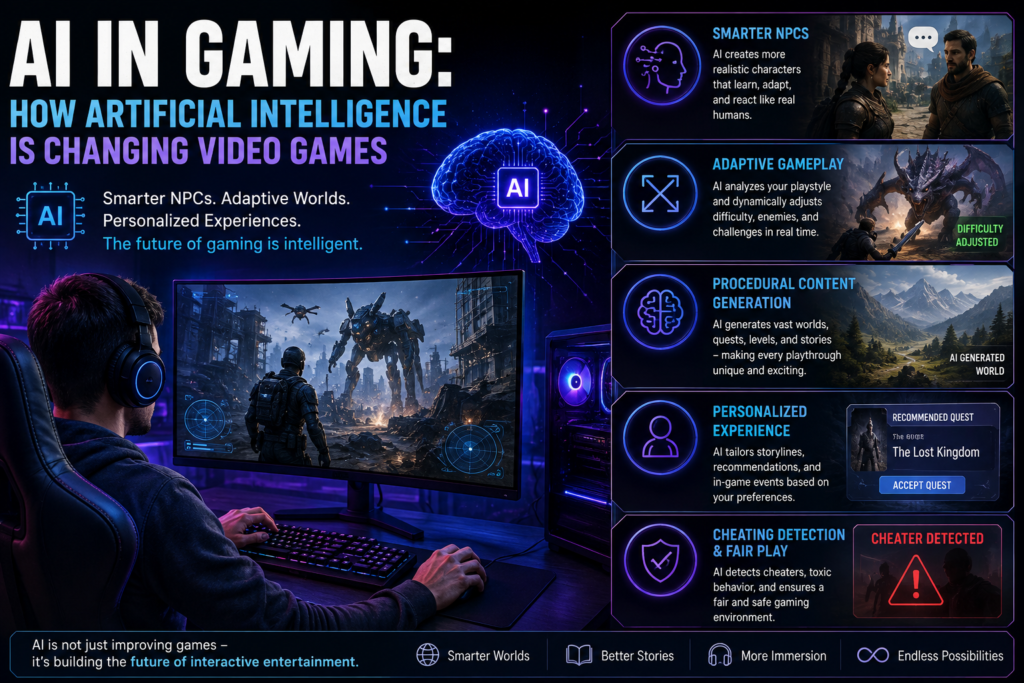
This is the headline shift. NVIDIA’s ACE platform — which gives non-player characters real-time, generative conversational responses instead of pre-scripted dialogue trees — started shipping in titles through 2025 and is now integrated into roughly a dozen games by mid-2026. The results are showing up in adoption numbers that would have sounded implausible two years ago: 62% of new RPG and adventure games now feature AI-powered NPCs, up from just 8% in 2024.
The technical shift underneath that number is real. Researchers describe today’s dominant approach as hybrid: strong, human-authored narrative foundations enhanced by generative layers that handle dynamic responses — memory systems that track what you’ve said and done, and reactions that shift accordingly. Be cruel to a character early in a game, and they might genuinely refuse to help you later, without a developer having scripted that specific outcome in advance.
Early player reaction has been notably positive. Research from the University of Bristol and Meaning Machine found over 95% of players enjoyed experiences with AI-powered NPCs, and 97% described them as rewarding — with many reporting a stronger sense of creative freedom and choices that actually felt meaningful.
Real titles are already proving the concept out: inZOI, PUBG’s AI teammates built on NVIDIA ACE, and integrations in NARAKA: BLADEPOINT are among the clearest examples running today. Even Grand Theft Auto VI, expected in November 2026, is rumored to include an advanced NPC system with “Dialogue Decay” and persistent memory of player actions — not fully generative LLM-driven dialogue, but a clear signal of where the bar has moved industry-wide.
Worlds built from a sentence
The other major shift is on the creation side, not just the playing side. AI-driven world generation can now take a short text description and turn it into a playable 3D environment complete with physics and lighting — describe “a neon city with rainy streets and flying cars” and the system handles placing buildings, lighting, and layout, freeing developers to spend more time on story and less on manual level placement.
This “text-to-world” capability is also driving a real democratization trend. Solo developers using tools like Midjourney, ElevenLabs, and Buildbox AI are now building games that would have required a full studio team just a few years ago — no-code platforms are increasingly putting the power to create playable worlds in the hands of people who aren’t traditional programmers at all.
It’s not just NPCs and worlds — it’s the whole pipeline
Generative AI’s footprint in game development now spans several distinct categories:
- Procedural content generation — AI-created levels, terrain, quests, and items, going well beyond older, more rigid procedural generation systems.
- AI-generated assets — models, textures, music, and animations, including AI-driven motion synthesis producing natural character movement and physics responses that no animator explicitly hand-keyed.
- Adaptive opponents — enemies that learn from and respond to how a specific player actually plays, rather than following a fixed difficulty curve.
- Adaptive difficulty systems — broader pacing and challenge adjustments tuned to the individual player’s skill and behavior over time.
One academic analysis of the technical architecture behind all this — spanning large language models, diffusion-based generative models, reinforcement learning agents, and hybrid rule-based systems — put overall studio adoption at 36% as of 2026, growing at a 23.2% CAGR specifically for the generative AI slice of the gaming market.
The part that doesn’t get the highlight reel: anti-cheat
AI’s role in gaming isn’t only about making things — it’s also increasingly about defending them. As AI capability spreads into the tools available to cheat developers, game studios are locked into a parallel AI arms race on the anti-cheat side, using machine learning to detect increasingly sophisticated, AI-assisted cheating in real time. It’s a less glamorous story than talking NPCs, but arguably just as consequential for whether online multiplayer games remain playable at all.
The honest caveats
A few things worth keeping in perspective before assuming every game is about to talk back to you:
- The gap between “AI is in the pipeline” and “a developer personally used it” is real. GDC’s numbers show roughly 90% of studios have AI embedded somewhere in their workflow, but only 36% of individual developers report hands-on use — AI is often present in production without every team member directly touching it.
- Conversational AI still needs real content moderation and testing. Letting an NPC generate live dialogue introduces genuine risk of off-tone, inconsistent, or inappropriate output that a hand-written script never would — which is exactly why the dominant approach remains hybrid, with human-authored guardrails around the generative layer, not fully open-ended AI dialogue.
- Hype and shipped reality don’t always match. Plenty of “AI game generator” marketing describes capability well ahead of what’s reliably shipping in finished, polished commercial titles today — worth treating with the same skepticism you’d apply to any fast-moving tech category.
The bigger picture
What’s happening in gaming right now genuinely resembles the biggest shift the industry has seen since online multiplayer reshaped how people connect through games. NPCs that remember you, worlds built from a sentence, and asset pipelines that used to require entire departments are converging into a version of game development — and game-playing — that looks structurally different from what shipped even three years ago. The next generation of games won’t just look better. For the first time, they might genuinely react to who you are as a player, not just what button you last pressed.
Leave a Reply