
For years, foldable phones were the “cool idea that isn’t quite ready yet” of the smartphone world — fragile screens, visible creases, mediocre battery life, and prices that were hard to justify for a device you were quietly worried about breaking. 2026 is the year that argument stops holding up as well as it used to.
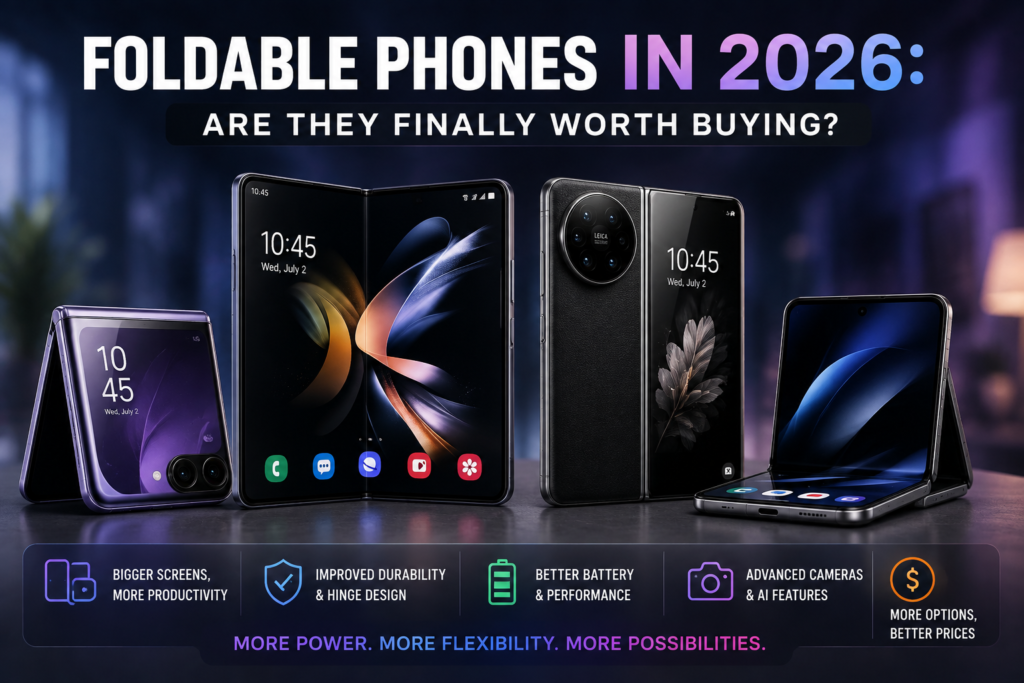
The market says the hesitation is fading
The numbers back up the shift. IDC projects foldable shipments will grow 30% year-over-year in 2026, building on 20.6 million units shipped in 2025 — a sharp contrast to the broader smartphone market, which is expected to shrink this year. Longer-term projections are even more striking: one market analysis puts the global foldable market at roughly $26 billion in 2023, potentially reaching $188.4 billion by 2033.
The biggest catalyst is a name that’s been conspicuously absent from this category until now: Apple is entering the foldable market for the first time in 2026, with a device expected to carry an average price point around $2,400. Analysts at IDC predict Apple will capture over 22% of unit share and roughly 34% of foldable market value in its debut year alone — an extraordinary opening for a brand-new product category, and a strong signal that Apple believes the durability and use-case concerns that held the category back are largely solved.
Samsung isn’t standing still either. The Galaxy Z TriFold — a genuinely new three-panel design with a 10-inch main display — has already been announced, while the Galaxy Z Fold 7 (soon Fold 8) remains the benchmark for book-style foldables. Motorola entered the book-style segment at MWC 2026 with its Razr Fold, and HONOR, Huawei, Google, and OnePlus are all fielding competitive options. The category has gone from a two-player Samsung-vs-everyone-else race to a genuinely crowded, competitive field.
Durability: the actual answer, not the marketing answer
This is the question that’s mattered most for years, and the honest 2026 answer is: meaningfully better, but not zero-risk.
The hinge is no longer the weak point it used to be. Most current foldables are rated for at least 200,000 consecutive folds before hinge wear becomes a concern, and manufacturers like Samsung and OnePlus tout durability well beyond that threshold before real problems develop. HONOR’s Magic V6, for example, claims its Super Steel Hinge has passed 500,000-fold testing. For context, opening a foldable 100 times a day would take roughly five and a half years to hit 200,000 folds — well beyond a typical upgrade cycle for most owners.
Screen technology has genuinely matured. Ultra-thin glass (UTG) yield rates industrywide reached approximately 85% in 2025, and IPX8 water resistance is now standard on flagship foldables from Samsung and Google. Some models, like the Google Pixel 10 Pro Fold, go further with a full IP68 rating and a gearless hinge design specifically built to reduce failure points.
But the inner screen is still the genuine trade-off. It remains more delicate than the Gorilla Glass or Ceramic Shield on a standard slab phone, and dust protection still varies meaningfully by model. Foldables also tend to survive drops slightly better than you’d expect, simply because the vulnerable inner display sits protected inside a clamshell when closed — but the honest framing is “improved risk,” not “no risk.”
The part nobody puts in the headline: repair costs
Here’s the detail that changes the actual ownership math. Even with better durability, a foldable that does break costs meaningfully more to fix than a standard phone. Two displays, a hinge assembly, and a more complex internal structure mean repairs run higher across the board — Samsung, for example, lists a Galaxy Z Fold 7 inner-screen repair at $449, with a full inner screen module replacement at $589 in the US. Pricing varies by country and service center, but the pattern holds everywhere: when something goes wrong on a foldable, it’s a bigger bill than a routine screen swap on a normal phone.
The practical takeaway from durability-focused reviewers is consistent: treat this as an ownership-cost decision, not a fear of the hinge itself. Check accidental-damage coverage terms — deductibles, claim limits, whether hinge damage and inner-screen issues are actually covered — with the same seriousness you’d apply to the purchase price. For some owners, a solid protection plan changes the real financial risk more than any discount on the device itself.
What you’re actually giving up
Foldables still carry two structural trade-offs worth being honest about:
- Battery life and camera quality typically lag behind a similarly-priced slab phone. The internal folding mechanism and dual-display design simply leave less room for battery capacity and camera hardware compared to a traditional phone at the same price point.
- Software optimization varies by brand. Samsung’s One UI remains the most mature multitasking system in the category, with reliable split-screen and floating windows. Other manufacturers are still catching up on making the large inner display genuinely useful rather than just bigger.
Who the current top picks are for
Reviewers converge on a fairly consistent set of recommendations for 2026:
- Best all-around pick: Samsung Galaxy Z Fold 7 (soon Z Fold 8) — the safest buy for most people, with the strongest app support, most refined software, and a camera that finally matches Samsung’s non-folding flagships.
- Best for durability specifically: Google Pixel 10 Pro Fold, with its full IP68 rating and gearless hinge design offering peace of mind other foldables can’t quite match.
- Best flip phone: Samsung Galaxy Z Flip 7 (or the newly arriving Z Flip 8) around $900 — the easiest flip-phone recommendation for most buyers, alongside seven years of promised OS updates.
- Best low-risk entry point: Motorola Razr (2025) at roughly $700, for anyone who wants to try the category without a flagship-level financial commitment.
- Best for battery and durability specs: HONOR Magic V6, with a 6,660mAh silicon-carbon battery and IP68/IP69 ratings — a standout for endurance, if it’s officially available in your market.
What to actually check before buying
If you’re considering a foldable in 2026, reviewers consistently point to the same checklist beyond the base spec sheet: hinge warranty coverage, official IP water-resistance rating (IPX8 is now the standard among top devices), charging speed, and whether the manufacturer offers a reasonably priced screen replacement program. Software support timelines matter too — at $1,800 or more, a foldable should realistically receive OS updates for at least four years to justify the price.
So — are they finally worth it?
For a meaningful and growing share of buyers, yes. Durability has improved enough that the fear of normal folding causing damage is no longer a strong reason to reject the entire category outright. The honest remaining trade-offs are financial and situational, not fundamental flaws in the concept anymore: foldables still cost more upfront, cost more to repair if something does go wrong, and still trail slab phones slightly on battery and camera performance at a matched price point.
The category has moved from “experimental novelty” to “premium choice with real trade-offs” — which is a very different, much more defensible place to be. If a foldable fits how you actually use your phone — multitasking, one-handed portability with a flip, or simply wanting a bigger screen without carrying a tablet — 2026 is a genuinely reasonable year to buy one, provided you go in with clear eyes about repair costs and pick a model with solid water resistance and hinge warranty coverage. If you’re still on the fence, waiting rarely costs you much either — foldables improve meaningfully every year, so there’s little harm in watching one more generation if your current phone still works fine.
Leave a Reply