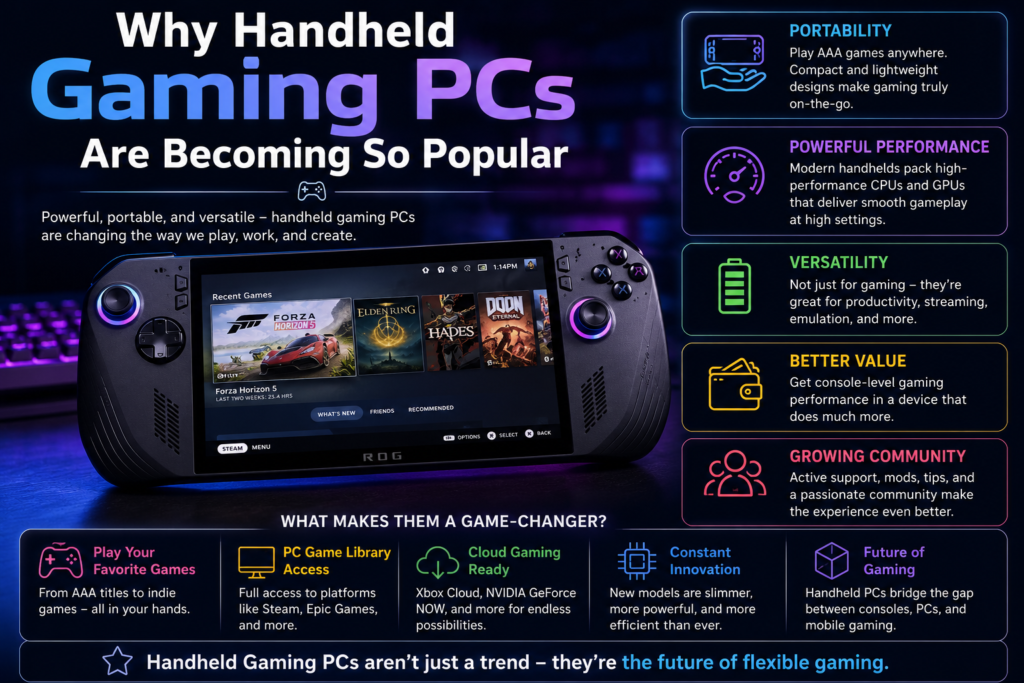
Four years ago, a handheld gaming PC was a niche hobbyist purchase — a slightly bulky device that ran your Steam library at compromised settings, mostly bought by the kind of person who reads spec sheets for fun. In 2026, it’s a genuinely contested product category with Valve, Microsoft, ASUS, Lenovo, and MSI all fighting for the same shelf space, prices stretching from $450 to nearly $1,500, and a full ecosystem of accessories, operating systems, and chip designs built specifically around the form factor. Here’s what actually drove that shift — and the honest complications in the growth story that don’t always make the headlines.
It started with one device proving the category could work
The Steam Deck, launched by Valve in 2022, wasn’t technically the first handheld gaming PC — that distinction goes to the far more niche Pandora back in 2010. But it was the first to spark real industry-wide interest: dedicated market tracking from IDC, a rush of competing devices, and notably, AMD’s decision to start designing chips specifically for handheld gaming systems — something AMD’s own gaming architect described as an entirely new hardware category, the first one to emerge in PC gaming in over two decades.
The scale of what followed is genuinely dramatic: the sector has seen reported growth of roughly +9,900% since the Steam Deck’s launch disrupted the market, and the current field has expanded from one device to six or more legitimate competitors fighting over the same buyers.
Why buyers are actually choosing these devices
A few concrete factors explain the pull toward handhelds specifically, rather than a gaming laptop or a traditional console:
- Hybrid flexibility. The dominant appeal is the ability to move seamlessly between handheld and docked, big-screen play — near-console performance in a form factor you can also take on a commute or a flight, without owning two separate devices.
- Access to existing PC libraries. Unlike a console, a handheld PC plugs directly into a library you may have already built over years on Steam or other PC storefronts — plus more frequent sales than console platforms typically offer.
- Real hardware improvements closing the performance gap. Chips like AMD’s Ryzen Z2 Extreme and the newer Ryzen AI Z2 Extreme have meaningfully narrowed the gap between what a handheld can do and what a full gaming PC or console delivers, while battery-efficient designs have made docked-versus-portable feel like less of a compromise than it used to.
- Cloud gaming as a complementary layer, not a replacement. Xbox Cloud Gaming and NVIDIA GeForce NOW have both expanded onto handheld devices, giving buyers access to console-quality libraries even beyond what local hardware alone could run.
- A maturing software layer. SteamOS in particular has become a genuine differentiator — reviewers consistently describe it as smoother and less clunky than Windows for handheld-specific use, which is a meaningful factor given how much friction Windows has historically added to this category.
The competitive field has genuinely exploded
What used to be a one-device category is now a real market segment with distinct tiers:
- Steam Deck OLED remains the reference point for most buyers chasing a large PC library at a reasonable price, and per IDC tracking, still holds around 50% of the four-brand handheld PC shipment share even with a much more crowded field around it.
- ASUS ROG Xbox Ally X ($999.99) — the result of a genuine collaboration between ASUS and Microsoft, running a full-screen Xbox Experience interface, and widely reviewed as the strongest Windows-native handheld for demanding, graphically intensive games.
- Lenovo Legion Go S (SteamOS) and the newer Legion Go 2 — competing directly with Steam Deck on Valve’s own operating system, at a higher price point but with a bigger screen and more raw power.
- MSI Claw 8 EX AI+ — chasing outright horsepower for buyers willing to spend close to $1,500.
- Nintendo Switch 2 — technically a hybrid console rather than a PC, but competing for the same buyer attention and, per Circana data, the one genuine hardware bright spot offsetting broader console sales declines this year; Nintendo has targeted 25 million units sold by March 2026.
The honest complication: this is not a simple, uninterrupted boom
Here’s where the story gets more nuanced than “handhelds are exploding.” The tracked handheld PC market actually fell roughly 50% in 2024, from about 2.9 million units in 2023 down to 1.45–1.48 million, before IDC forecast a recovery toward 1.926–2.3 million units in 2025 — a genuinely bumpy trajectory, not a straight line up and to the right.
There’s also a real headwind actively squeezing the category in 2026: a global RAM and NAND shortage, driven largely by AI server demand pulling memory supply away from consumer devices. Component costs for handheld manufacturers have reportedly risen as much as 41% for RAM and 8% for storage, forcing real price increases across the board — Valve raised Steam Deck OLED prices in May 2026, its first increase since the OLED model launched back in 2023, citing component costs and logistics tied to the shortage directly. Some devices, like the Legion Go 2, have seen price jumps of 15% in certain regions. The practical upshot: the era of a sub-$400 flagship handheld appears to be over, at least for now.
Even within the Windows handheld segment specifically, growth hasn’t been uniform — reporting suggests ASUS’s ROG Xbox Ally sales stalled after a strong launch month, underlining a broader tension in the category: software and content spending are thriving while hardware sales face real headwinds. Circana forecasts overall US video game spending will rise about 3% to $62.8 billion in 2026 — a record — but that growth is being driven by content and subscriptions, not hardware unit sales, which face genuine pressure this year.
What this means going forward
The category’s popularity isn’t really in question anymore — the sheer number of serious competitors, the dedicated silicon being built specifically for these devices, and the maturing software ecosystem all point to a genuinely established product category rather than a passing trend. What’s less settled is whether unit sales growth can keep pace with the enthusiasm, given real macro pressure from memory pricing pushing costs — and buyer hesitation — upward at exactly the moment the hardware itself has never been more capable.
The realistic read for 2026: handheld gaming PCs have won the argument about whether this form factor deserves to exist as its own category. Whether they can keep growing at their earlier pace while fighting a genuine component shortage is the more interesting question heading into 2027 — and probably the more honest headline than “explosive growth” alone would suggest.
Leave a Reply