
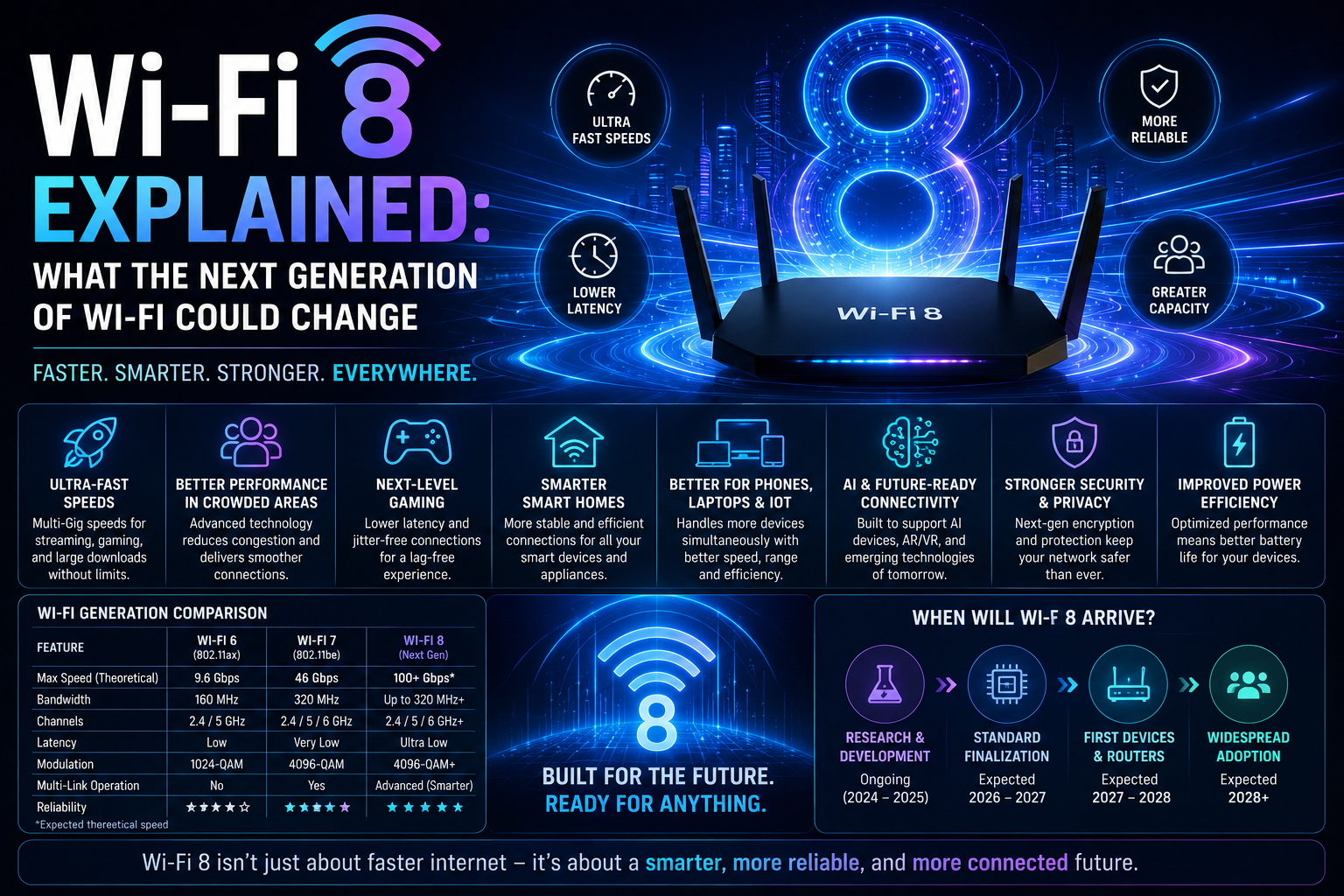
Every new Wi-Fi generation has sold itself on one word: faster. Wi-Fi 8 is breaking that pattern on purpose. The next standard, formally known as IEEE 802.11bn, isn’t chasing bigger speed numbers — it’s chasing something that’s arguably been the more annoying problem the whole time: the dead zone in your bedroom, the video call that stutters when three other people in the house are streaming, the smart speaker that randomly drops off the network for no obvious reason.
Here’s what Wi-Fi 8 actually is, what it changes, and why hardware is already shipping years before the standard is even finished.
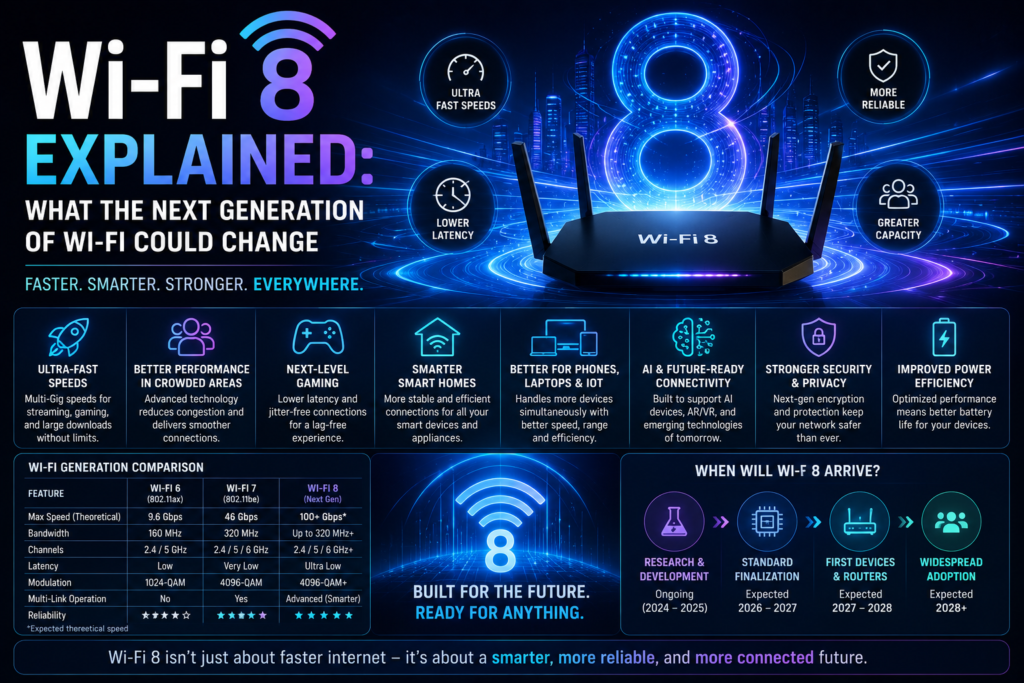
Reliability, not raw speed, is the entire pitch
Wi-Fi 8 is expected to offer roughly the same peak theoretical speed and bandwidth as Wi-Fi 7. That’s a deliberate choice, not a limitation. MediaTek, one of the chipmakers building early Wi-Fi 8 silicon, put it plainly: Wi-Fi 8 represents another leap in wireless technology, but this time the focus is on ultra-reliable connections, not headline throughput numbers. Industry sourcing consistently backs that framing — the standard is explicitly built around stability and consistency rather than chasing another speed record most people already can’t fully use.
The technical features actually driving that reliability
A handful of new mechanisms are doing the real work:
- Coordinated Spatial Reuse (Co-SR) — lets nearby Wi-Fi 8 access points coordinate their channel usage so they can transmit simultaneously with minimal interference, instead of stepping on each other’s signals.
- Dynamic Sub-Channel Operation — can boost real-world throughput by up to 80% by adapting channel usage on the fly rather than using fixed allocations.
- Distributed Resource Units (DRUs) — dynamically split and assign spectrum to multiple users at once, improving efficiency in crowded, device-dense homes.
- Multi-AP Coordination — a meaningfully deeper upgrade from Wi-Fi 7’s Multi-Link Operation, letting multiple access points genuinely work together as one coordinated system rather than operating as separate, loosely connected units.
- Enhanced Long Range (ELR) — aimed at maintaining strong performance further from the router, addressing the classic “great in the living room, terrible in the back bedroom” complaint.
- Single Mobility Domains — lets devices move between access points without losing connection, a meaningful upgrade for mesh systems and larger homes.
Early CES 2026 demos backed up the pitch with real numbers: pre-standard hardware reportedly doubled throughput at medium range and cut latency by up to six times in high-load scenarios compared to existing standards — exactly the kind of gains that matter for gaming, video calls, and streaming, even without a headline max-speed increase.
Wait — routers are already shipping? Before the standard’s even finished?
This is the part that trips people up, and understandably so. Wi-Fi 8 hardware is already hitting the market, but the IEEE 802.11bn standard itself won’t be finalized until 2028. ASUS demonstrated its ROG NeoCore concept router — a striking dodecahedron design that ditches traditional antennas entirely — at CES 2026, and has confirmed plans to ship actual Wi-Fi 8 home routers and mesh systems sometime in 2026. TP-Link announced its Archer 8 router for an October 2026 launch, with a Deco 8 mesh system and Roam 8 travel router following through 2027. Broadcom and MediaTek both unveiled Wi-Fi 8 chipsets at CES 2026, and Qualcomm’s FastConnect 8800 — the first mobile chip combining Wi-Fi 8, Bluetooth 7, Ultra Wideband, and Thread in one package — is expected to reach commercial devices by late 2026.
This isn’t unprecedented — it happened with Wi-Fi 7 too — but the timeline here is unusually aggressive. Previous Wi-Fi generations typically didn’t see retail products until the standard was much closer to completion. This time, consumer hardware is arriving roughly two years ahead of formal ratification.
The catch with buying early
If you’re tempted to jump in now, there’s a real trade-off worth understanding. Products launching before the standard is finalized are built on draft specifications, which nearly guarantees firmware updates will be required once the final 802.11bn standard is actually approved. This happened with early Wi-Fi 7 hardware too — some advertised features were limited or simply missing at launch, arriving later via updates once the standard settled.
There’s also a more basic limitation: you need Wi-Fi 8 on both ends of the connection to get any benefit. A Wi-Fi 8 router will happily work with your current phone, laptop, or smart speaker — but none of those older devices will actually receive Wi-Fi 8’s improvements until they ship with Wi-Fi 8 radios themselves. Realistically, that means phones and laptops with native Wi-Fi 8 support are still a ways off, even as router hardware starts appearing on shelves this year.
The realistic timeline
- 2026: Draft-spec hardware from ASUS, TP-Link, Broadcom, MediaTek, and Qualcomm starts reaching consumers and enterprises, based on pre-standard specifications.
- Late 2027: Wi-Fi Alliance certification for Wi-Fi 8 products is expected to begin.
- 2028: The IEEE 802.11bn standard is projected to be formally finalized, alongside the first fully certified enterprise access points.
Should you buy a Wi-Fi 8 router in 2026?
For most people, the honest answer is: not yet, or at least not as your only option. Early Wi-Fi 8 hardware will likely carry premium pricing for genuinely draft-stage technology, with a real chance some advertised features arrive later via firmware rather than working at launch. Wi-Fi 7 routers remain widely available today, span a broad $99–$600+ price range, and already deliver strong, standardized performance without the early-adopter risk.
If your current setup is struggling with dead zones, congestion, or unstable connections in a device-dense home, a solid Wi-Fi 7 mesh system is still the more dependable choice right now. Wi-Fi 8 is worth watching closely — the underlying goals are genuinely aimed at real, everyday frustrations rather than a speed number most home connections can’t fully use anyway — but the smart move for most households is waiting until certified hardware exists on both the router and device side, sometime around 2027–2028.
The bigger picture
Wi-Fi 8’s real significance isn’t a bigger speed number — it’s a philosophical shift in what “better Wi-Fi” even means. After several generations racing toward theoretical peak throughput most homes never approached, the industry is explicitly pivoting toward the problems people actually complain about: the room where the signal drops, the video call that stutters, the smart home device that mysteriously disconnects. Whether that pivot delivers on the hype is something we’ll only really know once real, finished hardware — on both ends of the connection — actually reaches people’s homes.
Leave a Reply