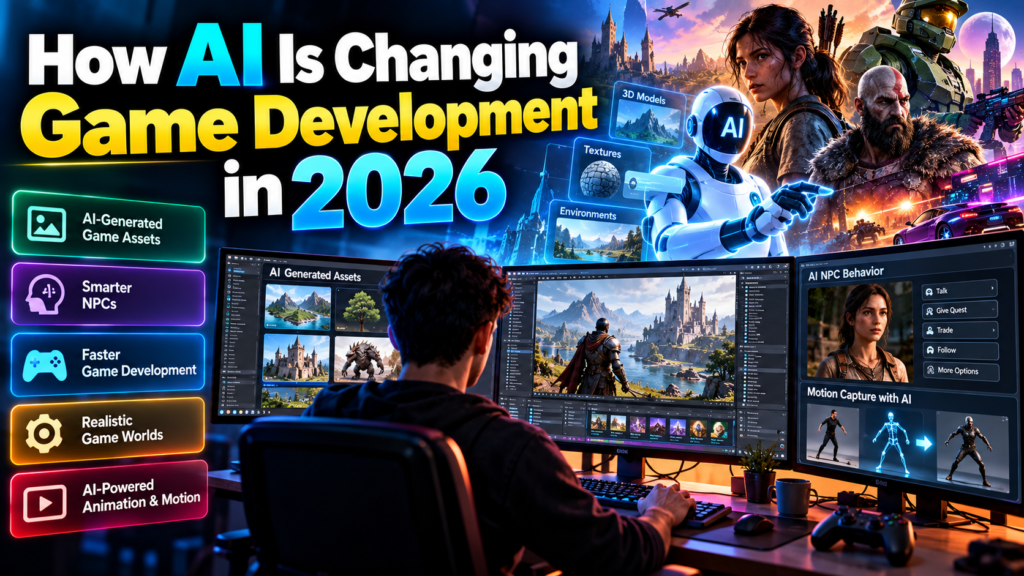
If you want to understand how AI has actually changed gaming in 2026, don’t just look at what players see on screen — look at what happens behind the studio walls, months before a game ever ships. Development pipelines, not just dialogue trees and procedural worlds, are where the real transformation has happened this year, and the numbers behind that shift are genuinely striking.
The adoption numbers are no longer a minority story
Unity’s official 2025 Game Development Report found 96% of studios are already integrating AI tools into at least some part of their workflow. A separate BCG 2026 Global Gaming Report, corroborated by a Google Cloud/Harris Poll survey of 615 developers, found 90% of game developers now integrate AI into their workflows, with 50% of studios actively using it in production specifically — not just experimenting in pre-production. This isn’t an emerging trend anymore; it’s the baseline.
Where the time and cost savings are actually landing
The productivity numbers being reported are large enough to explain why adoption moved so fast. Studios integrating AI tools properly report 20–30% faster iteration cycles, especially in prototyping and content-heavy pipelines. On the asset side specifically, AI tools are reducing creation time by 70–90%, cutting development costs by an estimated $100,000 to $500,000 per title on average — with AAA studios reportedly saving closer to $10 million per title across a full production pipeline. Some live-service studios are now shipping major content updates weekly rather than monthly, a roughly tenfold acceleration in content velocity compared to pre-AI release cadences.
Where AI is actually embedded in the pipeline
Coding and engineering. AI coding assistants have become a standard part of modern development pipelines, not a novelty. Tools like Cursor, GitHub Copilot, and general-purpose AI chat interfaces with code execution are now routine parts of how engineering work gets done — one indie studio specifically noted Cursor’s strength at handling Unreal Engine-specific macros like UCLASS, UFUNCTION, and UPROPERTY, the kind of repetitive boilerplate that used to eat real engineering time.
Concept art and visual assets. The typical production flow now runs through a deliberate multi-tool chain: Midjourney or Stable Diffusion for early style exploration and concept variations, followed by tools like Leonardo AI or Scenario.gg for production-ready asset generation, with Photoshop’s generative AI features used for cleanup and extension work. Crucially, studios report AI delivers its biggest value specifically before production fully ramps up — once pipelines harden and assets need to function correctly across gameplay systems, UI readability, animation logic, and platform constraints, the serious studios shift toward control rather than pure generation: curated prompt libraries, style anchors, custom-trained models, and human paintover as a standard, expected production stage rather than an optional cleanup pass.
Animation and motion capture. Tools like RADiCAL now let developers capture movement using standard cameras rather than dedicated motion-capture rigs, while platforms bringing AI texturing, automatic rigging, and motion libraries together are compressing what used to be some of the most time-intensive work in AAA development — character animation — into meaningfully faster workflows.
QA and testing. This is one of the most practical, high-impact uses of AI in development right now. Rather than relying solely on manual testing or rigid scripted automation, studios increasingly use AI-driven simulation to stress-test gameplay systems at scale — one estimate puts AI-driven playtesting at roughly 10,000+ hours of simulated testing completed in days, versus six-plus months for an equivalent human QA effort.
Game engines themselves. Both major engines have moved AI from an external add-on to something built directly into the development environment. Unity AI (combining Unity Muse for asset and scripting assistance with Unity Sentis for running AI models on-device) and comparable Unreal Engine tooling mean a developer increasingly has AI available at the actual point of creation, rather than needing to break workflow to reach for an outside tool.
The part studios are being careful about: NPCs and dialogue
Here’s a notable point of caution worth separating from the hype: runtime AI-generated NPC dialogue — characters generating responses live, on the fly, during actual gameplay — remains genuinely experimental in 2026, held back by latency, per-interaction token cost, and the real difficulty of guaranteeing safe, on-brand output in real time. The more common, proven pattern among teams actually shipping games is narrower: using large language models offline to generate large static dialogue corpora that get reviewed and locked before release, or restricting live AI generation to clearly bounded, low-risk tasks like ambient barks and background chatter rather than meaningful story dialogue. The flashier vision of every NPC conversing freely in real time is still mostly aspirational outside of a handful of flagship showcase titles.
The honest caveat: automation is augmentation, not replacement — so far
It’s worth being precise about what these numbers actually mean. Most studios report using AI to speed up iteration and reduce repetitive tasks — concept ideation, coding assistance, QA simulation, player behavior analysis, live-ops content — rather than fully automating development outright. One indie studio summarized the current state plainly: nothing AI generates ships untouched in their pipeline; every output still passes through human review and revision before it reaches a player. At scale, studios tend to integrate AI gradually into existing workflows rather than rebuilding their entire pipeline around it from scratch — which is a meaningfully different, more conservative picture than “AI now makes games,” even with adoption numbers this high.
What this means going forward
The throughline across nearly every 2026 industry report is the same: the question for studios has stopped being whether to use AI and has become where to stop — which parts of the creative and technical process genuinely benefit from AI acceleration, and which parts still need a human making the actual call. Coding, asset iteration, QA simulation, and early concept work have clearly crossed into “standard tool, not experiment” territory. Fully autonomous, real-time creative decision-making — live NPC dialogue chief among it — remains the frontier studios are still approaching carefully, for good reason.
Leave a Reply