
For two years, one of the PS5 Pro’s biggest selling points was a feature the base PS5 simply couldn’t run. That’s changed. On October 1, 2026, Sony announced Quick Spectral Super Resolution (QSSR), a new AI-powered upscaling technology built specifically to run on the standard PS5 — bringing a meaningful slice of the PS5 Pro’s signature graphics trick to the console most PlayStation owners actually have.
Here’s what it is, how it works, and what it actually changes.
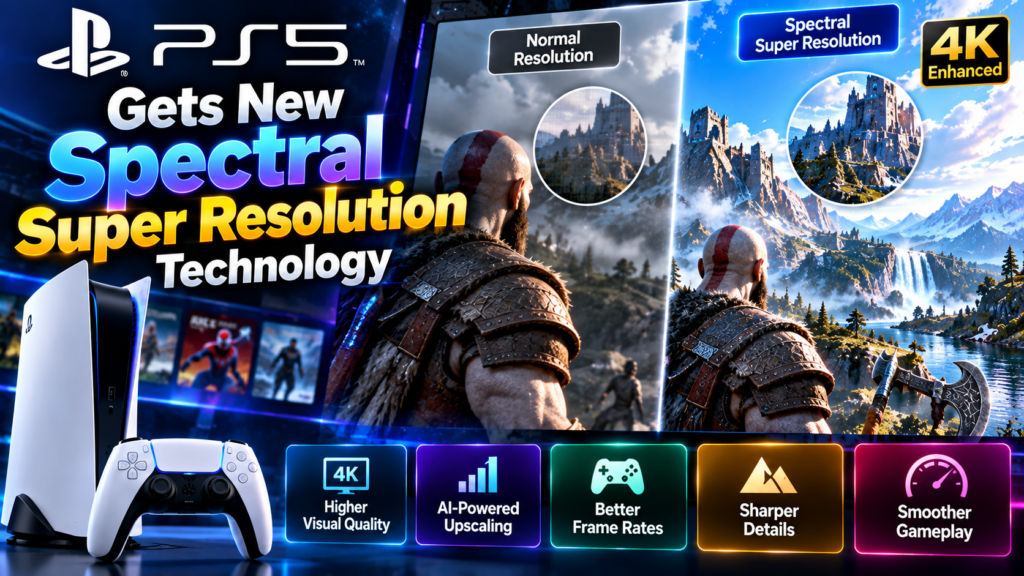
What QSSR actually is
QSSR is a streamlined offshoot of PlayStation Spectral Super Resolution (PSSR), the AI upscaling technology Sony introduced as a headline feature of the PS5 Pro. Both technologies work on the same basic principle: analyze a game’s image pixel by pixel and use AI to reconstruct it with more detail and stability than traditional upscaling methods — effectively letting a console render at a lower internal resolution while still displaying something close to a much sharper image.
The problem, until now, was horsepower. According to PlayStation, the computational demands of full PSSR made bringing that exact experience to the base PS5 “impossible.” QSSR solves that not by shrinking PSSR down, but by rebuilding it specifically for weaker hardware — Sony describes it as using a “streamlined neural network architecture” and a “hand-tuned implementation that maximizes performance on PS5,” rather than simply running a lighter version of the same model.
It’s a Sony-AMD collaboration, not a solo project
QSSR comes out of Project Amethyst, Sony’s ongoing AI graphics collaboration with AMD — the same partnership underpinning PSSR on PS5 Pro. That continuity matters: this isn’t a one-off side project, but a continuation of the same technical effort that produced the Pro’s headline feature, now extended downward to serve a far larger installed base.
Daniel Craig’s take — the actual engineer, not the actor
Daniel Craig, Principal Engineer for Graphics R&D at Sony Interactive Entertainment (notably, not the James Bond actor), described the trade-off plainly: “While PSSR remains the gold standard on PS5 Pro, QSSR provides some notable improvements to both image detail and image stability on PS5.” He added that the team has “long wished that all PS5 players could experience the incredible image quality that PSSR brings to PS5 Pro,” framing QSSR as a genuine step toward narrowing that gap — not a full replacement.
What it actually looks like in practice
Per reporting that drew on Digital Foundry’s technical analysis, PS5 owners should expect QSSR to deliver something closer to an upscaled 1440p experience, compared to the upscaled 4K that full PSSR typically delivers on PS5 Pro. Craig explained the underlying reason for that gap: on PS5 Pro, developers almost uniformly target 4K output and adjust the render resolution beneath that target — a ceiling the base PS5’s weaker hardware simply isn’t built to hit, even with AI reconstruction doing extra work. If you specifically want 4K output with AI upscaling across a wide range of games, the PS5 Pro remains the stronger choice — QSSR narrows the gap, it doesn’t erase it.
The first two games, live today
Marvel’s Wolverine (Insomniac Games) and Ghost of Yōtei (Sucker Punch Productions) are the first titles to support QSSR, and both are being patched to add it as a selectable graphics option on PS5 immediately. Sony says QSSR will be offered broadly to all PlayStation developers going forward, meaning this isn’t limited to first-party Sony studios — any developer building for PS5 will be able to implement it in future titles.
Why this matters beyond just these two games
The more significant story here isn’t the image-quality bump in two specific titles — it’s what Sony’s decision signals about the platform’s direction. Making QSSR available across Sony’s entire developer ecosystem, rather than keeping AI upscaling as a PS5 Pro exclusive, suggests AI-based upscaling is becoming a standard part of how PS5 developers optimize graphics going forward, not a premium feature reserved for buyers who paid extra for the Pro hardware.
For regular PS5 owners, that’s a genuinely good trade: sharper, more temporally stable visuals in supported games, without needing to upgrade hardware at all. It also gives developers a new lever for balancing rendering resolution, performance, and image quality on aging base PS5 hardware — useful as games keep getting more demanding on a console that’s now several years into its life cycle.
The honest caveat
Nobody — including Sony — is claiming QSSR turns a base PS5 into a PS5 Pro. Sony’s own framing consistently describes it as “a new performance tier of AI upscaling,” distinct from and below PSSR, not a way to close the hardware gap entirely. If raw image fidelity at native 4K is your priority, the Pro’s full PSSR implementation remains the better experience. What QSSR actually delivers is a meaningful, free upgrade to image clarity and stability on hardware tens of millions of people already own — which, for most PS5 owners who never bought the Pro, is a genuinely bigger deal than a marginal spec bump for the smaller slice of players who did.
The takeaway
QSSR is Sony quietly extending one of its best recent technical achievements to the console most of its audience actually owns, rather than keeping it locked behind a hardware upsell. Two games support it today, with Sony explicitly signaling more are coming as developers adopt the technology more broadly. If you own a base PS5 and have been eyeing a Pro upgrade purely for sharper visuals, QSSR is worth watching — it won’t make the two consoles equivalent, but it meaningfully narrows a gap that, until this week, didn’t exist as an option at all.
Leave a Reply