Microsoft is taking another major step in the artificial intelligence industry with its new Maia 300 AI chip, a custom-designed processor built to power the next generation of AI services. Announced on October 12, 2026, Maia 300 is designed to improve AI inference performance, reduce computing costs, and help Microsoft serve more AI requests using available data-center power.
The announcement highlights an important trend in the technology industry: major companies are developing their own AI chips instead of relying entirely on processors from Nvidia and other semiconductor manufacturers.
Microsoft plans to begin production deployments of Maia 300 in 2027. The chip will form part of its Azure AI infrastructure, supporting services such as Microsoft Copilot and other AI-powered applications.
But what makes Maia 300 different, and could it change the competition between Microsoft and Nvidia?
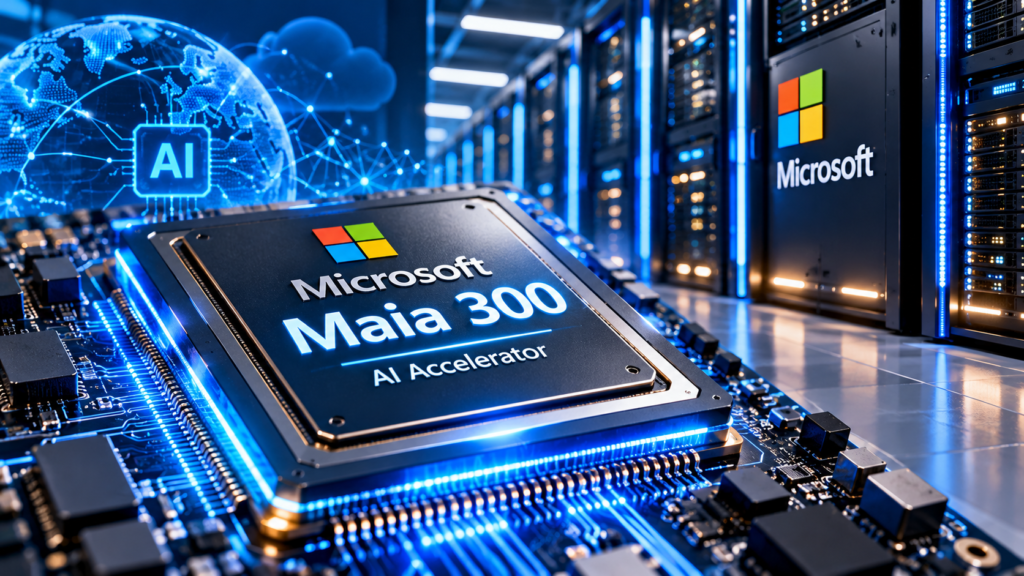
What Is Microsoft Maia 300?
Microsoft Maia 300 is the third generation of Microsoft’s Azure Maia AI accelerator program. It is designed primarily for AI inference, the process of running a trained AI model to generate answers, summarize documents, write code, and complete other tasks.
Training an AI model and running it after training are different workloads. Training generally involves developing a model using large datasets, while inference happens whenever users or applications request an AI-generated result.
As AI assistants and autonomous AI agents become more widely used, companies need infrastructure capable of processing large numbers of requests efficiently.
Microsoft designed Maia 300 around these requirements, with an emphasis on long-context reasoning, responsive conversations, and multi-step AI workflows.
According to Microsoft’s official announcement, the company expects Maia 300 to deliver 40% more tokens per megawatt than leading GPU-based systems. This is a company-reported efficiency target, not a universal guarantee across every AI workload.
Source: Microsoft Official Blog
Microsoft Maia 300: Key Specifications
Here are some of the most notable technical details Microsoft has disclosed.
| Specification | Details |
|---|---|
| Chip name | Azure Maia 300 |
| Generation | Third-generation Maia program |
| Primary purpose | AI inference |
| Compute chiplet process | TSMC N2P |
| Architecture | Multi-chiplet design |
| Full rack configuration | 96 accelerators |
| Rack power envelope | Approximately 167 kW |
| Combined HBM capacity per rack | 27.6 TB |
| Aggregate HBM bandwidth per rack | 1.7 PB/s |
| Planned production deployment | 2027 |
These figures describe Microsoft’s announced system configuration. Actual performance will depend on the AI model, software, workload, and deployment environment.
Source: Microsoft Azure Maia 300 Architecture
1. Up to 40% More Tokens per Megawatt
One of the biggest claims associated with Maia 300 is its expected energy efficiency.
Microsoft says the chip system is designed to deliver 40% more tokens per megawatt than leading GPU-based systems.
In simple terms, tokens are small units of text processed or generated by an AI model. Higher token throughput for the same amount of electricity can help cloud providers serve more AI requests without increasing power consumption proportionally.
This matters because modern AI data centers require substantial electricity, cooling capacity, networking equipment, and computing hardware.
If Maia 300 achieves the expected efficiency improvements in production, Microsoft could potentially increase AI capacity while using its data-center power more effectively.
However, the reported percentage is Microsoft’s own comparison, and performance can vary depending on the workload and competing hardware configuration.
2. A New Chiplet Architecture
Maia 300 uses a multi-chiplet design that separates compute, memory-controller, and input/output functions into different components.
Instead of treating the processor as one large, monolithic chip, a chiplet architecture combines specialized silicon components into a larger system.
Microsoft says the compute chiplets use TSMC’s N2P manufacturing process, a next-generation semiconductor process intended to improve performance and power efficiency.
The design allows Microsoft to optimize different parts of the processor for their particular roles.
This approach is particularly useful for AI accelerators, where processing speed, memory access, and communication between components all influence performance.
The overall result depends on how effectively the chiplets, software, memory, and networking work together.
3. Up to Seven Times the Rack-Scale Throughput
Microsoft also reports that a complete Maia 300 rack containing 96 accelerators can achieve up to seven times the token throughput of a Maia 200 rack.
This is a comparison between two generations of Microsoft’s own AI infrastructure, rather than a direct seven-times performance advantage over Nvidia.
Higher rack-scale throughput could allow Microsoft to handle more simultaneous AI requests or support larger workloads within its data centers.
The rack combines computing accelerators, high-bandwidth memory, and networking infrastructure into an integrated system.
For businesses using cloud AI services, improvements at this level could eventually contribute to greater capacity and more efficient service delivery.
Actual results will depend on the configuration and workload being measured.
4. Built for AI Agents and Long-Context Reasoning
AI systems are moving beyond simple question-and-answer interactions. Modern applications increasingly involve agents that plan tasks, call tools, examine information, and perform multiple steps before returning a result.
Maia 300 is designed for these more demanding workloads.
Potential applications include:
- AI coding assistance through GitHub Copilot.
- Document analysis and enterprise productivity with Microsoft Copilot.
- AI model deployment through Microsoft Foundry.
- Long-context processing for complex business workflows.
- Conversational AI applications requiring responsive results.
- Multi-step AI agents that use tools to complete tasks.
These workloads can put pressure on memory capacity and bandwidth as well as raw computing performance.
Microsoft says Maia 300 uses techniques including support for advanced low-precision numerical formats to reduce memory and bandwidth requirements.
The goal is to process more useful AI work within the available power and infrastructure limits.
5. Why Microsoft Is Building Its Own AI Chips
Developing custom processors gives Microsoft greater control over the hardware supporting its cloud services.
Companies operating large AI platforms face several challenges, including high computing costs, limited power availability, and strong demand for accelerators.
By developing its own chips, Microsoft can optimize hardware around the AI workloads it operates at scale.
Potential benefits include:
Better workload optimization: Hardware can be designed for Microsoft’s particular AI services instead of relying exclusively on general-purpose accelerators.
Improved energy efficiency: More useful AI processing per unit of electricity can help make large deployments more economical.
Greater infrastructure flexibility: Custom chips give Microsoft another option alongside processors purchased from outside suppliers.
Hardware and software integration: Microsoft can design its chips, software stack, networking, and data centers to work together.
Nevertheless, building custom silicon requires substantial investment, specialized engineering, and ongoing software development. It is not a simple or immediate replacement for established GPU platforms.
Microsoft Maia 300 vs Nvidia AI Chips
Nvidia remains a major supplier of AI accelerators, supported by its GPU hardware, software ecosystem, and broad adoption among AI developers.
Microsoft’s Maia program introduces another option for workloads running within Microsoft’s own infrastructure.
The two approaches have different advantages.
| Feature | Microsoft Maia 300 | Nvidia AI accelerators |
|---|---|---|
| Main focus | Microsoft’s integrated AI infrastructure | Broad AI computing and accelerator ecosystem |
| Hardware approach | Custom AI inference system | GPU-based accelerator platforms |
| Software integration | Azure and Microsoft’s AI services | CUDA and a broad AI software ecosystem |
| Main strategic benefit | Workload-specific optimization | Broad developer adoption and flexibility |
| Availability | Planned production deployment in 2027 | Depends on the particular product and market |
This comparison is high-level because Nvidia offers multiple accelerator generations and configurations, and Microsoft has not published enough information to establish a universal winner across all workloads.
Maia 300’s announced efficiency figures should therefore be evaluated against comparable systems using the same models, software settings, and measurement methods.
Microsoft is not abandoning Nvidia entirely. Its custom chips are intended to expand its hardware options and improve the efficiency of its AI infrastructure.
When Will Microsoft Maia 300 Launch?
Microsoft announced Maia 300 on October 12, 2026, and plans to begin production deployments in 2027.
The company also plans to expand Azure Maia deployments to multi-gigawatt scale beginning in 2027. This refers to the planned power capacity of large infrastructure deployments, rather than the power consumption of one chip.
Microsoft’s existing Maia 200 system is already serving production workloads, including Microsoft Copilot. The company plans to expand the Maia family across more of its AI services.
For now, Maia 300 is primarily an infrastructure development for Microsoft’s cloud and AI ecosystem rather than a consumer processor intended for ordinary desktop PCs.
How Maia 300 Could Affect AI Costs
Running advanced AI services at scale is expensive. Providers must pay for accelerators, electricity, cooling, networking, data-center construction, and ongoing maintenance.
Improvements in computing efficiency could help Microsoft reduce the cost of serving each AI request.
For example, if a system processes more AI-generated tokens using the same amount of electricity, it may improve the economics of operating an AI service.
However, greater chip efficiency does not automatically mean that customers will receive lower prices. Costs also depend on model size, utilization, software efficiency, infrastructure investment, and commercial pricing decisions.
The practical impact will become clearer as Maia 300 enters production and Microsoft publishes more information about its real-world performance.
Challenges Microsoft Must Overcome
Despite its potential, Maia 300 faces several challenges.
Software Compatibility
Developers already use established AI frameworks and tools optimized for existing accelerators. Microsoft must ensure its hardware works effectively with the software needed to deploy and maintain AI applications.
Reliability at Scale
Operating thousands of accelerators requires reliable hardware, networking, cooling, monitoring, and fault recovery.
Competition
Nvidia and other semiconductor companies continue to develop new processors. Microsoft will need to keep improving its custom hardware to remain competitive.
Measuring Real-World Performance
Performance figures announced by manufacturers are useful starting points, but independent testing and real production workloads are needed to establish how a system compares with alternatives.
These challenges will determine whether Maia 300 becomes a major foundation for Microsoft’s AI infrastructure.
Conclusion
Microsoft Maia 300 represents an important step in the company’s effort to build more efficient AI infrastructure.
Its multi-chiplet design, 96-accelerator rack configuration, and reported target of 40% more tokens per megawatt demonstrate Microsoft’s focus on improving inference efficiency at data-center scale.
The planned 2027 deployment could help power AI services such as Copilot and GitHub Copilot while giving Microsoft more control over its computing infrastructure.
However, Maia 300 should not yet be considered a definitive Nvidia replacement. Its success will depend on real-world performance, software support, reliability, and overall operating costs.
As AI demand continues to grow, the competition between custom AI chips and established GPU platforms will be an important trend to watch.
Frequently Asked Questions (FAQs)
1. What is Microsoft Maia 300?
Microsoft Maia 300 is a custom AI accelerator designed primarily for inference workloads, including AI assistants, long-context reasoning, and multi-step AI agents.
2. When will Microsoft Maia 300 launch?
Microsoft plans to begin production deployments in 2027.
3. Is Maia 300 faster than Nvidia GPUs?
Microsoft claims up to 40% more tokens per megawatt than leading GPU-based systems. This is an efficiency comparison, not proof that Maia 300 is faster than every Nvidia GPU in every task.
4. How many accelerators are in a Maia 300 rack?
Microsoft’s announced full rack configuration contains 96 accelerators.
5. What is the main purpose of Maia 300?
Its primary purpose is AI inference: processing requests from trained models to generate answers, code, summaries, and other outputs.
6. Will Maia 300 power Microsoft Copilot?
Microsoft plans to use the Maia family across its AI services. Maia 200 is already running production workloads, including Copilot, while Maia 300 is planned for future deployment.
7. Is Microsoft stopping its use of Nvidia chips?
No. Maia 300 expands Microsoft’s custom hardware options. Microsoft continues to offer Nvidia-based computing through its cloud infrastructure.
8. Why are technology companies developing custom AI chips?
Custom AI chips can be optimized for specific workloads, potentially improving energy efficiency, performance, infrastructure control, and operating economics.
Disclaimer: Specifications, efficiency figures, and deployment plans in this article are based on Microsoft’s published information and may change as the product develops.
Leave a Reply