
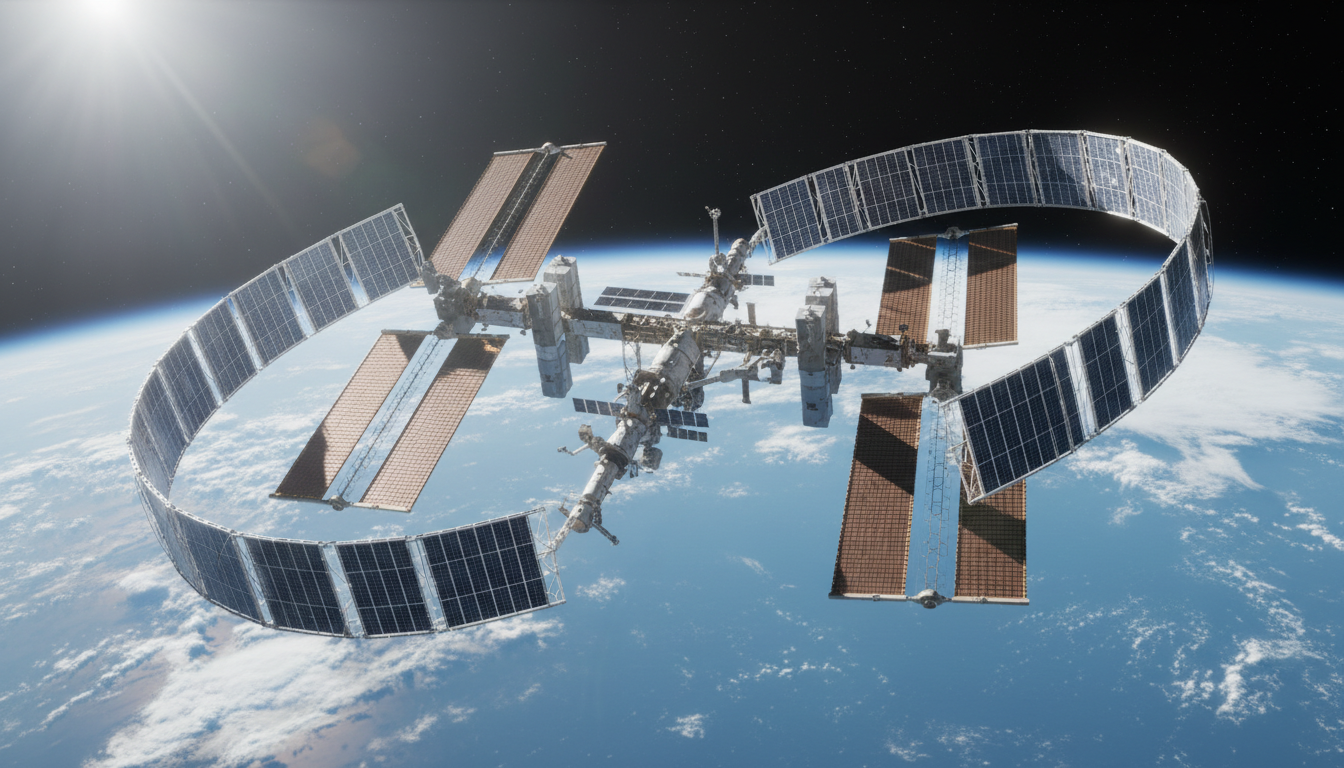
The International Space Station (ISS) has completed a major power-generation upgrade. On November 5, 2026, NASA astronaut Anil Menon and Canadian Space Agency astronaut Joshua Kutryk installed and deployed the eighth and final Roll-Out Solar Array, completing a project designed to provide the orbiting laboratory with more electrical power.
What happened during the final spacewalk?
The two Expedition 75 crew members spent six hours and 59 minutes outside the station to install the final array on the station’s 3B power channel. The new panel was attached to the station’s truss structure and carefully deployed so it could begin collecting sunlight.
This was the eighth and final installation in the station’s Roll-Out Solar Array programme. The work marks the completion of a series of upgrades intended to strengthen the ISS electrical system as the orbital laboratory continues its scientific mission.
How much more power will the ISS generate?
With all eight new arrays installed, the station’s power-generation capacity increases from about 160 kilowatts to approximately 215 kilowatts. That is a substantial boost for a research facility that depends on electricity for life-support equipment, experiments, communications, computers and everyday operations.
The additional capacity gives station teams more flexibility to operate scientific equipment and support the complex systems needed to keep the crew and laboratory functioning in orbit.
What are Roll-Out Solar Arrays?
Roll-Out Solar Arrays, often called ROSAs, are compact solar-power systems that are launched in a rolled-up form and then extended in space. Their design allows a large solar collecting surface to be carried in a smaller package than a traditional rigid panel of similar size.
Once deployed, the arrays convert sunlight into electrical energy. Their flexible, roll-out design is useful for spacecraft because launch space is limited and equipment must be carefully packed to survive the journey into orbit.
Why did the space station need a power upgrade?
The ISS has been operating for decades, and its original solar arrays have experienced the natural effects of long-term exposure to the space environment. The new arrays were developed to supplement the existing power system and help maintain the station’s electrical capacity.
The upgrade programme began in 2021 and required many carefully planned operations. Astronauts completed 18 spacewalks to prepare the power channels and install all eight arrays. The final deployment brings that multi-year effort to completion.
How solar power works in orbit
Solar arrays use photovoltaic cells to convert sunlight into electricity. In orbit, the station travels around Earth and repeatedly moves between sunlight and darkness. Its electrical systems therefore need to generate power when sunlight is available and manage stored energy when the station is in Earth’s shadow.
Reliable power is essential for everything from scientific instruments to temperature control and communications. Increasing the station’s generation capacity helps support its demanding operations and research schedule.
What does this mean for future space missions?
The ISS solar upgrade demonstrates how spacecraft infrastructure can be improved while a station remains occupied and operational. Modular equipment, robotic systems and carefully coordinated spacewalks all play a role in maintaining complex facilities in orbit.
Lessons from the project can inform the design of future space stations and other long-duration missions, where dependable electrical power will be essential for science, communications and crew support.
Final thoughts
The installation of the eighth Roll-Out Solar Array is an important milestone for the International Space Station. By increasing its power-generation capacity to approximately 215 kilowatts, the completed upgrade gives the orbital laboratory additional electrical capability for its remaining years of operation. It is also a strong example of how engineering, robotics and human spaceflight work together to maintain one of the most complex research facilities ever built.
Leave a Reply