


Introduction
AI Predictions 2026 make one thing clear: artificial intelligence is moving from hype to hardened reality. After rapid adoption in 2025, 2026 will be the year AI truly matures, shifting focus from raw compute power to governance, data ecosystems, and real-world deployment.
According to John Roese, Global CTO and Chief AI Officer at Dell Technologies, the next phase of AI will be defined not by faster GPUs alone, but by how responsibly, securely, and effectively AI is integrated into enterprises, governments, and the physical world. For countries like India and other fast-growing tech markets, these predictions act as a strategic roadmap for digital leadership.
What Was Announced: The 2026 AI Forecast
Dell’s annual AI outlook has become a trusted signal for where enterprise technology is heading. The 2026 forecast centers on one core theme: maturity.
The industry is no longer asking “What is AI?” Instead, the critical questions are:
- How do we govern AI at scale?
- How do we build resilient AI infrastructure?
- How do we deploy AI beyond screens and into the physical world?
Key focus areas include AI governance frameworks, sovereign AI infrastructure, and the rise of Physical AI powered by robotics.
Key Predictions & Specifications for 2026
1️⃣ AI Governance Frameworks Become Mandatory
In 2026, AI governance will no longer be optional. Enterprises will be required to implement:
- Clear AI usage policies
- Risk and compliance models
- Ethical AI standards
At the same time, governments will formalize national-level AI governance as a competitive advantage. Rather than slowing innovation, these frameworks are expected to enable responsible and scalable AI adoption, especially in regulated industries.
2️⃣ Data Ecosystems Replace Compute as the Core Focus
For years, AI progress was measured by GPU power and compute scale. In 2026, the spotlight shifts to data ecosystems:
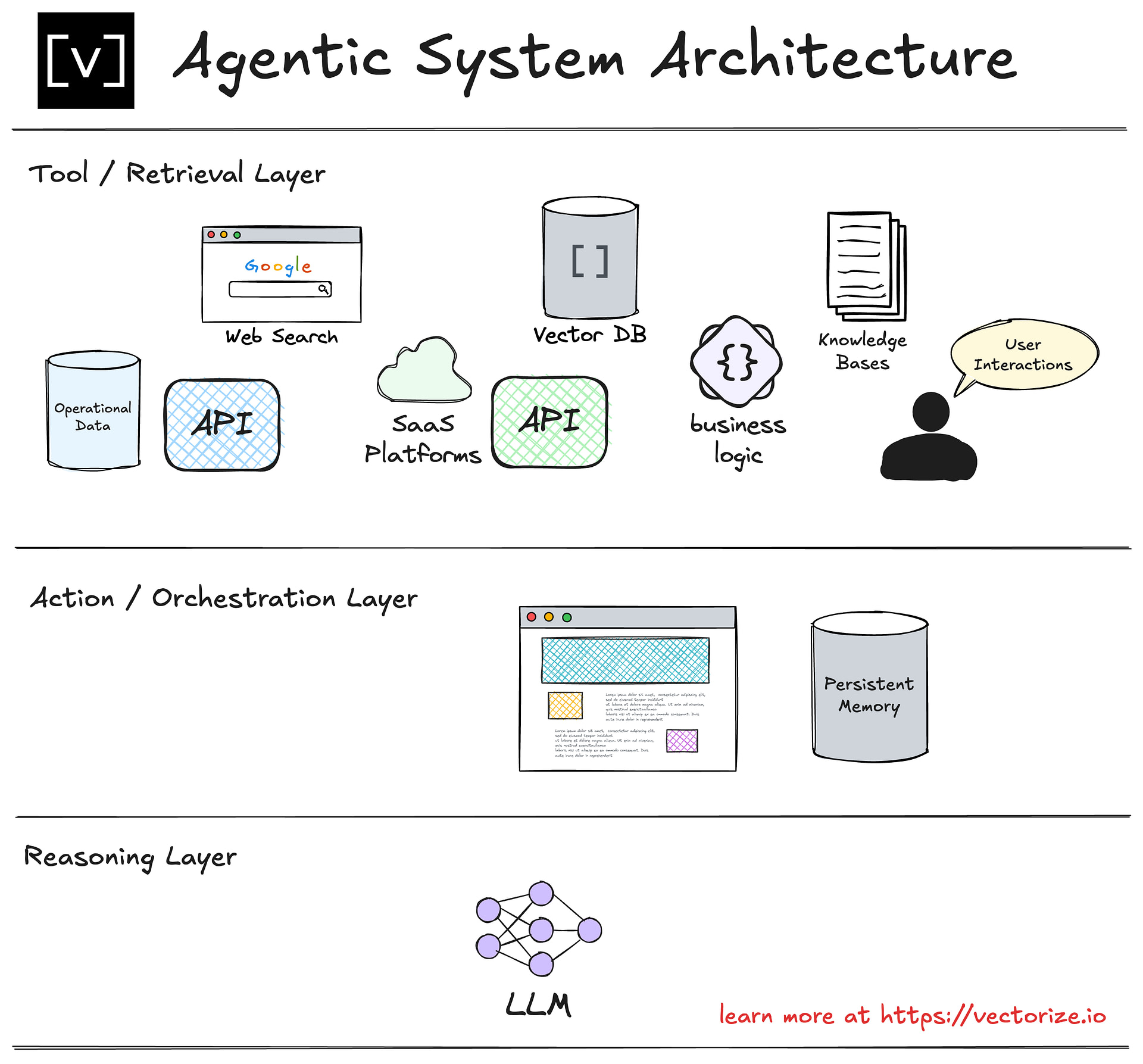
- Vector databases
- Knowledge graphs
- Graph databases
As AI systems move into production, they don’t just consume data—they generate massive volumes of new data. Managing this knowledge layer will be critical for advanced systems like agentic AI, accelerating the move toward hybrid cloud and edge computing.
3️⃣ Agentic AI Moves Beyond Chatbots
The term agent has been overused, but in 2026 its true meaning becomes clear. Agentic AI refers to autonomous AI agents that can:
- Think
- Ask questions
- Decide and act independently
These agents won’t just respond to prompts—they will orchestrate complex workflows, ensuring continuity between human and machine processes. Industries such as logistics, healthcare, and enterprise software are expected to see early breakthroughs.
4️⃣ Disaster Recovery for AI Factories
With the rise of sovereign AI clouds and massive GPU clusters, resilience becomes mission-critical. In 2026, organizations will invest heavily in:
- AI-specific disaster recovery (DR)
- Business continuity planning
- Rapid GPU and data pipeline failover
The ability to recover AI workloads within minutes—not hours—will separate leaders from laggards in both the public and private sectors.
5️⃣ Sovereign AI Meets Enterprise Demand
Sovereign AI—AI infrastructure controlled at the national level—will directly intersect with enterprise needs. Countries building domestic AI capacity will find strong demand from local businesses seeking:
- Data sovereignty
- Regulatory alignment
- Reduced reliance on foreign hyperscalers
This alignment between national supply and enterprise demand is expected to accelerate local AI economies, particularly in emerging markets.
Comparison With the 2025 Landscape
In 2025, the conversation focused on barriers to enterprise AI adoption—organizational friction, skills gaps, and unclear ROI.
The 2026 outlook is different. It’s about solutions:
- Governance to manage risk
- Data ecosystems to fuel models
- Resilient infrastructure to support scale
The industry is moving from problem identification to foundation building for industrial-grade AI.
Expert Opinions & Industry Reaction
Industry analysts note that John Roese’s predictions consistently capture the shift from research to real-world deployment. The emphasis on governance and sovereign AI aligns closely with national digital strategies worldwide.
For enterprises, the opportunity lies in leveraging these global trends to build sustainable, homegrown AI capabilities rather than relying solely on imported platforms.
Performance, Software & the Physical AI Impact
In 2026, AI performance will increasingly be measured by its impact on the physical world.
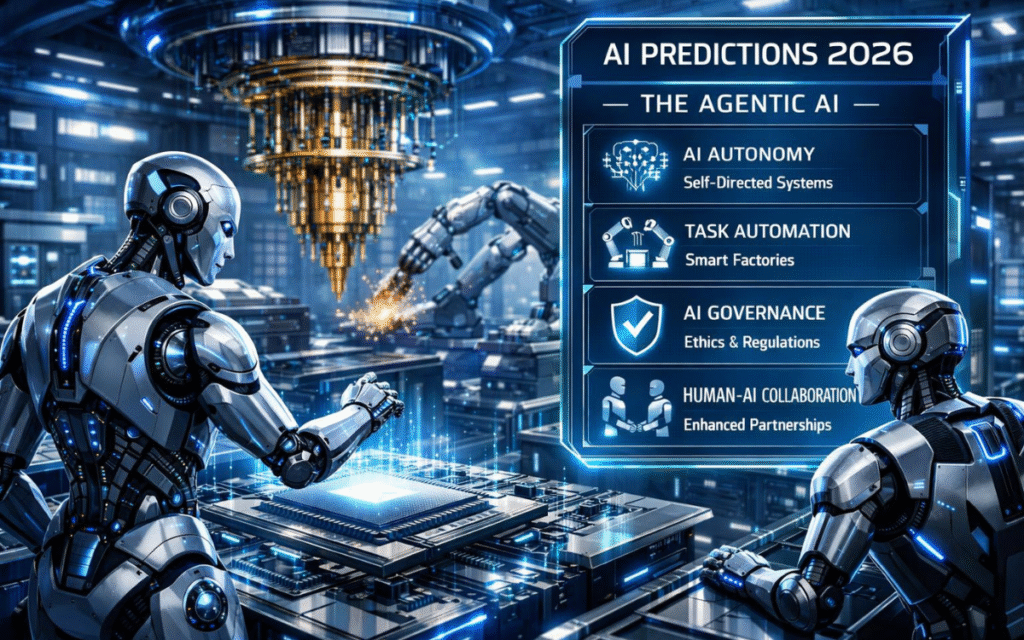
Physical AI, combining robotics with advanced AI reasoning, has the potential to transform manufacturing, warehousing, and healthcare. At the same time, quantum computing—while not yet at full supremacy—will see software-level breakthroughs that enable more complex simulations and optimization problems, laying the groundwork for future disruption.
Global & India Market Implications
Globally, these trends will intensify competition around:
- Semiconductor supply chains
- Energy infrastructure for data centers
- AI-driven geopolitics
In India, the predictions reinforce ongoing investments in AI infrastructure, skills development, and public–private partnerships. Expect increased focus on AI governance skills, data engineering, robotics startups, and AI-native enterprises.
Why This Tech News Matters
AI Predictions 2026 are more than forecasts—they are a call to action. They highlight that:
- AI without governance will not scale
- AI without data ecosystems will fail
- Agentic and physical AI will define the next decade
Organizations and professionals who prepare now—by investing in governance, data, and advanced AI skills—will shape the future rather than react to it.
FAQs (SEO Friendly)
Q1: What is the most important AI trend for 2026?
AI governance frameworks at both enterprise and national levels are the top priority for responsible and scalable AI adoption.
Q2: What is Agentic AI?
Agentic AI consists of autonomous agents that can independently plan, decide, and act, managing complex workflows rather than just responding to prompts.
Q3: Why is Sovereign AI important for countries like India?
Sovereign AI improves data security, reduces foreign dependence, and supports locally tailored innovation aligned with national priorities.
Q4: What role will quantum computing play in 2026?
While full quantum supremacy is unlikely, significant software advancements will expand AI’s problem-solving capabilities.
Q5: Why is Physical AI considered a potential breakthrough?
Because it moves AI beyond digital environments into real-world tasks through robotics, enabling human-like precision and automation.
Final Verdict
AI Predictions 2026 show that artificial intelligence is entering its most serious and impactful phase yet. Governance, agentic systems, robotics, and quantum computing will not just redefine technology—they will reshape how the world works over the next decade.



One thought on “BREAKING: AI Predictions 2026 – Governance, Robotics & Quantum to Redefine Tech”