
OpenAI has entered the translation battlefield with confidence. With the launch of ChatGPT Translate, the company has made it clear that it wants to challenge long-established tools like Google Translate, not with noise, but with intelligence. The new tool promises free access, no login barriers, and translations in more than 50 languages, all while understanding tone, context, and idioms.
In a digital world where translation often decides how well ideas travel, ChatGPT Translate arrives as a practical upgrade rather than a flashy experiment. It focuses on meaning, not just words, and that difference matters.
What Is ChatGPT Translate?
ChatGPT Translate is a new AI-powered translation platform launched by OpenAI. Unlike earlier translation features built into ChatGPT, this tool lives on a dedicated web interface that closely resembles the layout of Google Translate.
Users can access it directly via the browser without logging in or paying a subscription fee. That decision alone lowers friction and opens the tool to a wider audience, including students, travelers, and professionals who just want fast and reliable translations.
Why OpenAI Built a Separate Translate Platform
ChatGPT already supported translations inside chats, so why launch a new platform?
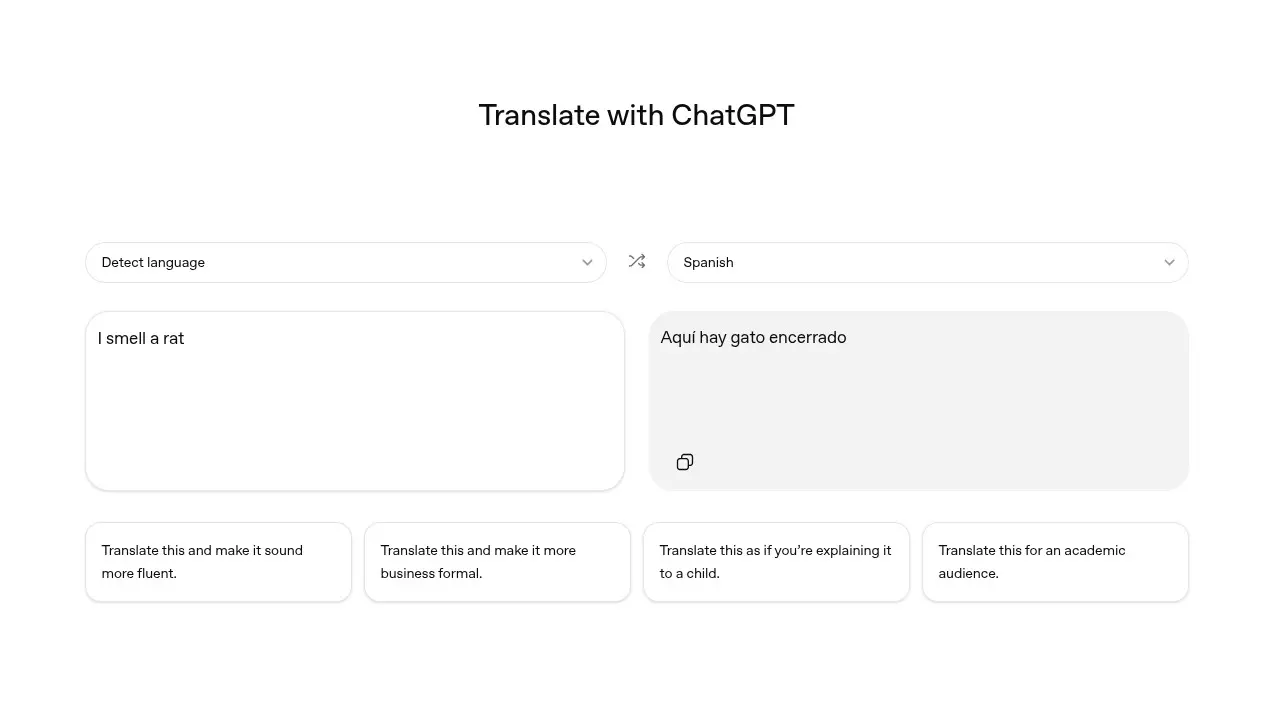
The answer is focus. A dedicated translation interface removes distractions and speeds up the workflow. Instead of conversations, users get a clean two-box layout: one for input and one for output. This design mirrors what users already understand, which reduces learning time to almost zero.
OpenAI clearly wants ChatGPT Translate to compete head-on with Google Translate, not replace ChatGPT itself.
ChatGPT Translate Supports 50+ Languages
Language coverage plays a major role in adoption, and OpenAI knows it. According to the company, ChatGPT Translate supports more than 50 languages, including:
- Hindi
- English
- Spanish
- Japanese
- Arabic
The list targets both global and regional users. More importantly, OpenAI claims the translations focus on context and depth, not word-for-word substitution. That approach improves clarity, especially in longer sentences.
Context, Tone, and Idioms: Where ChatGPT Translate Shines
Most translation tools can convert words. Fewer can explain what those words actually mean in real life.
ChatGPT Translate understands tone and intent. If a sentence sounds formal, casual, emotional, or instructional, the tool adjusts accordingly. It can also explain idioms and phrases, which often confuse learners and non-native speakers.
For example, instead of just translating an idiom, the tool can explain why it is used and what emotion it carries. That feature alone makes it more educational than many traditional translators.
No Login Required: How to Use ChatGPT Translate
Using ChatGPT Translate is refreshingly simple.
- Visit
chatgpt.com/translate - Select the source language
- Choose the target language
- Paste or type your text
The translation appears instantly. No account. No subscription. No setup.
This friction-free experience makes the tool ideal for quick tasks, especially on shared or public devices.
Clean and User-Friendly Interface
OpenAI kept the interface minimal on purpose. Two large text boxes dominate the screen, making it easy to focus on content. Buttons and icons stay subtle and functional.
The design avoids clutter, ads, and unnecessary prompts. That simplicity improves speed and reduces mistakes, especially for users who translate frequently.
Customization Options That Add Real Value
Here’s where ChatGPT Translate adds an extra layer of intelligence.
Users can customize the output tone using built-in options:
- Natural conversation: Makes translations sound more human and spoken
- Professional tone: Ideal for emails, reports, and business communication
- Child-friendly language: Simplifies complex ideas into easy explanations
This level of control helps users match translations to real-world situations instead of forcing one-style-fits-all output.
Image Assistance and Grammar Support
OpenAI has confirmed that users can upload photos, such as restaurant menus or street signs, to get explanations and grammar help. The tool doesn’t just translate text from images; it helps users understand structure and usage.
This feature supports travelers and learners who need clarity, not just conversion.
What ChatGPT Translate Still Lacks
Despite its strengths, ChatGPT Translate is not perfect yet.
Currently missing features include:
- PDF uploads
- Real-time voice input
- Live speech-to-speech translation
These gaps matter because Google Translate already supports them. Google recently added live AI-powered speech translation using its Gemini model, preserving tone and rhythm during conversations.
OpenAI has not announced timelines for these features, but it has confirmed ongoing improvements.
ChatGPT Translate vs Google Translate: A Clear Difference in Approach
Google Translate focuses on speed and scale. It translates almost anything, instantly, across platforms.
ChatGPT Translate focuses on understanding and explanation. It tells you why something means what it means.
Both tools serve different needs. Users who want raw speed may prefer Google. Users who want clarity, learning, and tone control may lean toward ChatGPT Translate.
Why Language Learners Will Love ChatGPT Translate
Language learners gain a clear advantage here. If a translation feels confusing, users can ask follow-up questions right away.
They can ask:
- Why was this word used?
- Is this sentence formal or casual?
- Can you simplify this line?
That interactive layer turns translation into learning, not just output.
The Bigger Picture: AI Translation Is Changing Fast
AI translation has moved beyond dictionaries. Tools now understand emotion, culture, and intent. ChatGPT Translate represents this shift clearly.
Instead of competing only on features, OpenAI is competing on understanding. That strategy builds long-term trust and positions the tool as more than a utility.
Final Thoughts on ChatGPT Translate
ChatGPT Translate does not try to replace Google Translate overnight. Instead, it offers an alternative built around clarity, context, and learning.
Free access, no login, tone control, and idiom explanations make it a strong option for daily users. While it still lacks voice and document support, its foundation looks solid.
As OpenAI continues improving the platform, competition in AI translation will only benefit users.