
Apple’s foldable iPhone is finally taking shape. now point toward a 2026 launch, making this the most credible foldable iPhone timeline we’ve seen so far.
Apple’s entry into foldables matters. Not because foldables are new—Samsung, Google, and Motorola already sell them—but because Apple rarely enters a category unless it believes it can redefine it. That patience may explain why the iPhone Fold has taken so long.
Why Apple Waited While Others Rushed
Samsung introduced foldables years ago. Since then, the category has improved, but problems remain. Creases are still visible. Durability still worries buyers. Cameras still trail standard flagships. Software often feels stretched rather than designed.
Apple watched all of this closely.
According to supply-chain reports, Apple has been testing foldable prototypes internally for several years. The company reportedly delayed launch until it could address the biggest pain points—especially display creases, hinge reliability, and long-term usability.
Apple doesn’t want to sell an interesting device. It wants to sell a device that feels inevitable.
iPhone Fold Launch Timeline: When Is It Coming?
Most credible reports now agree on one thing:
- Expected launch year: 2026
- Likely launch window: September 2026
- Initial availability: Limited markets and volumes
Analysts familiar with Apple’s supply chain suggest that component testing has reached an advanced stage. Apple typically enters mass production roughly a year before launch, which aligns with the current timeline.
This will not be a mass-market iPhone on day one. Apple is likely to treat the iPhone Fold as a premium, experimental flagship—much like the original Apple Watch.
Design: A Book-Style Foldable, Not a Flip
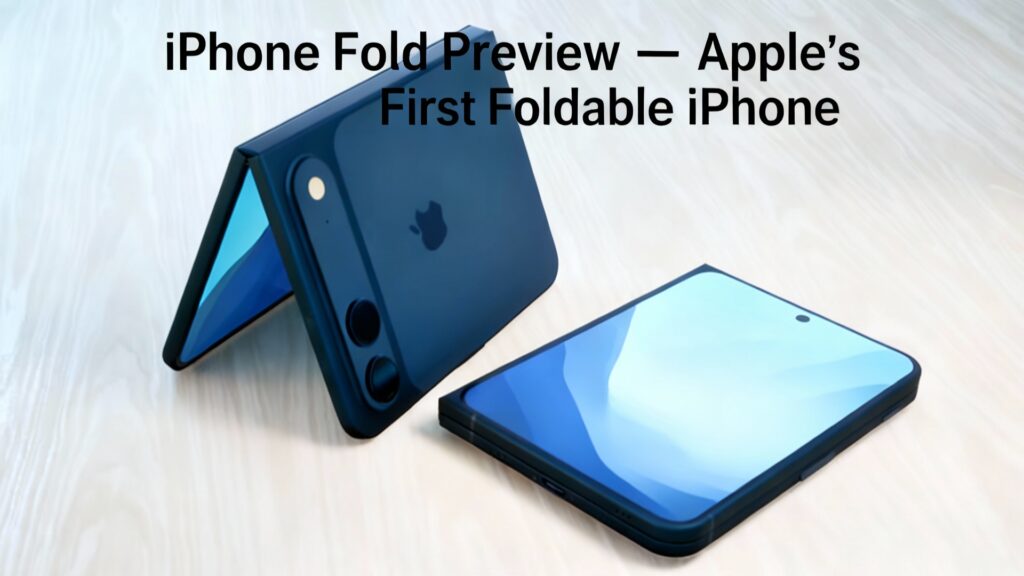
The iPhone Fold is expected to follow a book-style foldable design, similar to the Galaxy Z Fold series rather than a flip phone.
That means:
- A compact outer display for daily tasks
- A large inner display that opens like a book
Apple is not expected to launch a flip-style iPhone yet. A flip model could arrive later, but the first foldable iPhone will focus on productivity and immersive usage.
Display Sizes and Thickness (Leaked)
Multiple reports suggest slightly different measurements, but the overall picture is clear.
Expected Display Sizes
- Outer display: ~5.5 inches
- Inner foldable display: ~7.8 inches
This setup creates a useful balance. When folded, the phone remains pocketable. When opened, it offers near-tablet real estate.
Thickness Targets
- Folded: ~9–9.5mm
- Unfolded: ~4.5–4.8mm
If Apple achieves this, the iPhone Fold could match or surpass current foldables in slimness.
Apple’s Biggest Challenge: A Crease-Free Display
Ask users why they avoid foldables, and you’ll hear the same answer: the crease.
Apple reportedly considers the crease unacceptable.
To fix this, Apple may:
- Work with Corning on advanced flexible glass
- Use a bendable version of Ceramic Shield
- Combine new hinge mechanics with layered display materials
If Apple succeeds in making the crease nearly invisible, it could remove the single biggest psychological barrier to foldables.
Hinge and Durability: Built for the Long Term
Foldables open and close thousands of times. Early models struggled here.
Apple’s hinge design is expected to:
- Use fewer moving parts
- Distribute stress more evenly
- Improve resistance to dust and wear
Apple’s goal isn’t just durability—it’s confidence. Users should never worry whether opening their phone is damaging it.
Camera System: No Foldable Compromises
This is where Apple could change the industry.
Most foldables today use decent cameras, but none truly match top-tier flagships. Apple reportedly doesn’t want that compromise.
Expected Camera Approach
- High-resolution dual rear cameras (likely 48MP sensors)
- Front camera on the outer display
- Under-display camera (UPC) on the inner screen
The under-display camera would stay hidden during normal use, keeping the inner display clean and immersive.
If Apple delivers flagship-grade camera performance in a foldable, competitors will be forced to raise their standards.
Face ID vs Touch ID: A Practical Choice
Surprisingly, reports suggest the iPhone Fold may skip Face ID.
Instead, Apple may use:
- Touch ID integrated into the side power button
This isn’t a step backward. Face ID hardware takes space, and foldables demand ultra-thin internals. Touch ID works reliably whether the phone is folded or unfolded, in any lighting condition.
Sometimes, practicality beats tradition.
Performance and Battery Expectations
Apple will almost certainly power the iPhone Fold with:
- Its latest A-series processor
- Increased RAM for multitasking
Battery capacity remains unclear, but Apple is expected to use high-density battery cells similar to those found in its ultra-thin devices. Efficiency, not raw size, will be the focus.
Battery life will be closely watched. Foldables live or die by endurance.
Software: Apple’s Quiet Advantage
Hardware alone won’t win this battle. Software will.
Many Android foldables still struggle with:
- Poor app scaling
- Awkward multitasking
- Interfaces that feel stretched
Apple plans to rethink the experience by:
- Combining the best elements of iOS and iPadOS
- Designing multitasking specifically for folding screens
- Improving split-screen, drag-and-drop, and app continuity
Apple has reinvented user interfaces before. Expect the foldable UI to feel intentional, not adapted.
Expected Price: Premium, Without Apology
Let’s be realistic.
The iPhone Fold will be expensive.
Price Estimates
- Expected price: $2,000–$2,500
This places it above the Galaxy Z Fold and Pixel Fold. Apple isn’t trying to compete on price. It’s positioning the foldable iPhone as:
- A productivity powerhouse
- A phone-tablet hybrid
- A statement device
Early adopters and professionals are the target audience.
Why the iPhone Fold Matters to the Market
Even if sales are limited, Apple’s entry will:
- Push foldables into mainstream conversation
- Force better software optimization
- Raise expectations for quality and durability
Apple doesn’t need to dominate foldable sales. It only needs to redefine what people expect from a foldable phone.
Final Verdict: Apple’s Foldable Moment
The iPhone Fold preview suggests Apple is taking a familiar path—wait, refine, then enter with confidence.
Yes, it will be expensive.
Yes, it will be niche at first.
But if Apple delivers:
- A nearly crease-free display
- Flagship-level cameras
- Strong durability
- Thoughtful software
The iPhone Fold could be the device that finally makes foldables feel practical rather than experimental.
And when Apple gets something right, the industry usually follows.