


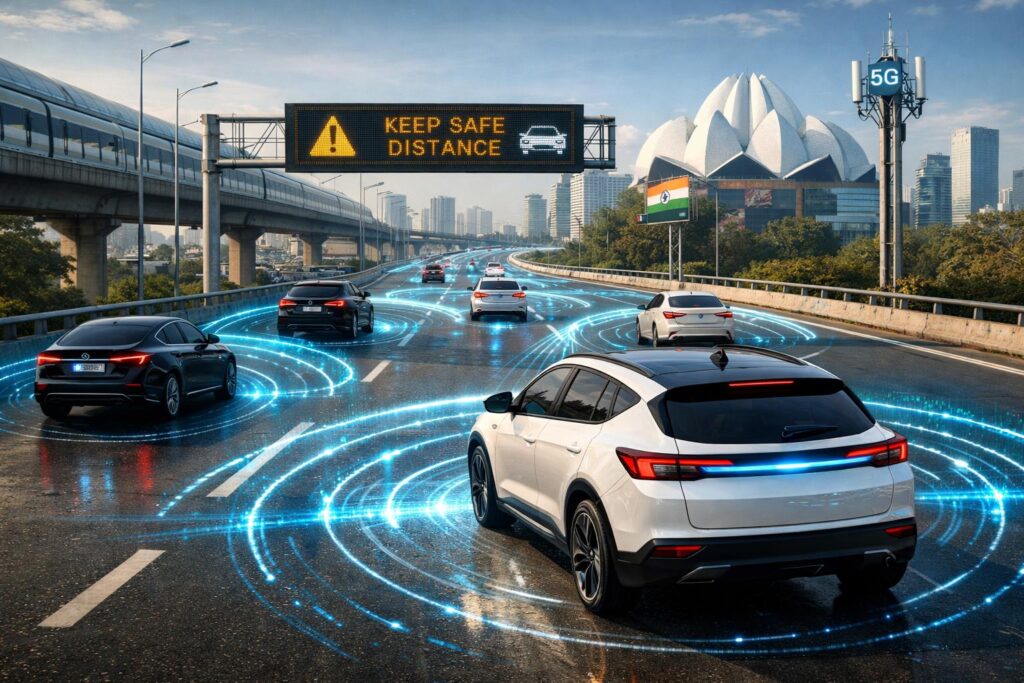
V2V Technology India Is Changing Road Safety Forever
V2V Technology India is no longer a concept from science fiction or premium global car shows. It is moving from policy discussions to Indian roads, and it could quietly become the most important safety upgrade your car ever gets.
By the end of 2026, vehicles in India may start warning each other before collisions happen. No shouting. No honking. Just machines talking to machines—faster than human reflexes.
The announcement came after discussions led by Nitin Gadkari, India’s Minister for Road Transport and Highways, during a meeting with transport ministers from states and Union Territories. The goal is ambitious but clear: reduce road accident deaths by 50% by 2030.
And honestly, considering India’s accident numbers, this upgrade is long overdue.
What Is V2V Technology?
Vehicle-to-Vehicle (V2V) communication technology allows cars, buses, and trucks to share safety information wirelessly with each other in real time.
Each vehicle uses an On-Board Unit (OBU)—a small communication chip—to broadcast critical data such as:
- Current speed
- Location
- Direction of travel
- Sudden braking events
Think of it as vehicles speaking a universal safety language. No mobile network. No internet dependency. Just direct communication.
If cars were humans, V2V would be the equivalent of telepathy for traffic safety.
How V2V Technology India Will Actually Work
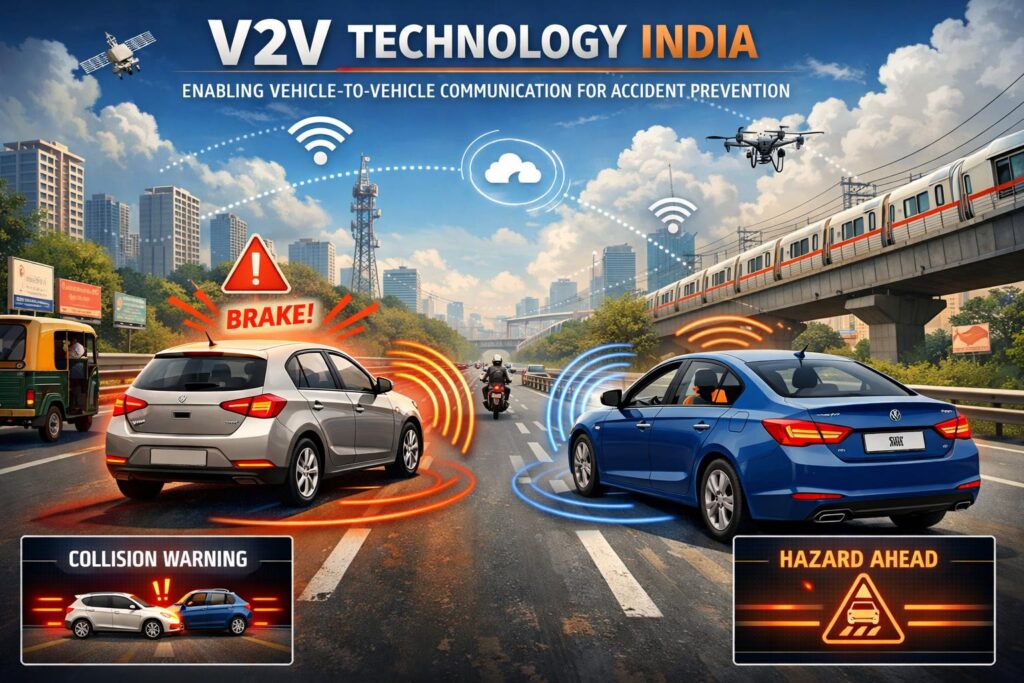
Once V2V Technology India becomes mandatory, every new vehicle will carry an OBU that continuously sends and receives signals from nearby vehicles.
Here’s what happens in real life:
- A car ahead brakes suddenly
- The OBU sends a warning signal
- Your car receives the alert instantly
- You get a visual or audio warning before your eyes even register danger
The system works faster than human reaction time, which is exactly why it matters.
Fog, Blind Turns, and Hidden Dangers: Where V2V Shines
Indian roads do not fail because drivers are careless alone. They fail because visibility fails first.
V2V Technology India directly targets the most dangerous scenarios:
1. Fog and Low Visibility
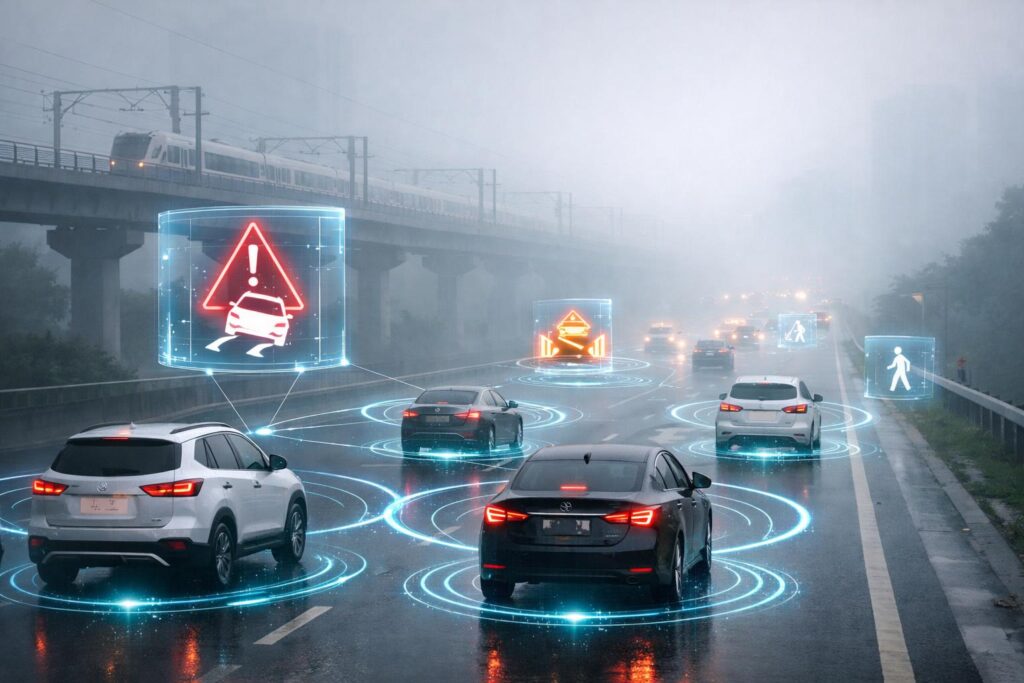
In dense fog, cameras and human eyes struggle. V2V does not.
If a vehicle ahead slows down, your car knows—even if you see nothing.
2. Blind Curves and Intersections
Vehicles approaching from the other side of a blind turn can warn each other before drivers can see anything.
3. Stationary or Broken-Down Vehicles
A stalled truck on a highway becomes visible digitally long before it becomes visible physically.
This is where V2V outperforms almost every existing safety system.
V2V Technology vs ADAS: Not a Replacement, but an Upgrade
Many people ask whether V2V Technology India replaces ADAS (Advanced Driver Assistance Systems).
The answer is simple: No. It completes it.
ADAS relies on:
- Cameras
- Radar
- Lidar
These systems only see what is physically visible.
V2V relies on:
- Wireless communication
That means your car can receive danger alerts from vehicles beyond your line of sight.
If ADAS is eyesight, V2V is intuition.
Cost Impact: Will Cars Become Expensive?
Yes—but not dramatically.
According to government estimates, the On-Board Unit (OBU) may add approximately:
₹5,000 to ₹7,000 per vehicle
This is a one-time hardware cost. Compared to the cost of repairs, insurance claims, or medical bills after accidents, it is a surprisingly small price.
The government may initially mandate this for:
- New cars
- Buses
- Trucks
Retrofit options for older vehicles could follow later.
Spectrum Allocation: The Technical Backbone
V2V Technology India requires a dedicated wireless frequency band to avoid interference.
For this, the Department of Telecommunications (DoT) has agreed in principle to allocate:
5.875–5.905 GHz (30 MHz spectrum)
This frequency band is already used globally for vehicle communication. A joint task force is currently finalising technical standards with automobile manufacturers.
This matters because standardisation prevents chaos. Cars must speak the same digital language.
Global Reality Check: Why 2026 Is Ambitious
Countries like the US, Japan, and several European nations allocated spectrum for V2V years ago. Yet, even there, full-scale adoption remains slow.
Why?
- High implementation costs
- Interoperability challenges
- Manufacturer coordination
India’s 2026 timeline is bold. But if achieved, it places the country among global leaders in connected vehicle safety, not followers.
Why V2V Technology India Matters More Than You Think
India records one of the highest road accident death rates globally. Many accidents happen not because of speed, but because of lack of timely information.
V2V Technology India solves exactly that problem.
It does not depend on:
- Driver skill
- Weather conditions
- Road lighting
It depends on data and speed—things machines do better than humans.
What About Data Privacy and Tracking?
A valid concern—but V2V does not track drivers.
The system:
- Shares safety data, not personal data
- Uses short-range communication
- Does not store identity information
Think of it as vehicles shouting “Brake!”—not sharing phone numbers.
Timeline: When Will V2V Technology India Become Reality?
- 2024–2025: Technical standards and trials
- 2026 (End): Mandatory notification expected
- Post-2026: Gradual rollout and compliance
Initial implementation will focus on new vehicles.
The Bigger Picture: Toward Zero Fatalities
The government’s target is clear: 50% reduction in road deaths by 2030.
V2V Technology India alone cannot achieve this. But combined with:
- Safer road design
- Better enforcement
- Improved vehicle safety
It becomes a powerful pillar.
And unlike many safety measures, V2V works silently in the background—no behaviour change required.
Final Thoughts: When Cars Start Talking, Roads Get Safer
V2V Technology India represents a shift from reactive driving to predictive safety.
Cars will no longer wait for accidents to happen. They will warn each other first.
That may sound simple. But simplicity is often the most powerful innovation.
By 2026, your car might just save your life—without you even noticing.
And that is exactly how good safety technology should work.