
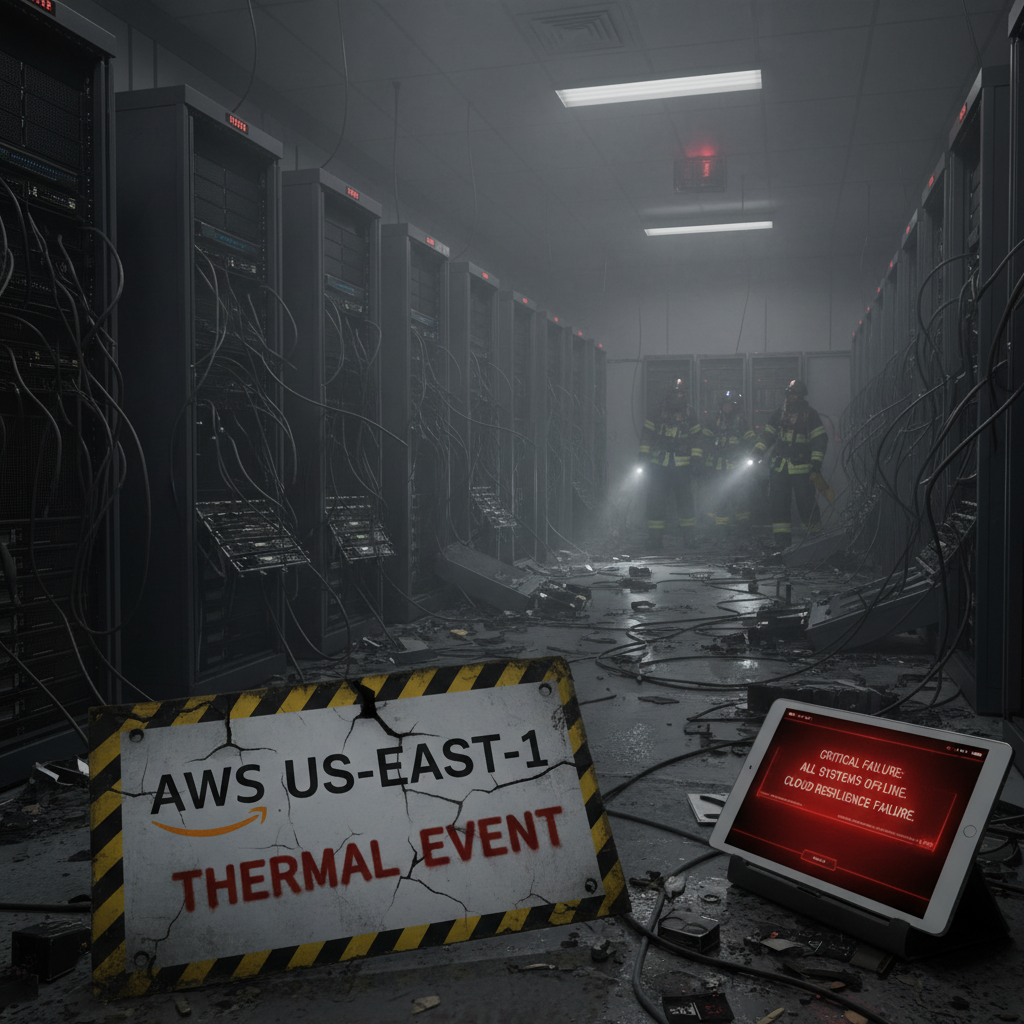
The promise of the cloud is unparalleled reliability and scalability. Yet, even the most robust infrastructure providers can face unexpected challenges. The recent AWS US-East-1 outage, triggered by a data center thermal event, served as a stark reminder that even the cloud is not infallible. This incident, while ultimately resolved, offers critical insights for businesses relying on AWS and underscores the paramount importance of strategic cloud architecture and disaster recovery planning.
Understanding the US-East-1 Thermal Event
In a rare and impactful event, Amazon Web Services (AWS)’s crucial US-East-1 region experienced significant disruptions following what was officially described as a “thermal event” within one of its data centers. While the precise details of the thermal event (e.g., overheating, cooling system failure, or localized fire) are often proprietary, such occurrences typically involve equipment overheating, leading to power loss, component failure, and a cascading effect across connected services.
US-East-1, located in Northern Virginia, is AWS’s oldest and largest region, serving as the default for many new accounts and hosting a vast array of mission-critical applications and services for businesses worldwide. Its interconnectedness means that an incident here can ripple through countless applications, affecting everything from popular streaming services to enterprise SaaS platforms and internal business operations.
The outage led to degraded performance and service interruptions across multiple AWS services within the region, impacting a wide range of customers globally. For many, this meant downtime for their websites, applications, and customer-facing tools, leading to potential revenue loss, productivity hits, and reputational damage.
Why US-East-1’s Reliability is Critical
The significance of an outage in US-East-1 cannot be overstated. Beyond its size and default status, many third-party services and APIs often default to or heavily rely on this region. Historical incidents have shown that while AWS generally boasts an incredibly high uptime, issues in US-East-1 tend to have a disproportionately large impact across the internet. This incident once again highlighted the importance of understanding regional dependencies and the potential single points of failure in cloud architectures, even when seemingly diversified within an Availability Zone.
Crucial Lessons for Robust Cloud Resilience
While no cloud provider can guarantee 100% uptime, businesses can architect their applications to be highly available and resilient to regional outages. The US-East-1 thermal event serves as a powerful case study for reinforcing cloud best practices:
1. Multi-Region and Multi-AZ Architectures are Non-Negotiable
- Multi-Availability Zone (Multi-AZ): Within a single AWS region, spreading resources across multiple Availability Zones (isolated locations designed to be independent) protects against failures like power outages or localized hardware issues within a single data center.
- Multi-Region Deployment: For critical applications, deploying across two or more geographically separate AWS regions is the ultimate safeguard against a region-wide event like the US-East-1 thermal incident. This could involve active-passive (pilot light or warm standby) or active-active architectures.
2. Develop and Regularly Test Disaster Recovery (DR) Plans
Having a theoretical DR plan is not enough. Organizations must:
- Define clear Recovery Time Objectives (RTOs) and Recovery Point Objectives (RPOs).
- Automate failover procedures where possible to minimize manual intervention.
- Conduct regular, realistic DR drills to identify gaps and ensure teams are prepared.
3. Implement Robust Monitoring and Alerting
Proactive monitoring of application health, resource utilization, and AWS service status is essential. Set up alerts that notify relevant teams immediately upon detecting anomalies or service degradation, allowing for rapid response.
4. Automate and Orchestrate Failover
Manual failover processes are slow and prone to human error. Leverage AWS services like Route 53 for DNS failover, AWS Auto Scaling for self-healing, and infrastructure-as-code (e.g., CloudFormation, Terraform) to quickly provision resources in alternative regions.
5. Strategic Data Backup and Recovery
Ensure your data is regularly backed up to different Availability Zones and, for critical data, replicated to a different region. Understand AWS’s various backup services (e.g., AWS Backup, S3 Cross-Region Replication) and implement a strategy that aligns with your RPO.
6. Understand AWS Service Level Agreements (SLAs)
While AWS provides high SLAs, it’s crucial to understand what they cover, how downtime is calculated, and what remedies (e.g., service credits) are available. More importantly, understand that even with an SLA, business disruption can be costly.
AWS’s Commitment to Post-Mortem and Improvement
Historically, AWS has been transparent post-incident, providing detailed post-mortem reports that outline the root cause, remediation steps taken, and future preventative measures. These reports are invaluable for the broader cloud community, helping customers understand potential risks and adjust their architectures accordingly. It’s expected that a similar detailed analysis will follow this thermal event, offering further insights into data center resilience.
Conclusion: Building for an Imperfect World
The AWS US-East-1 outage, caused by a data center thermal event, is a powerful reminder that even the most advanced cloud infrastructure can experience disruptions. For businesses, this isn’t a reason to distrust the cloud, but rather a catalyst to critically evaluate and strengthen their own cloud resilience strategies. By adopting multi-region architectures, comprehensive disaster recovery plans, robust monitoring, and automation, organizations can significantly mitigate the impact of future cloud incidents, ensuring their applications remain available and their operations continuous, even in an imperfect world.
Leave a Reply