
For years, one of the most frustrating parts of gaming was waiting for a game to load. Players could spend several minutes staring at loading screens before entering a level, starting a match, or moving between areas. Then SSDs, or Solid-State Drives, became common in gaming PCs and modern consoles—and loading times changed dramatically.
But why are SSDs so much faster than traditional hard disk drives (HDDs), and how exactly do they affect gaming? Let’s explore how SSD technology transformed the gaming experience.
HDD vs SSD: What’s the Difference?
To understand why SSDs changed gaming, it helps to understand how they store data.
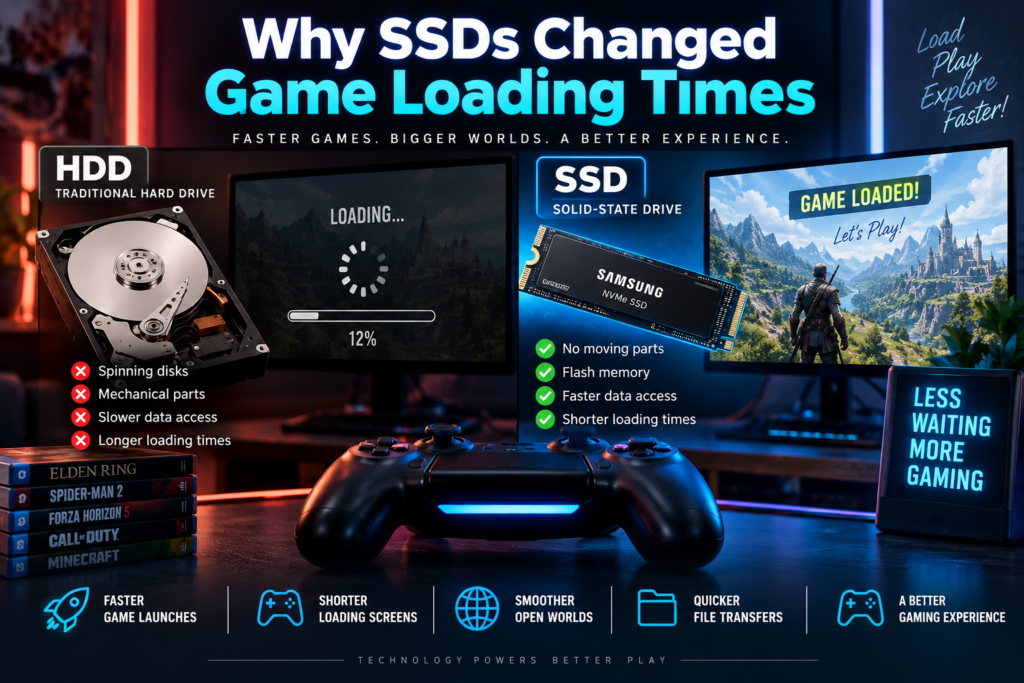
A traditional HDD uses spinning magnetic disks called platters. A mechanical arm moves across these platters to find the information requested by the computer. Because the drive contains moving parts, it takes time to locate and read data.
An SSD works differently. It stores data using flash memory and has no spinning disks or mechanical read/write arm. This allows an SSD to access data much more quickly.
When a game needs to load thousands of files, textures, models, audio files, and other assets, the SSD can retrieve that information with much less delay.
Why Games Benefit So Much From SSDs
Modern video games are enormous. A single game can require tens or even hundreds of gigabytes of storage. Those files can include high-resolution textures, character models, animations, sound effects, maps, and other assets.
When you launch a game, the system needs to move a large amount of data from storage into memory.
With an HDD, accessing many different files can be relatively slow because the mechanical head may need to move around the disk repeatedly. This is especially noticeable when a game constantly needs small pieces of data from different locations.
SSDs are much better at handling these random access operations. They can retrieve many pieces of data quickly without physically moving a mechanical head.
The result is shorter loading screens and faster transitions.
SSDs Made Open-World Games Better
One of the biggest changes brought by SSDs is the way developers can design large game worlds.
Older games often had to divide their worlds into separate areas. When players moved from one area to another, the game could display a loading screen while it loaded the next section.
With faster storage, developers can stream game assets more quickly while the player moves through the environment.
This is particularly useful for open-world games. Instead of loading an entire world at once, the game can continuously load nearby buildings, textures, characters, and objects as needed.
An SSD doesn’t eliminate every loading screen, but it gives developers much more flexibility when designing large and detailed environments.
Consoles Made SSDs Mainstream
SSDs became particularly important with modern gaming consoles.
The PlayStation 5 and Xbox Series X|S use high-speed SSD storage as part of their system design. This was a major change from previous console generations that commonly relied on HDDs.
The PlayStation 5, for example, was designed around a high-speed internal SSD. Faster storage helps games load levels and assets more quickly and supports technologies designed for rapid data streaming.
This means developers can build games around faster access to game data rather than treating slow storage as a major limitation.
NVMe SSDs Take Speed Even Further
Not all SSDs are equally fast.
Older SATA SSDs are already much faster than traditional HDDs for many tasks, but NVMe SSDs can offer significantly higher throughput because they communicate with the computer through PCIe.
Modern NVMe drives are especially useful for gaming PCs because they can transfer large amounts of data quickly.
However, there’s an important point: buying the fastest SSD available doesn’t necessarily mean every game will load dramatically faster.
Game loading depends on several factors, including the game engine, CPU, decompression technology, memory, operating system, and how efficiently the game is designed.
SSDs Don’t Improve Everything
An SSD is not a magic upgrade that makes every part of gaming faster.
It can dramatically improve storage-related tasks, but it doesn’t directly make your GPU render graphics faster.
For example, replacing an HDD with an SSD can reduce loading times, but it generally won’t turn a game running at 60 frames per second into a 120 FPS experience.
The GPU and CPU are still responsible for most rendering and gameplay calculations.
The biggest improvements from an SSD are faster game launches, quicker loading screens, faster file transfers, and improved asset streaming.
DirectStorage and the Future of Game Loading
PC gaming is also moving toward technologies designed to take better advantage of fast SSDs.
Microsoft’s DirectStorage technology allows games to efficiently transfer large amounts of data from storage to the GPU and system memory. The goal is to reduce bottlenecks and make asset streaming more efficient.
This is important because modern games are using increasingly detailed textures and larger assets.
As storage becomes faster, developers can potentially create worlds with more detail without relying on long loading screens.
Are SSDs Essential for Gaming?
For modern gaming, an SSD is highly recommended.
You can still run many games from an HDD, especially older titles, but newer games are increasingly designed with faster storage in mind. Some modern games even list an SSD as part of their recommended or required system specifications.
For a gaming PC, an NVMe SSD is a popular choice because it offers excellent performance while taking up little physical space.
If you’re upgrading from an HDD, even a standard SATA SSD can feel like a major improvement.
Conclusion
SSDs changed game loading times because they removed one of the biggest limitations of traditional storage: mechanical movement.
Instead of waiting for spinning disks and moving heads to find data, games can access information from flash memory much more quickly. This has helped reduce loading screens, improve level transitions, and enable developers to build larger and more detailed game worlds.
As technologies such as NVMe and DirectStorage continue to evolve, fast storage will become even more important to game development.
The SSD may not make your GPU more powerful, but it has fundamentally changed how quickly games can access and stream the enormous amounts of data required by modern gaming.