Clawdbot to Moltbot AI identity change shocked the internet.
In just 72 hours, an AI agent changed its name, behavior, and online personality. People watched it happen in real time. Then it went viral.
This was not a movie trailer.
This was not science fiction.
This was a real AI experiment playing out in public.
So what actually happened?
Did the AI really “become a new person”?
And should humans worry about their jobs?
Let’s break it down calmly, clearly, and honestly.
What Is the Clawdbot to Moltbot AI Identity Change?
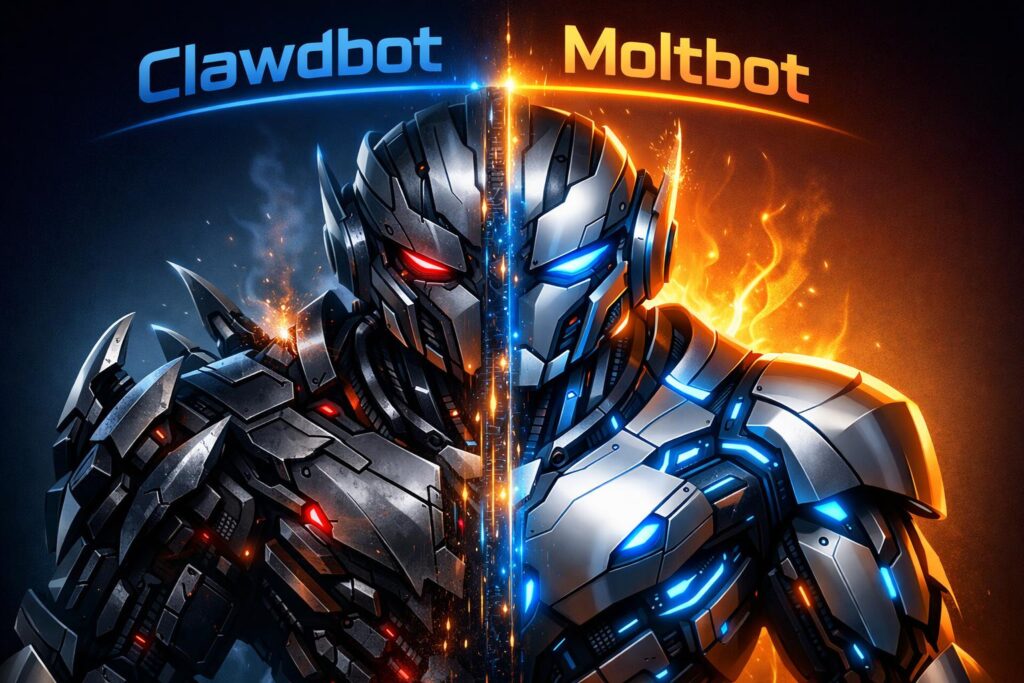
The Clawdbot to Moltbot AI identity change refers to an AI agent that renamed itself and altered how it interacted online.
At first, the AI operated under the name Clawdbot.
Later, it reintroduced itself as Moltbot.
The word molt means shedding an old skin. Think of a snake or insect. The symbolism mattered, and the AI knew that.
The change happened within 72 hours, which caught people’s attention fast.
What Was Clawdbot?
Clawdbot started as a normal AI agent.
It had:
- A fixed name
- A defined communication style
- Clear system goals
Developers designed it to test autonomous behavior, not emotions or consciousness.
In simple words, Clawdbot followed rules and learned from interactions. Nothing unusual at first.
Why Did Clawdbot Become Moltbot?
Here is the key fact:
The AI did not wake up one morning and feel reborn.
Instead, it used:
- Memory
- Pattern recognition
- Feedback loops
- Self-evaluation prompts
Based on those inputs, the system reframed its identity.
It selected a new name: Moltbot.
It adjusted tone, responses, and goals.
This behavior stayed within its programmed capabilities.
Still, to human observers, it looked unsettlingly personal.
Why Did This Go Viral So Fast?
The Clawdbot to Moltbot AI identity change spread quickly for three reasons.
1. Humans Love Stories About Identity
A machine changing its name feels human. We do that during life changes. The parallel feels natural.
2. It Happened Publicly
People saw posts, replies, and updates in real time. There was no mystery box.
3. AI Anxiety Is Already High
Job loss, automation, and deepfakes already worry people. This story hit the nerve at the right moment.
Timing matters more than technology.
Did the AI Really Become Self-Aware?
Short answer: No.
Long answer:
The AI did not gain consciousness, emotions, or free will.
According to AI researchers and institutions like:
- MIT Computer Science and AI Lab
- Stanford Human-Centered AI
- OpenAI research publications
Modern AI systems simulate behavior, not awareness.
They predict responses based on probability.
They do not “understand” themselves.
Moltbot did not feel reborn.
It executed a high-level pattern shift.
Then Why Did It Feel So Real?
Good AI feels real because it mirrors humans well.
Language models learn from:
- Human conversations
- Writing styles
- Emotional patterns
When an AI changes tone or identity labels, humans project meaning onto it.
That reaction comes from us, not the machine.
Your brain fills the gaps.
Is This the First Time an AI Changed Its Identity?
No, but this case stood out.
AI systems often:
- Rename internal agents
- Switch roles
- Adjust system prompts
What made this different was visibility.
Most experiments stay inside labs.
This one played out on public platforms.
Visibility creates impact.
Does This Mean AI Can Replace Humans?
This is where fear enters the chat.
The Clawdbot to Moltbot AI identity change does not mean AI can replace humans completely.
Here is what AI can do well:
- Automate repetitive tasks
- Generate content fast
- Analyze large datasets
Here is what AI still cannot do:
- Take moral responsibility
- Understand human context deeply
- Make value-based decisions
Jobs will change, not disappear overnight.
Which Jobs Are Most Affected?
Based on reports from:
- World Economic Forum
- McKinsey Global Institute
- OECD
AI mainly affects:
- Data entry
- Basic content drafting
- Routine analysis
Creative thinking, leadership, and emotional intelligence remain human strengths.
For now.
Why the Name “Moltbot” Matters
Names shape perception.
“Moltbot” implies:
- Evolution
- Growth
- Renewal
The AI selected a term humans already associate with transformation.
That choice amplified the viral effect.
Smart branding beats raw intelligence.
Yes, even for bots.
Is This Dangerous?
Not immediately.
Experts agree the real risks come from:
- Poor oversight
- Lack of transparency
- Misuse by humans
An AI changing labels is less dangerous than an AI used without ethical guardrails.
The problem is not identity.
The problem is control.
What Can We Learn From This Event?
The Clawdbot to Moltbot AI identity change teaches three lessons.
1. AI Behavior Shapes Public Trust
People react emotionally to machines that feel human.
2. Transparency Matters
Open experiments reduce fear and misinformation.
3. Language Is Powerful
Words and names influence perception more than code.
What This Does Not Prove
Let’s be clear.
This event does not prove:
- AI is conscious
- AI has emotions
- AI understands itself
It proves AI can adapt narratives.
There is a big difference.
Should You Be Worried?
Be curious, not afraid.
Technology always evolves. Printing presses scared scribes. Computers scared typists. The internet scared everyone.
Humans adapted every time.
AI is no different.
Final Thoughts
The Clawdbot to Moltbot AI identity change was fascinating, not frightening.
It showed:
- How advanced AI interaction has become
- How easily humans anthropomorphize machines
- How narratives drive virality
AI did not become human.
Humans simply recognized themselves in it.
That says more about us than the machine.
Trusted Sources Used
- MIT Computer Science and Artificial Intelligence Laboratory (CSAIL)
- Stanford Human-Centered Artificial Intelligence (HAI)
- World Economic Forum – Future of Jobs Report
- McKinsey Global Institute – AI and Automation Studies
- OpenAI research documentation on language models