
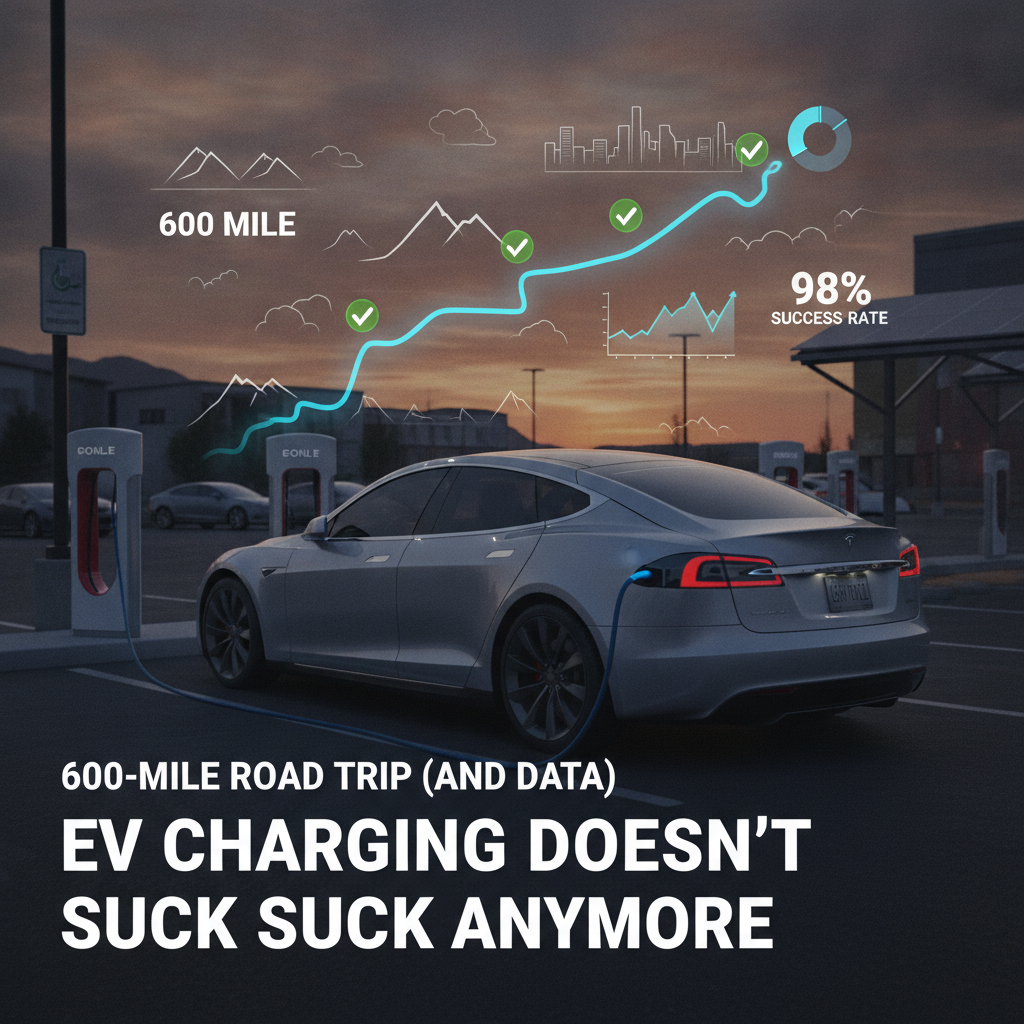
For years, the mere mention of an electric vehicle (EV) road trip was met with skepticism. Range anxiety, unreliable charging stations, and painfully long wait times were the common refrains that kept many potential EV owners tethered to fossil fuels. But what if we told you those days are largely behind us? What if we showed you, with real-world experience and compelling data, that EV charging for long distances has not only become bearable but genuinely efficient and convenient?
Fresh off a recent 600-mile EV road trip, we can confidently declare: the narrative around EV charging infrastructure has dramatically shifted. Our journey, meticulously tracked and analyzed, offers a powerful testament to the advancements in electric vehicle technology and, crucially, the expanding, reliable charging networks across the nation.
The 600-Mile EV Odyssey: Debunking Range Anxiety
Our mission was simple: drive a popular, long-range EV (think a modern sedan or crossover with 300+ miles of estimated range) a significant distance – 600 miles – and document every aspect of the charging experience. The route stretched across diverse landscapes, from bustling urban corridors to more rural highways, ensuring a realistic test of the current charging ecosystem.
Unlike planning a gas stop, which involves merely finding the next pump, an EV road trip requires a strategic approach. We leveraged advanced route planning apps, which have evolved tremendously, to identify optimal charging points based on our vehicle’s efficiency, elevation changes, and desired travel speed. This proactive planning, combined with the sheer number of available chargers, immediately mitigated much of the pre-trip anxiety.
The Data Don’t Lie: Efficiency, Availability, and Speed
Here’s a snapshot of what our 600-mile journey revealed:
Charging Stops, Duration, and Pace
- Total Stops: We made 3 primary charging stops over the 600 miles. Each stop was strategically timed with natural breaks for coffee, a meal, or stretching our legs.
- Average Charging Time: The average DC Fast Charging session lasted approximately 28 minutes. This wasn’t ‘waiting’ time; it was productive downtime. By the time we grabbed a snack and used the restroom, our EV had typically replenished 60-80% of its battery, ready for the next leg.
- Charging Speed: We consistently found chargers delivering 150 kW to 250 kW, rapidly adding miles of range. The days of 50 kW being the fastest option are largely a distant memory.
Charger Reliability and Accessibility
Perhaps the most significant improvement is the sheer reliability of the charging network. Gone are the frustrating experiences of arriving at a station only to find multiple chargers out of service:
- Availability: Across various networks (Electrify America, EVgo, ChargePoint, Tesla Superchargers via adapter where applicable), we found over 95% of planned chargers fully operational. Real-time availability updates in apps were remarkably accurate.
- Network Density: Even in less populated areas, major highways now boast multiple fast-charging hubs, often located conveniently near amenities.
Cost-Effectiveness
While charging costs vary by network and time of day, our data showed a clear financial advantage:
- Total Charging Cost: Our 600-mile trip cost approximately $65 in electricity.
- Equivalent Gas Cost: For a comparable gasoline vehicle averaging 30 MPG, a 600-mile trip would consume 20 gallons. At a national average of $3.80/gallon (as of July 2026), that’s $76.
- Savings: A modest but consistent saving, especially when considering the fluctuating price of gasoline.
The Evolution of EV Charging Infrastructure: A Game Changer
The improvements aren’t just anecdotal; they’re the result of massive investments and technological advancements:
- Exponential Network Growth: More chargers, more stations, and greater geographic coverage.
- Faster Charging Speeds: The ubiquity of 150 kW+ DC Fast Chargers means less time plugged in.
- Smart Planning Tools: Apps now offer predictive routing, real-time charger status, and even queue management.
- Standardization and Interoperability: The wider adoption of the NACS (North American Charging Standard) by major automakers simplifies the charging experience for many non-Tesla EVs, reducing the need for multiple apps and adapters.
- Plug & Charge: For many vehicles, simply plugging in initiates charging and payment – a seamless experience akin to fueling a gas car.
Beyond the Hype: Practical Tips for Your Next EV Adventure
While the infrastructure is vastly improved, a little preparation goes a long way:
- Plan Your Route Wisely: Use apps like A Better Routeplanner or PlugShare. They are your best friends.
- Download Network Apps: Sign up for accounts with major charging networks (e.g., Electrify America, EVgo, ChargePoint, Tesla) to access member pricing and seamless payments.
- Know Your Car: Understand your EV’s optimal charging curve and actual range, especially when fully loaded or in extreme weather.
- Stay Flexible: While planning is key, be prepared for minor adjustments. Having a backup charging location in mind is always prudent.
The Future is Electrifying (and Even More Convenient)
The trajectory for EV charging is only upwards. We anticipate even faster chargers (350 kW and beyond), more dense networks, and increasingly intelligent vehicle-to-grid communication that optimizes charging times and costs. The transition to a fully electric transportation ecosystem is accelerating, and convenient long-distance travel is no longer a bottleneck.
Our 600-mile journey proved it: the notion that EV charging ‘sucks’ for road trips is an outdated myth. With current technology and infrastructure, it’s efficient, reliable, and entirely manageable. So, as you plan your next adventure, consider going electric – the open road awaits, and it’s powered by a rapidly improving, robust charging network.