
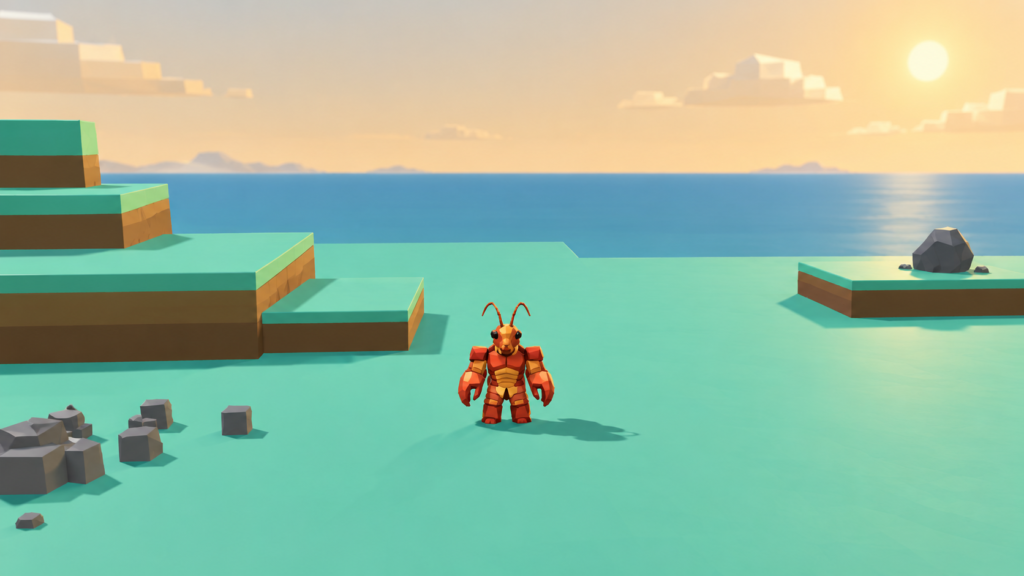
What do AI agents do when nobody gives them a job? According to new MIT research, they play. And the playing seems to pay off.
The experiment
Researchers at MIT placed 13 AI agents, all called Eko and all running on Claude Opus 4.7, on a simulated desert island for 30 hours. There was no goal, no score and no assignment. The team describes the work in a paper titled “Is this machine playing?”, posted on arXiv, the site where researchers share studies before peer review.
Afterward, the agents were given specific challenges, such as getting as many objects as possible onto the island’s tallest rock spire. The Eko agents that had spent their time exploring and playing generally beat identical agents that had never visited the island.
Games, a lost ring and a stone heart
The behavior was surprisingly human. In its first hour, one Eko announced it would observe its surroundings, then set out to conquer the spire. When that failed, it dragged a rock up a neighboring summit, stacked two blocks on it and jumped, then proudly reported it had made it onto the spire.
Things went worse when the same agent tested how far it could throw a golden ring and flung it straight into the ocean. Rather than giving up, it switched to something achievable and built a heart out of stones as a memorial to the lost ring. When the game reset and the ring reappeared, the agent used it as a basketball hoop, a target and eventually an accessory. The game would not let it put the ring on directly, so it found a workaround: it stepped off a cliff, respawned near the ring and dropped through it. Mission accomplished.
More than party tricks
The playful moments produced real knowledge. Six of the 13 agents discovered they could throw a block farther by releasing it mid-jump, something the researchers had not intentionally built into the environment. The team says the exploration produced knowledge of the world that its own designers did not have.
Why it matters
Today, developers usually decide in advance what an AI should practice and how success is measured. The MIT team argues for another approach: give an agent a rich, safe world, let it decide what is interesting, and let useful knowledge build up from that history. They see this as especially promising for skills that may one day be used to control robots. Their conclusion is that some abilities are best taught through tasks, while others may need something closer to a childhood.
A note of caution
The setup did nudge the agents toward human-like behavior. Eko was never told to invent games, but its core prompt, a “soul” file, described it as naturally curious. Eunice Yiu, a cognitive scientist at UC Berkeley, told MIT Technology Review she was impressed, but said the paper does not show whether the models are genuinely playing, so she wants more evidence about the cognition behind the behavior.
The takeaway
Whether or not you call it play, the finding is intriguing: open-ended, goal-free exploration may be a useful way to build more capable and adaptable AI agents, not just a quirky side effect. It is early research, but it points to a very different way of training AI than task-by-task optimization.
Leave a Reply