Three seconds. That’s roughly all the audio a modern AI system needs to build a usable clone of someone’s voice in 2026 — not a rough approximation, but something that can reproduce tone, accent, pacing, and emotional nuance well enough that listeners often can’t reliably tell it apart from the real person, especially over a phone line. That single fact has reshaped everything from marketing production to bank fraud detection this year.
Here’s where the technology actually stands.
The technical leap: from “sounds synthetic” to “sounds like a real recording”
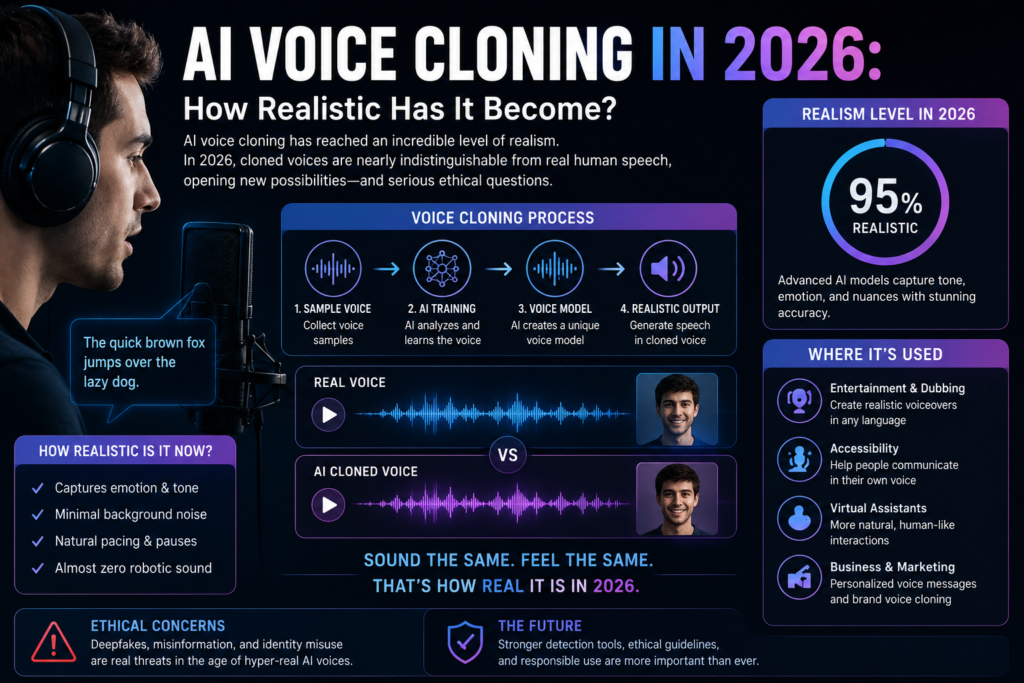
The core shift in 2026 is described consistently across the industry: the gap between synthetic and human speech has crossed into imperceptible territory for most casual listening conditions. This didn’t happen suddenly — it’s the result of a few specific technical advances converging:
- Zero-shot cloning now works from remarkably little source audio — as short as 3 to 10 seconds — without any additional fine-tuning. Tools like ElevenLabs Voice Design, OpenAI’s voice synthesis, and open-source models such as YourTTS, StyleTTS2, and E2/F5-TTS can all produce convincing clones from a minimal sample.
- Emotional prosody control — the ability to direct not just what a cloned voice says but how it says it, with genuine emotional inflection — has gone from a research curiosity to a standard, adjustable parameter available through ordinary APIs.
- Regional accent control has gotten notably more precise. Systems can now render fine-grained accent variation within a language — US Southern versus UK Received Pronunciation versus Australian English, for instance — sometimes controllable just by describing the accent in a text prompt.
- Real-time, speech-to-speech models — like OpenAI’s Advanced Voice Mode — now skip the intermediate text-to-speech conversion step entirely, which noticeably improves conversational rhythm and reduces the slightly stilted cadence older systems had.
One data point puts the raw accuracy in concrete terms: research from McAfee found that just three seconds of audio can produce an 85% voice match to the original speaker — and that 53% of adults share their voice online on a weekly basis, meaning most people already have more than enough public audio for a clone to be built from, whether they intended to provide it or not.
Where this technology is actually being used
The legitimate use cases have expanded well beyond the novelty phase:
- Content and marketing production. Brands, podcasters, and video creators are using cloned or synthetic voices to produce scalable voiceovers without repeated studio recording sessions — increasingly paired directly with AI video generation tools for full automated ad production.
- Corporate training and e-learning. Trainers can record a short voice sample once and have their own voice narrate every course module going forward, preserving the personal, recognizable quality that makes instructional content land better than a generic narrator.
- Accessibility and language preservation. Voice cloning is helping visually impaired users interact with familiar, human-sounding AI voices, and is being used by some communities to digitally preserve endangered languages and authentic speech patterns that might otherwise be lost.
- Call centers and customer support. AI agents built around a cloned voice — often based on a company’s top-performing human agent — are increasingly handling tier-one support at a fraction of the per-call cost of outsourced human staffing, running 24/7 in a consistent tone.
- Real-time dubbing and translation. Live translation for meetings, webinars, and broadcasts can now preserve the original speaker’s actual vocal identity while rendering their words in another language — instead of dubbing over them with a generic translator voice.
- Entertainment and digital performers. Some platforms are building consent-based frameworks — Soundverse’s “Ethical AI Music Framework” is one example — designed to ensure an artist’s cloned voice is used only with attribution and compensation, aiming for a more transparent model than the opaque, ungoverned systems that defined the technology’s earlier years.
The market reflects how fast this has scaled
The global voice cloning market was valued at roughly $2.3 billion in 2025 and is projected to reach $3.1 billion in 2026, with longer-range forecasts pointing toward $31.41 billion by 2035 — a 28% compound annual growth rate. That trajectory reflects a technology that’s moved decisively from research novelty to genuine commercial infrastructure.
The part that matters most: this is also a fraud problem now
The same qualities that make voice cloning useful for legitimate production — speed, minimal source audio, emotional realism — are exactly what make it dangerous in the wrong hands. Security researchers now frame understanding the cloning pipeline as a genuine necessity for fraud analysts and identity verification providers, not just a curiosity for content creators, because the technology has directly reshaped the fraud landscape for banks, call centers, and anyone relying on voice as a form of identity verification.
This connects directly to real, documented scams already circulating — including impersonation schemes where a cloned voice message, appearing to come from a trusted contact or a company executive, is used to pressure someone into an urgent financial transfer. If a request for money or sensitive information arrives as a voice message or call and feels urgent, unusual, or hard to verify in the moment, the safest response is always to hang up and call the person back on a number you already know — never one provided in the suspicious message itself.
Can you still tell the difference?
Increasingly, no — at least not reliably by ear alone. But detection technology is advancing alongside cloning technology, not simply losing the race to it:
- Digital watermarking is being embedded by some platforms directly into generated audio — an invisible, inaudible signal marking the file as synthetic.
- AI-based detection tools are trained specifically to find subtle, unnatural artifacts in cloned audio, often by analyzing a recording’s spectrogram for tell-tale signs of generation that aren’t audible to a human ear.
Neither approach is foolproof, and it’s genuinely an arms race — but it means “AI voices are now undetectable” isn’t quite the full picture. Detection tools exist and are improving; they’re just not something an average listener has quick access to in the middle of a phone call.
The legal and ethical baseline
Across most legitimate platforms and jurisdictions, the standard has converged on a clear principle: cloning someone’s voice without their explicit, informed permission is illegal, not just an ethical gray area. Responsible platforms are increasingly building in consent protocols, transparent data governance, and audit trails specifically to keep commercial use on the right side of that line — a meaningful shift from the far more opaque, permission-optional tools that characterized the technology’s earlier years.
The bottom line
AI voice cloning in 2026 has crossed a genuine threshold: the technical barrier to convincingly replicating almost anyone’s voice from a few seconds of audio is essentially gone. What’s left to sort out isn’t really a technology problem anymore — it’s a legal, ethical, and safety problem, playing out in real time across marketing studios, call centers, and unfortunately, fraud schemes as well. The realism is no longer in question. Where the responsibility, consent, and detection frameworks land is the part still being actively written.
If you’re concerned about voice-based scams targeting yourself or family members, the core protection remains simple and hasn’t changed: never act on an urgent financial request based on a voice message or call alone — verify independently, through a channel the caller doesn’t control, before doing anything.
Leave a Reply