The AI infrastructure race has entered an exciting new phase. At its Advancing AI 2026 event, AMD officially introduced the Helios AI System, its most ambitious AI platform yet. Designed to power massive AI models and next-generation data centers, Helios is aimed directly at Nvidia’s dominance in enterprise AI computing.
But can AMD truly compete with Nvidia, the company that currently powers most of the world’s leading AI models?
Let’s take a closer look.
What Is AMD Helios?
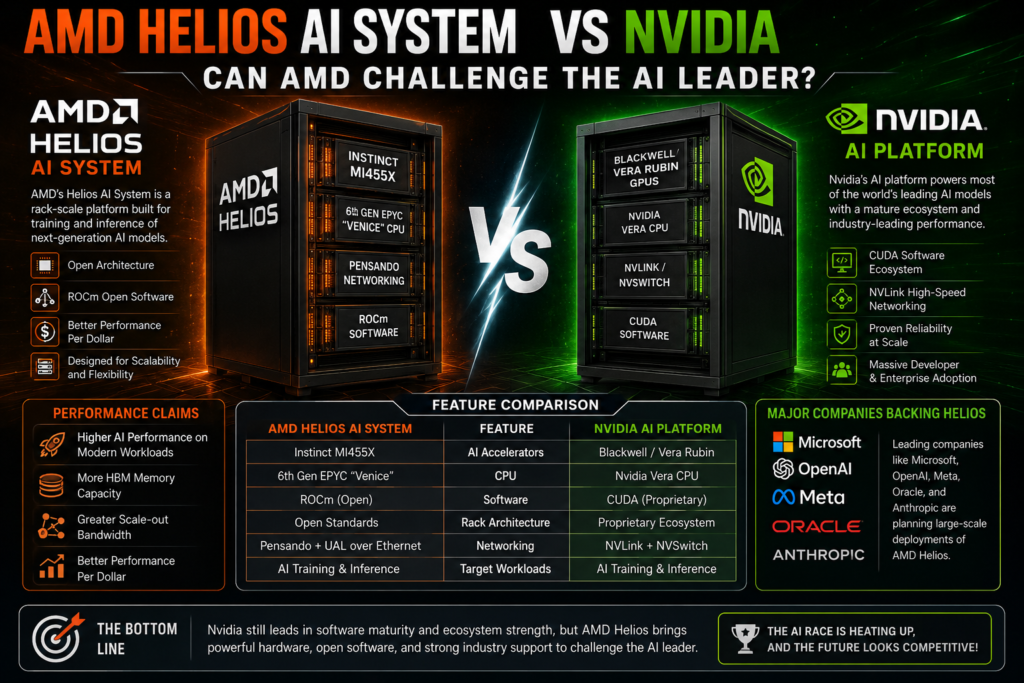
AMD Helios is a rack-scale AI computing platform built for training and running large language models (LLMs) and other advanced AI workloads.
Unlike previous GPU-only offerings, Helios combines:
- AMD Instinct MI455X AI accelerators
- 6th Gen AMD EPYC “Venice” CPUs
- AMD Pensando networking
- Open ROCm AI software ecosystem
- High-speed rack-scale interconnects
The entire platform is engineered to operate as one integrated AI system rather than a collection of separate servers.
Nvidia’s Current AI Leadership
Nvidia remains the clear market leader in AI infrastructure.
Its ecosystem includes:
- Blackwell GPUs
- Vera Rubin architecture
- NVLink networking
- CUDA software platform
- DGX and NVL rack systems
The biggest advantage Nvidia holds isn’t just hardware—it’s the mature software ecosystem that thousands of AI developers already rely on. CUDA has become the industry standard for AI training and inference, making it difficult for competitors to gain market share.
AMD Helios vs Nvidia: Feature Comparison
| Feature | AMD Helios | Nvidia AI Platform |
|---|---|---|
| AI Accelerators | Instinct MI455X | Blackwell / Vera Rubin |
| CPU | EPYC Venice | Nvidia Vera CPU |
| Software | ROCm (Open) | CUDA |
| Rack Architecture | Open standards | Proprietary ecosystem |
| Target Workloads | AI Training & Inference | AI Training & Inference |
| Networking | Pensando + UAL over Ethernet | NVLink + NVSwitch |
Performance Claims
AMD claims Helios delivers significant improvements over competing AI systems.
According to AMD, Helios offers:
- Higher AI performance for modern workloads
- Increased HBM memory capacity
- Greater scale-out networking bandwidth
- Better performance per dollar
- Open architecture for easier deployment
AMD also says Helios can outperform Nvidia’s Vera Rubin rack in several theoretical performance metrics, though independent benchmarking across real-world AI workloads is still limited.
Open Software Could Be AMD’s Biggest Advantage
One of AMD’s biggest selling points is its commitment to open software.
Instead of relying on proprietary CUDA, AMD continues expanding ROCm, an open AI software platform that supports popular machine learning frameworks.
Benefits include:
- Reduced vendor lock-in
- Greater flexibility
- Easier integration across cloud providers
- Open standards for enterprise deployments
This approach appeals to organizations that want more freedom in designing AI infrastructure.
Major Companies Already Backing Helios
AMD has secured support from several major technology companies.
Organizations planning deployments include:
- Microsoft
- OpenAI
- Meta
- Oracle
- Anthropic
Microsoft has announced plans to deploy Helios on Azure for frontier AI inference, while OpenAI is expected to use Helios infrastructure at scale beginning later in 2026.
Why Nvidia Still Has the Advantage
Despite AMD’s impressive hardware, Nvidia continues to hold several important advantages.
Mature Software
CUDA remains the preferred development platform for many AI researchers and enterprises.
Massive Ecosystem
Thousands of AI tools, libraries, and enterprise applications are already optimized for Nvidia GPUs.
Proven Reliability
Most hyperscale AI deployments today still rely heavily on Nvidia hardware.
Broad Customer Base
Cloud providers including AWS, Google Cloud, Microsoft Azure, and Oracle all offer extensive Nvidia GPU services.
These factors make Nvidia difficult to displace, even if competing hardware becomes more competitive.
Where AMD Could Win
AMD doesn’t necessarily need to overtake Nvidia overnight.
Instead, Helios could succeed by offering:
- Lower deployment costs
- Competitive performance
- Open software ecosystem
- Better pricing for hyperscalers
- Reduced dependence on a single vendor
As AI infrastructure spending grows into the trillions of dollars, even capturing a modest share of the market could represent a significant win for AMD.
Can AMD Really Challenge Nvidia?
The short answer is yes—but with important caveats.
AMD has never been stronger in AI infrastructure. Helios combines modern GPUs, powerful CPUs, open networking, and an improving software stack into a comprehensive AI platform. Partnerships with Microsoft, OpenAI, Meta, Oracle, and Anthropic also demonstrate growing confidence in AMD’s AI strategy.
However, Nvidia still leads in software maturity, developer adoption, and the breadth of its AI ecosystem. For many organizations, those advantages remain more valuable than raw hardware specifications.
Final Thoughts
AMD Helios marks the company’s boldest attempt yet to compete in enterprise AI computing. By combining high-performance hardware with an open software ecosystem and backing from major cloud providers, AMD has become a far more credible challenger than in previous years.
While Nvidia remains the dominant force in AI infrastructure, Helios signals that the market is becoming increasingly competitive. Over the next few years, enterprises may benefit from more choice, better pricing, and faster innovation as AMD and Nvidia continue to push the boundaries of AI computing.