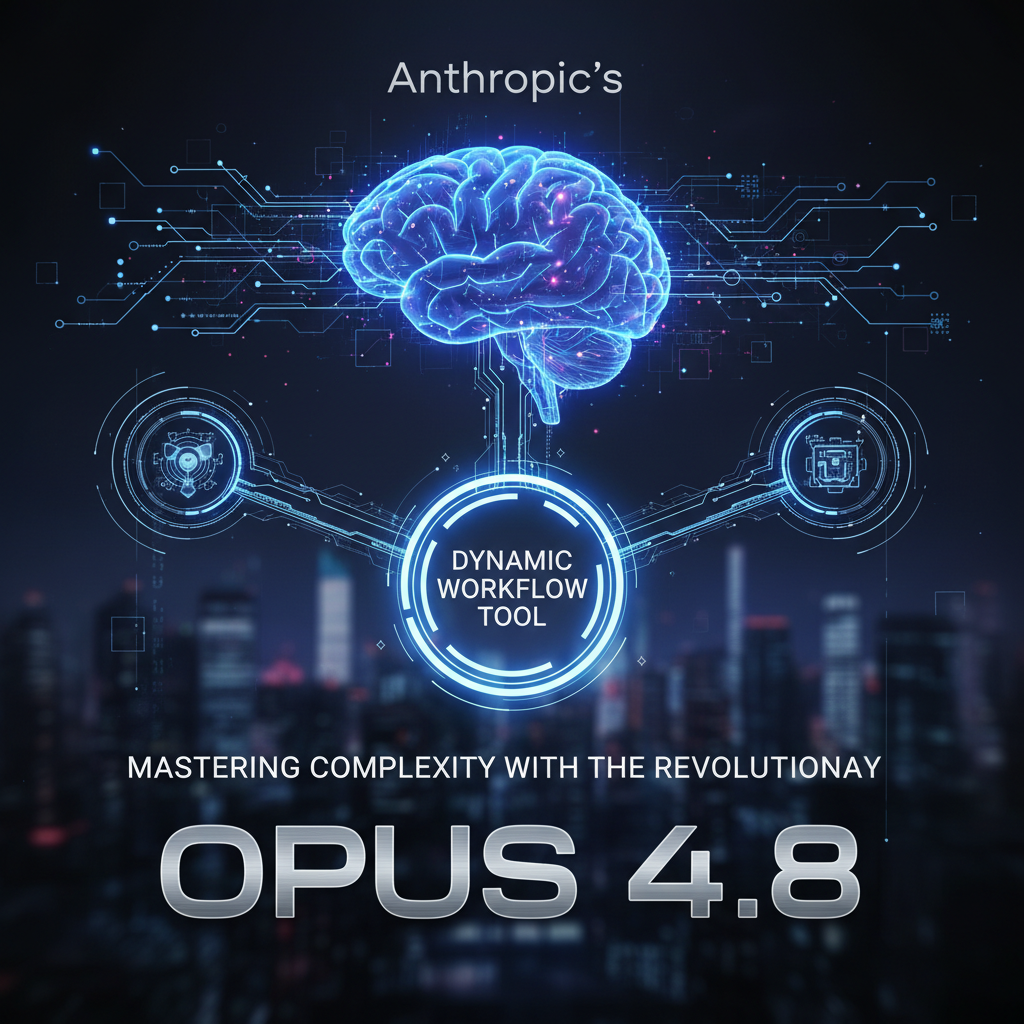
The landscape of Artificial Intelligence is evolving at an unprecedented pace, with leading developers continually pushing the boundaries of what’s possible. In a significant leap forward for enterprise-grade AI, Anthropic has officially unveiled Opus 4.8, an update to its flagship Claude model family, featuring a groundbreaking new capability: the ‘dynamic workflow’ tool. This isn’t just another incremental improvement; it marks a pivotal shift towards more autonomous, adaptable, and reliable AI systems, promising to redefine how businesses leverage intelligent agents.
What is Anthropic Opus 4.8?
Anthropic’s Claude models have established themselves as powerful competitors in the large language model (LLM) arena, known for their safety-first approach and robust performance in complex reasoning tasks. Opus 4.8 represents the latest iteration of their most advanced model, Opus, building upon its already impressive capabilities. While earlier versions excelled at understanding context and generating coherent text, Opus 4.8 is engineered to transcend static responses, venturing into true intelligent task execution.
This update solidifies Anthropic’s commitment to developing frontier AI that is not only intelligent but also practical and trustworthy for sophisticated real-world applications. The core enhancement driving this leap is the innovative ‘dynamic workflow’ tool, designed to tackle multi-step challenges with unparalleled adaptability.
Unlocking Adaptive Intelligence: The ‘Dynamic Workflow’ Tool
At the heart of Opus 4.8’s power lies the ‘dynamic workflow’ tool. Traditionally, AI models excel at single-shot tasks or following predefined, rigid sequences. However, real-world problems are rarely linear. They often require adapting to new information, re-evaluating steps, and even learning from failures—capabilities that have largely eluded AI until now.
The ‘dynamic workflow’ tool empowers Opus 4.8 to:
- Deconstruct Complex Tasks: It can break down an overarching goal into a series of smaller, manageable sub-tasks.
- Plan and Execute Dynamically: Unlike fixed scripts, the AI can intelligently plan the optimal sequence of actions, selecting the right tools or internal processes for each step.
- Self-Correction and Iteration: If a step yields unexpected results or fails, Opus 4.8 can recognize the issue, re-evaluate its strategy, and attempt alternative approaches without explicit human intervention.
- Contextual Adaptability: The workflow isn’t rigid; it adapts based on real-time data and environmental changes, making decisions that are responsive to the current situation.
Essentially, Anthropic has equipped Opus 4.8 with an internal, adaptive project manager, allowing it to navigate intricate processes with a level of autonomy and intelligence previously unseen in commercial LLMs.
Key Benefits for Businesses and Developers
The introduction of the ‘dynamic workflow’ tool in Opus 4.8 brings a host of transformative benefits:
1. Enhanced Automation and Efficiency
Businesses can automate entire multi-step processes that previously required human oversight or complex, brittle rule-based systems. This leads to significant time savings, reduced operational costs, and the freeing up of human resources for higher-value tasks.
2. Unprecedented Reliability and Accuracy
By intelligently breaking down tasks and self-correcting, Opus 4.8 dramatically reduces the likelihood of errors and ‘hallucinations’ in complex sequences. The AI can ensure each step is validated before proceeding, leading to more dependable outcomes.
3. Scalability for Complex Operations
The ability to manage dynamic workflows means Opus 4.8 can tackle increasingly complex and varied challenges without needing extensive re-training or manual adjustments for every new scenario. This makes it a highly scalable solution for growing enterprises.
4. Adaptive Intelligence and Problem-Solving
The model moves beyond mere response generation to proactive problem-solving. It can adapt to unforeseen variables and adjust its approach on the fly, making it a more robust and valuable asset in dynamic business environments.
Real-World Applications of Dynamic Workflow
The practical implications of Opus 4.8 with its dynamic workflow are vast and span across numerous industries:
-
Automated Customer Support Agents
Imagine an AI agent that doesn’t just answer FAQs but can diagnose a complex technical issue, access various internal databases, troubleshoot solutions, guide a customer through steps, and even escalate to a human only when necessary—all while adapting to the customer’s unique responses.
-
Intelligent Data Analysis and Reporting
Opus 4.8 could be tasked with analyzing vast datasets, identifying trends, generating detailed reports, and even creating follow-up queries or visual representations based on the initial findings, without needing a rigid script for every potential outcome.
-
Advanced Content Creation and Optimization
Beyond generating simple articles, the AI could research a topic, outline a full marketing campaign, draft content variations for different platforms, optimize for SEO, and then refine based on simulated audience feedback, all within a dynamic, iterative process.
-
Streamlined Software Development
Developers could use Opus 4.8 to analyze code, identify bugs, suggest fixes, generate test cases, and even refactor sections of code, dynamically adjusting its approach based on the codebase’s specific challenges and programming language.
-
Personalized Education and Training
An AI tutor powered by dynamic workflow could assess a student’s learning style and knowledge gaps, dynamically generate personalized lesson plans, provide targeted exercises, and adapt its teaching methods based on the student’s progress and difficulties.
Anthropic’s Strategic Position in the AI Race
With Opus 4.8 and the dynamic workflow tool, Anthropic is making a strong statement in the competitive AI landscape. This advancement positions Claude not just as a powerful LLM for text generation and reasoning, but as a sophisticated AI agent capable of orchestrating complex, multi-faceted tasks with intelligent autonomy. It signifies a move towards more generalist AI systems that can truly act as digital collaborators across various professional domains.
Embrace the Future of AI with Opus 4.8
The release of Anthropic’s Opus 4.8 with its revolutionary ‘dynamic workflow’ tool is more than just an update; it’s an invitation to rethink the possibilities of AI automation. For businesses and developers eager to unlock new levels of efficiency, reliability, and intelligent problem-solving, exploring Opus 4.8 is a crucial next step.
As AI continues its rapid evolution, tools like ‘dynamic workflow’ will be instrumental in bridging the gap between theoretical AI capabilities and practical, impactful enterprise solutions. The future of work is becoming increasingly intelligent, and Anthropic’s latest offering is a powerful testament to that transformation.
Leave a Reply