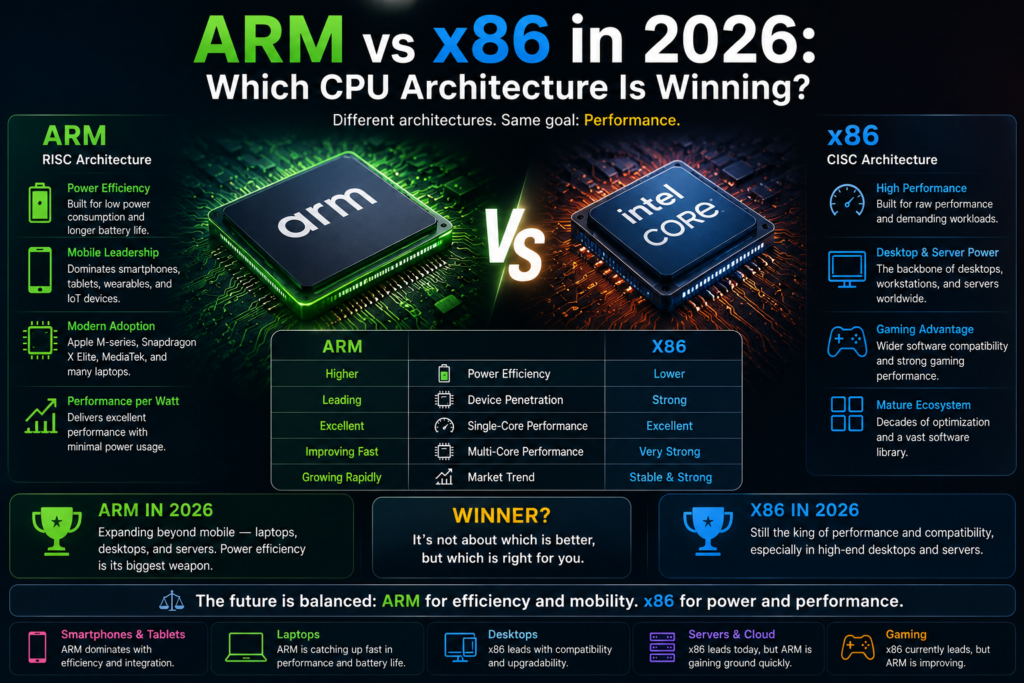
Ask an ARM advocate and an x86 loyalist this question and you’ll get two completely different, equally defensible answers — because both sides are, in their own way, correct. Rather than another market-by-market data dump, here’s the case each side would actually make, and an honest verdict on who has the stronger argument right now.
The case for ARM
“We’re winning where the growth actually is.” ARM’s advocates would point to the fact that nearly every fast-growing segment of computing in 2026 is trending their way. ARM-based server CPU shipments nearly doubled year-over-year, driven by AI infrastructure demand — and on the revenue side, ARM-based servers now capture over 45% of data center market revenue, powered heavily by Nvidia’s Grace CPUs paired with Blackwell AI systems. Nvidia alone is on track to ship roughly 4 million CPUs in 2026. When the highest-value, fastest-growing part of the entire computing market is choosing ARM, unit share numbers elsewhere start to look like a lagging indicator, not the real story.
“Look what we did to the laptop market in five years.” Apple Silicon went from a standing start in November 2020 to a laptop market share now rivaling AMD’s — a company that’s been building x86 laptop chips for decades. That’s not a fluke; it’s proof the architecture can compete directly on performance and efficiency at the high end, not just win on power savings in phones.
“Qualcomm just proved it again.” The Snapdragon X2 Elite, launched in April 2026, posted benchmark results that reportedly outpaced Intel’s own flagship Panther Lake chip — with reviewers calling it “a genuine problem for x86.” Canalys projects ARM-based PCs could reach 30% of the total PC market by the end of 2026, up from roughly 13% just a year prior. The momentum is real and it’s accelerating.
The case for x86
“We still ship more computers, period.” For all of ARM’s growth-curve bragging rights, x86 remains the dominant architecture by raw unit volume across both servers and PCs. ARM-based servers, even after nearly doubling, sit at just 13.2% of server unit shipments. Momentum is a story about direction, not a story about who’s actually ahead today — and today, x86 is still ahead almost everywhere except phones.
“Software compatibility isn’t a minor detail — it’s the whole game.” Even Qualcomm’s biggest boosters concede the same point every time: Windows-on-ARM’s greatest weakness isn’t the silicon, it’s the ecosystem. Microsoft’s Prism emulation layer has improved substantially, but performance under emulation still meaningfully trails native execution, and the availability of natively-compiled ARM software remains the most commonly cited reason buyers hesitate. Four decades of x86 software — enterprise tools, PC games, niche professional applications — doesn’t disappear because a new chip wins a benchmark.
“We’re not standing still either.” AMD just posted its highest-ever x86 market share, at 32.6%, gaining nearly 6 percentage points in a single year largely at Intel’s expense — proof the x86 side of the house is still innovating hard and competing on its own terms, not just defending old ground. AMD’s EPYC server chips alone now claim over 33% of x86 server shipments. The competitive intensity inside x86 is arguably higher right now than the ARM-vs-x86 framing gives it credit for.
“The AI story cuts both ways.” Server processor demand overall increased roughly 10% year-over-year in early 2026, and a meaningful chunk of that is x86 growth too — agentic AI systems benefit from high CPU performance broadly, not exclusively from ARM designs. Intel has actually shifted production capacity toward servers to meet this demand, which is part of why laptop supply has tightened — a sign x86 is very much still fighting for, and winning, real AI-driven demand.
Where the debate actually gets settled: efficiency vs. compatibility
Strip away the market share sparring, and the real disagreement is philosophical. ARM’s core promise has always been power efficiency and purpose-built design — chips engineered from the ground up for a specific workload, whether that’s a phone, a laptop, or now an AI server rack. x86’s core promise has always been universal compatibility — one instruction set that runs four decades of accumulated software without asking questions.
In 2026, both promises are being tested simultaneously. ARM is proving it can scale up into workloads (high-performance laptops, AI-optimized servers) that used to be x86’s exclusive territory. x86 is proving that raw compatibility and an enormous existing software base are still worth more to a huge number of buyers than a benchmark win or a longer battery life claim.
The verdict
If this were a courtroom, the honest ruling would be: ARM wins on the evidence of where things are headed; x86 wins on the evidence of where things currently stand. Neither side has a knockout argument yet. ARM’s case is genuinely stronger than it’s ever been — the growth curves, the AI server win, and the laptop momentum are all real and hard to argue with. But x86’s case isn’t collapsing either — AMD is thriving, Intel still leads by a wide margin in raw share, and the compatibility moat that’s protected x86 for 40 years hasn’t actually been breached, just pressured.
The most honest answer to “which is winning” in 2026 isn’t a name — it’s a direction. ARM is winning the argument about the future. x86 is still winning the argument about right now. How long that gap holds is the real question worth watching heading into 2027.
Leave a Reply