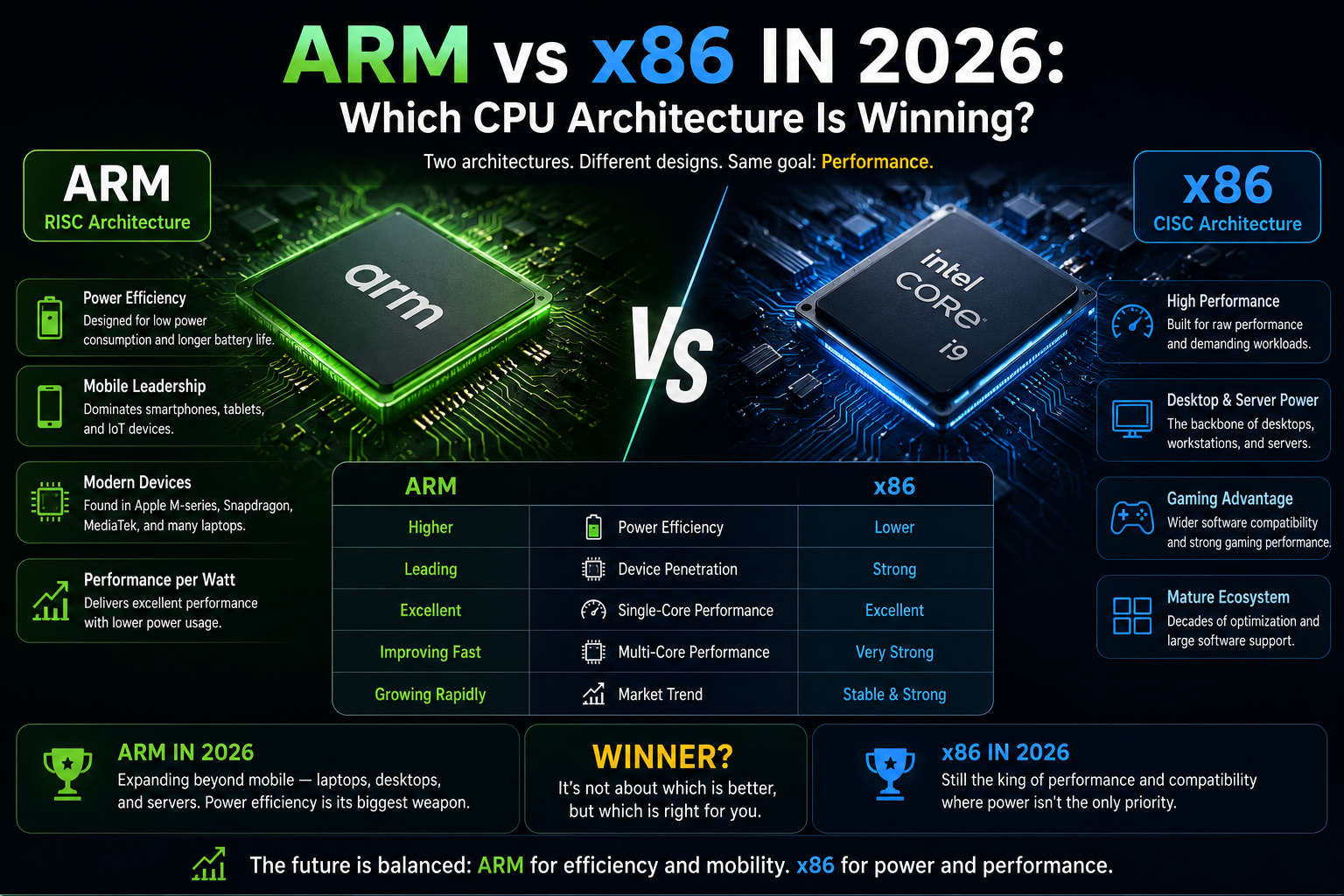
For most of the last two decades, this wasn’t really a debate — x86 ran your PC and your server, ARM ran your phone, and the two rarely competed for the same buyer. That structure is genuinely gone in 2026. Four architectures are now realistically competing for the same laptop purchase, ARM has broken into the server market in a way that would have sounded implausible five years ago, and even a third contender, RISC-V, has quietly become relevant enough to mention. Here’s an honest read on who’s actually winning, broken out by where the fight is actually happening.
The short answer: it depends which market you’re asking about
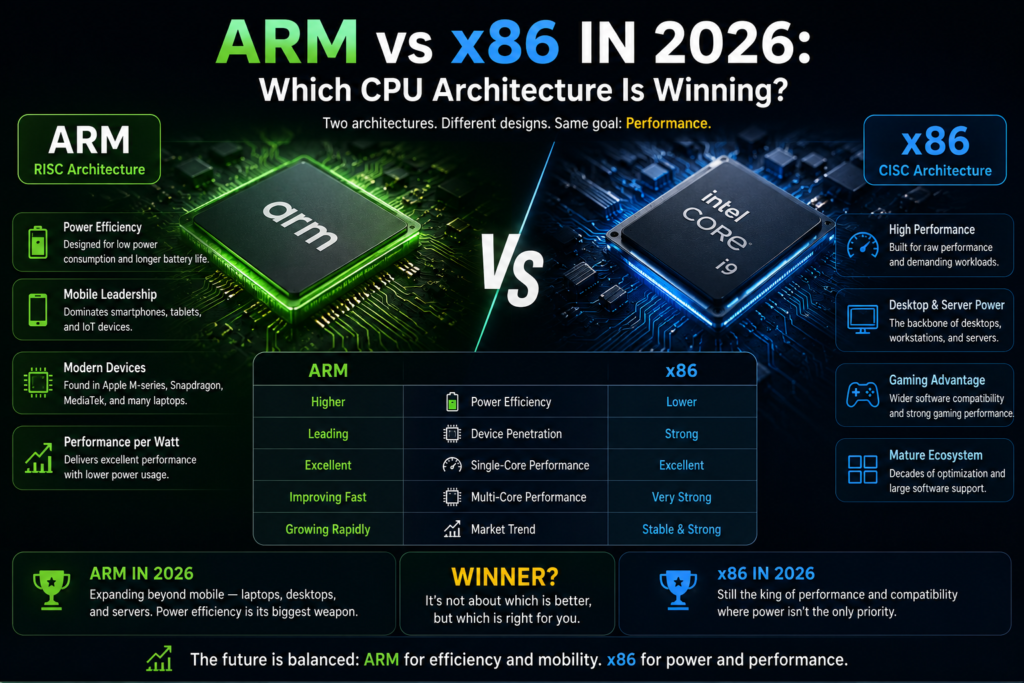
There’s no single winner in 2026 because “CPU architecture” isn’t one market anymore — it’s at least three separate ones (servers, laptops/desktops, and mobile/embedded), and ARM and x86 are trending in opposite directions depending on which one you look at.
Servers: x86 still leads, but ARM’s growth curve is real
In raw unit share, x86 remains dominant in servers — but the trendlines matter more than the current snapshot. ARM-based server CPU shipments nearly doubled year-over-year in early 2026, driven heavily by demand for AI infrastructure. Even with that surge, ARM-based server CPUs represent a moderate 13.2% share of total server processor unit volume — climbing, but from a small base, and growing more slowly than the headline shipment numbers suggest because x86 server volumes are also rising strongly at the same time.
But unit share tells only part of the story. On the revenue side, one analysis found ARM-based servers now capture over 45% of data center market revenue, largely fueled by GPU clusters and high-end AI infrastructure — most notably Nvidia’s “Grace” ARM CPUs paired with Blackwell systems like the NVL72. Nvidia alone is on track to ship roughly 4 million CPUs in 2026. That gap between unit share and revenue share is the real story: ARM is winning disproportionately in the highest-value, AI-driven segment of the data center market, even while x86 still ships more total units.
Within x86 itself, there’s also a real shakeup underway. AMD hit a record 32.6% share of the overall x86 CPU market in Q1 2026, up from 27.1% a year earlier, with its EPYC server chips reaching 33.2% of x86 server shipments — a notable dent in what used to be overwhelming Intel dominance. Intel still leads x86 overall at 67.4%, but that’s down from 72.9% a year ago.
Laptops and desktops: the most competitive it’s been in 20 years
This is where the architecture story has changed the most for ordinary buyers. As one industry analysis put it, the “Intel or AMD, with Qualcomm on the periphery” framework that defined Windows laptops for years is simply gone. Four legitimate architectures — Apple Silicon, Intel, AMD, and Qualcomm’s Snapdragon X series — are now competing for the same buyer, each with real strengths and no single one dominating every use case.
Apple Silicon has made the most striking gains of the group. Five years after Apple’s shift away from Intel began in November 2020, Apple Silicon’s laptop market share (per Mercury Research data) now sits close to AMD’s long-established laptop share — both hovering in the high-teens to low-20% range, a genuinely remarkable outcome for a from-scratch architecture transition.
Qualcomm’s Snapdragon X series is the newer, faster-moving story. The second-generation Snapdragon X2 Elite launched in April 2026 to strong reviews, with an 18-core design, up to 80 TOPS NPU performance, and benchmarks that reportedly outpaced Intel’s latest Panther Lake flagship — described by multiple outlets as “a genuine problem for x86.” Canalys projects ARM-based PCs could capture up to 30% of the total PC market by the end of 2026, up from roughly 13% in 2025 — though that figure includes Macs and ARM Chromebooks, not just Windows-on-ARM devices specifically, which remain a smaller (if fast-growing) slice on their own.
The catch for ARM on Windows remains software, not silicon. Microsoft’s Prism emulation layer, which lets Windows-on-ARM devices run legacy x86 software, has improved substantially — but performance under emulation still meaningfully trails native execution, and software availability remains the most commonly cited friction point for buyers considering the switch.
AMD and Intel aren’t standing still either. AMD pushed past 35% of x86 CPU revenue share in desktop and laptop markets combined earlier in 2026, while Intel has focused on shoring up its desktop position and shifting production capacity toward the surging server market — partly explaining recent supply constraints on the laptop side.
Mobile and embedded: ARM’s home turf, largely uncontested
This part of the story hasn’t changed much, and doesn’t need to — ARM has dominated smartphones and embedded/IoT devices for well over a decade, and x86 has never seriously threatened that position. This remains the one battlefield where the outcome isn’t really in question.
The wildcard nobody was watching closely until recently: RISC-V
A third open-source architecture, RISC-V, has quietly built enough momentum in 2026 that some analysts now describe the field as a genuine three-way contest rather than a strict ARM-versus-x86 duopoly — with one estimate putting RISC-V’s aggregate share (spanning application processors, microcontrollers, and embedded use cases) at roughly 25%. It’s still a minority player specifically in high-performance application CPUs, but it’s gaining real ground in automotive (Infineon has committed to it for next-generation vehicle microcontrollers), edge AI inference, and some consumer devices — including products like the Framework laptop’s DC-ROMA II module and Amazfit’s T-Rex 3 Pro, which has reportedly shipped over a million units.
So, which one is actually winning?
If you force a single answer: ARM is winning the momentum battle, x86 is winning the installed base battle. ARM’s growth curve is steeper in nearly every segment that matters right now — AI-driven server revenue, laptop market share, and NPU-driven efficiency gains that align with where computing demand is actually heading. x86 still ships more total units almost everywhere except mobile, and legacy software compatibility remains a real, unresolved advantage that isn’t disappearing anytime soon.
The more useful way to frame 2026 isn’t “which architecture won” — it’s that the assumption of x86 default dominance, which held for roughly 40 years, is now genuinely being tested for the first time since the PC era began. Whether that becomes a full changing of the guard or settles into a durable multi-architecture split depends heavily on how fast Windows-on-ARM software support catches up to the hardware — and how well x86 can keep proving to hyperscalers that it belongs in the AI-driven data centers currently pulling ARM’s growth curve upward.
Leave a Reply