
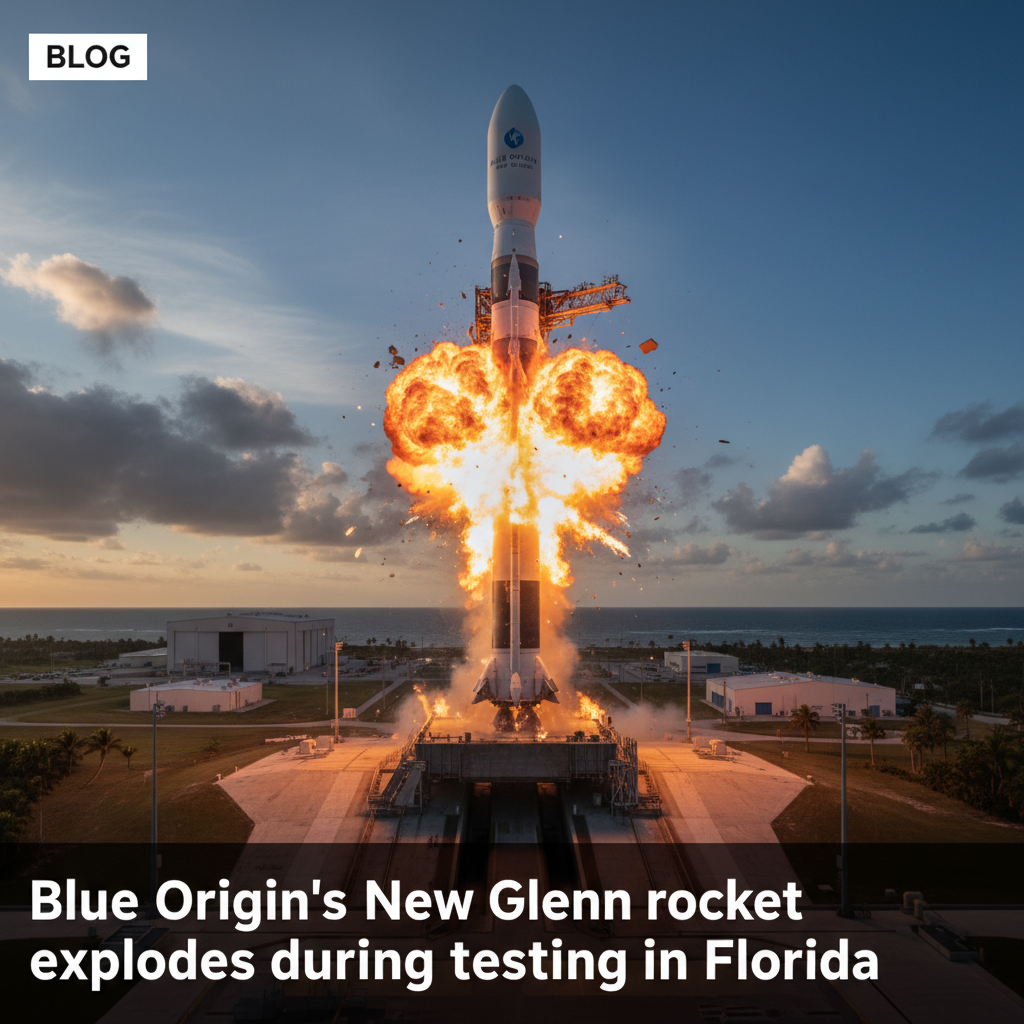
CAPE CANAVERAL, FL – May 28, 2026 – A significant setback has rocked the private space industry today as Blue Origin’s much-anticipated New Glenn heavy-lift rocket reportedly exploded during a critical test firing at Launch Complex 36 at Cape Canaveral Space Force Station in Florida. The incident, which occurred earlier this afternoon, has sent shockwaves through Blue Origin and the broader aerospace community, raising immediate questions about the future of the program.
What Happened? Eyewitness Accounts and Initial Reports
While official statements from Blue Origin remain forthcoming, eyewitnesses in the vicinity reported hearing a thunderous explosion followed by a large plume of smoke visible for miles across the Florida coast. Initial, unconfirmed reports suggest the incident took place during a complex static fire test of the New Glenn’s BE-4 engines on its first stage, a crucial step before any maiden orbital flight attempt.
Emergency services were reportedly dispatched to the scene, though there are no immediate confirmed reports of casualties. The extent of the damage to the launch complex and surrounding infrastructure is currently unknown, but is expected to be substantial given the sheer power of the New Glenn vehicle.
The New Glenn Program: Ambition Meets Reality
Blue Origin, founded by Amazon CEO Jeff Bezos, has positioned the New Glenn as its flagship orbital launch vehicle, designed to compete directly with SpaceX’s Falcon Heavy and Starship, as well as ULA’s Vulcan Centaur. With its reusable first stage and immense payload capacity, New Glenn was intended to deliver satellites to various orbits, facilitate deep-space missions, and eventually support Blue Origin’s vision for human spaceflight and a future where millions of people live and work in space.
The development of New Glenn has been a marathon, marked by technical challenges, engine development hurdles (specifically the BE-4, which also powers ULA’s Vulcan), and schedule adjustments. This incident represents by far the most significant public failure in the program’s history.
The Immediate Aftermath and Safety Concerns
The safety of personnel on site is paramount, and it is understood that standard protocols for high-risk testing would have been in place. However, the sheer destructive power of a fully fueled rocket means that even with precautions, such events carry inherent dangers.
Beyond immediate safety, the explosion raises serious environmental concerns due to potential propellants and debris scattered across the launch site and surrounding areas. Cleanup and environmental assessment will be a lengthy and complex process.
What This Means for Blue Origin and the Space Industry
This catastrophic failure is a crushing blow to Blue Origin’s aspirations and could lead to significant delays, potentially pushing back the New Glenn’s debut by years. The financial implications will be substantial, encompassing the cost of the lost hardware, damage to the launch facility, and the expenses of a protracted investigation. Furthermore, this incident could impact Blue Origin’s competitive standing in the increasingly fierce commercial space race, potentially eroding investor and customer confidence.
For the wider space industry, while acknowledging the inherent risks of rocket development, this serves as a stark reminder of the unforgiving nature of spaceflight. Every successful launch vehicle is built upon a foundation of countless tests, failures, and lessons learned. The industry will be watching closely to understand the root cause and how Blue Origin responds.
The Road Ahead: Investigations and Resilience
A comprehensive investigation, likely involving the Federal Aviation Administration (FAA) and other regulatory bodies, will commence immediately. This probe will aim to identify the exact cause of the explosion, whether it was a component failure, a software anomaly, human error, or a combination of factors.
Blue Origin faces a formidable challenge to recover from this setback. The company’s commitment to safety, transparency, and its ability to learn from this failure will be critical in determining its long-term trajectory. Despite the severe blow, the history of aerospace is replete with companies that have faced and overcome similar—or even greater—challenges, ultimately emerging stronger. The journey to make space accessible remains a testament to human ingenuity and perseverance, even in the face of such dramatic setbacks.
Stay tuned to TechCrunch for ongoing updates as more official information becomes available regarding this developing story.