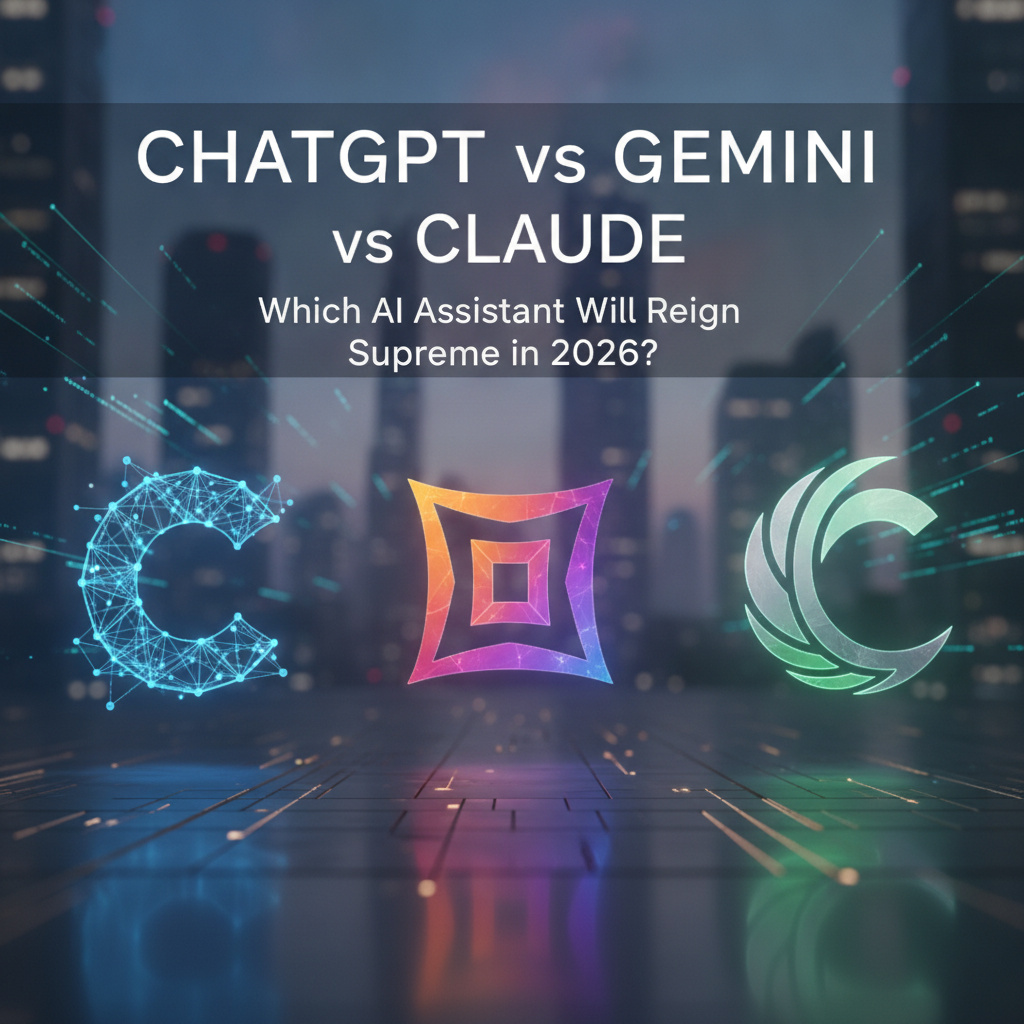
The artificial intelligence landscape is evolving at an unprecedented pace. What seems cutting-edge today can feel rudimentary tomorrow. As we hurtle towards 2026, the race among the titans – OpenAI’s ChatGPT, Google’s Gemini, and Anthropic’s Claude – promises to deliver advancements that will fundamentally reshape how we interact with technology. But with each vying for dominance, which AI assistant is truly poised to be the best for your needs in two short years?
This article dives deep into the projected trajectories of these three leading AI models, comparing their strengths, anticipated developments, and potential weaknesses to help you understand which will likely excel in various domains by 2026.
The Contenders: A Glimpse into Their Future Selves
Before we pit them against each other, let’s briefly forecast the strategic directions each platform is likely to take by 2026.
ChatGPT (OpenAI): The Generalist Innovator
- Current Foundation: Known for its exceptional conversational abilities, creative text generation, and a vast ecosystem of plugins and custom GPTs.
- Projected 2026 Evolution: Expect profound advancements in reasoning capabilities, making it more adept at complex problem-solving. Its multimodal capabilities will likely integrate seamlessly across various input types (text, voice, image, video) with enhanced real-time processing. OpenAI’s continued focus on democratizing AI means more accessible, powerful versions, potentially with greater personalization and autonomous agent-like features. Enterprise solutions will mature, offering robust, tailored AI deployments.
Gemini (Google): The Multimodal Integrator
- Current Foundation: Designed from the ground up as a multimodal model, excelling at understanding and generating content across different data types simultaneously. Deeply integrated with Google’s vast information ecosystem.
- Projected 2026 Evolution: Gemini will likely leverage Google’s unparalleled data and research capabilities to become a master of real-time information processing and complex, multi-step tasks. Its integration across Google products (Workspace, Android, Search) will become even more seamless, acting as a ubiquitous intelligent layer. Expect significant strides in physical world interaction (robotics, ambient computing) and highly contextual reasoning based on user activity and environment.
Claude (Anthropic): The Ethical Powerhouse
- Current Foundation: Distinguished by its commitment to safety, constitutional AI principles, and an impressive context window, making it excellent for processing lengthy documents and maintaining nuanced conversations.
- Projected 2026 Evolution: Claude will likely solidify its position as the go-to AI for sensitive applications requiring high levels of ethical reasoning, transparency, and safety. Its long context window will continue to expand, enabling mastery over entire databases of information. Expect specialized versions tailored for industries like legal, healthcare, and finance, where reliability, interpretability, and adherence to strict guidelines are paramount. Enhanced conversational depth and reduced hallucination will be key focuses.
The Battleground: Key Comparison Categories for 2026
Now, let’s predict how these AI giants will stack up in crucial areas by 2026.
1. Reasoning and Problem Solving
- ChatGPT: Strong general-purpose reasoning, excellent at creative problem-solving and generating multiple approaches. Will likely excel in complex, novel tasks where abstract thinking is required.
- Gemini: Exceptional at analytical and logical reasoning, especially when tied to real-world data and multi-step processes. Its ability to process information across modalities simultaneously will give it an edge in tasks requiring diverse inputs (e.g., analyzing a video, transcript, and data sheet).
- Claude: Will likely shine in nuanced, ethical, and long-form reasoning. Ideal for legal analysis, policy formulation, and complex ethical dilemmas where understanding subtle implications is critical.
2. Creativity and Content Generation
- ChatGPT: Will remain a powerhouse for diverse creative outputs, from poetry and storytelling to scriptwriting and marketing copy. Its customization options will allow users to fine-tune its creative style.
- Gemini: Excellent for multimodal creative tasks – think generating a cohesive story with accompanying images and music, or editing a video based on text prompts. Its access to Google’s vast creative datasets could give it an advantage.
- Claude: Will likely excel in generating high-quality, long-form creative content that requires consistency, depth, and adherence to specific narrative or stylistic guidelines, particularly in professional contexts.
3. Multimodality and Real-World Interaction
- ChatGPT: Will boast robust multimodal capabilities, making it highly versatile for interacting with images, voice, and video. Expected to improve significantly in understanding and generating across these formats.
- Gemini: Designed from the ground up for multimodality, Gemini is likely to be the undisputed leader here. Its ability to interpret complex real-world scenarios from diverse sensor inputs and respond contextually will be unparalleled, making it ideal for robotics, smart devices, and ambient computing.
- Claude: While also multimodal, Claude’s focus might lean towards ethical interpretation of multimodal inputs, ensuring safety and compliance rather than cutting-edge real-time interaction in dynamic physical environments.
4. Coding and Development
- ChatGPT: Will continue to be a strong general-purpose coding assistant, proficient in many languages, debugging, and generating boilerplates. Its custom GPTs will allow for specialized coding tools.
- Gemini: With Google’s vast developer ecosystem, Gemini will likely excel in generating highly optimized code, performing complex refactoring, and integrating with cloud platforms (GCP). Its ability to understand and generate code from diagrams or specifications will be a significant advantage.
- Claude: Will likely be favored for generating secure, robust, and well-documented code, especially in regulated environments where code reliability and safety are paramount. Its long context could help it manage entire codebases effectively.
5. Safety, Ethics, and Bias Mitigation
- ChatGPT: OpenAI is investing heavily in safety, but its broader applicability means balancing innovation with safeguards. Expect continuous improvements in bias detection and mitigation.
- Gemini: Google’s scale means facing significant challenges in bias, but their research in fairness and transparency will yield advanced mitigation techniques. Their deep learning on diverse data could reduce certain biases.
- Claude: This is Claude’s inherent strength. Anthropic’s constitutional AI approach and focus on alignment mean it will likely be the safest and most ethically aligned AI by 2026, making it invaluable for sensitive applications and industries.
6. Integration and Ecosystem
- ChatGPT: Will continue to expand its vast plugin ecosystem, offering integrations with thousands of third-party apps and services, making it a highly customizable hub.
- Gemini: Its seamless integration across Google’s ubiquitous suite of products (Search, Workspace, Android, Chrome) will make it incredibly powerful and convenient for users embedded in the Google ecosystem.
- Claude: While not as broadly integrated as the others, Claude will likely focus on deep, secure integrations within enterprise environments, particularly those with high compliance requirements.
The Verdict for 2026: No Single Winner, But Clear Leaders in Niches
By 2026, the notion of a single ‘best’ AI assistant will likely be obsolete. Instead, we’ll see each model truly shine in distinct domains:
- Choose ChatGPT if… you need a versatile, highly customizable general-purpose assistant that excels in creative tasks, conversational depth, and a wide array of plugins for diverse needs. It will likely be the go-to for many individual users and businesses seeking broad applicability.
- Choose Gemini if… you are deeply integrated into the Google ecosystem, require superior multimodal capabilities, real-time information processing, and complex analytical reasoning. It will likely dominate in fields requiring dynamic interaction with diverse data streams and real-world environments.
- Choose Claude if… ethical considerations, safety, long-context processing, and nuanced, reliable output are paramount. It will be the preferred choice for regulated industries, critical infrastructure, and applications where trustworthiness and responsible AI behavior are non-negotiable.
The AI landscape in 2026 will be characterized by intense specialization and cross-pollination of ideas. Users and businesses will likely leverage multiple AI assistants, each chosen for its unique strengths to tackle specific problems. The true ‘winner’ will be the one that best adapts to user needs, embraces responsible development, and pushes the boundaries of what’s possible, all while remaining accessible and efficient.
Staying Ahead of the Curve
The journey to 2026 will be filled with rapid advancements. To truly harness the power of these AI assistants, stay curious, experiment with new features, and understand their evolving capabilities. The future of AI is not about finding one ‘best’ tool, but about mastering the symphony of intelligence at our fingertips.