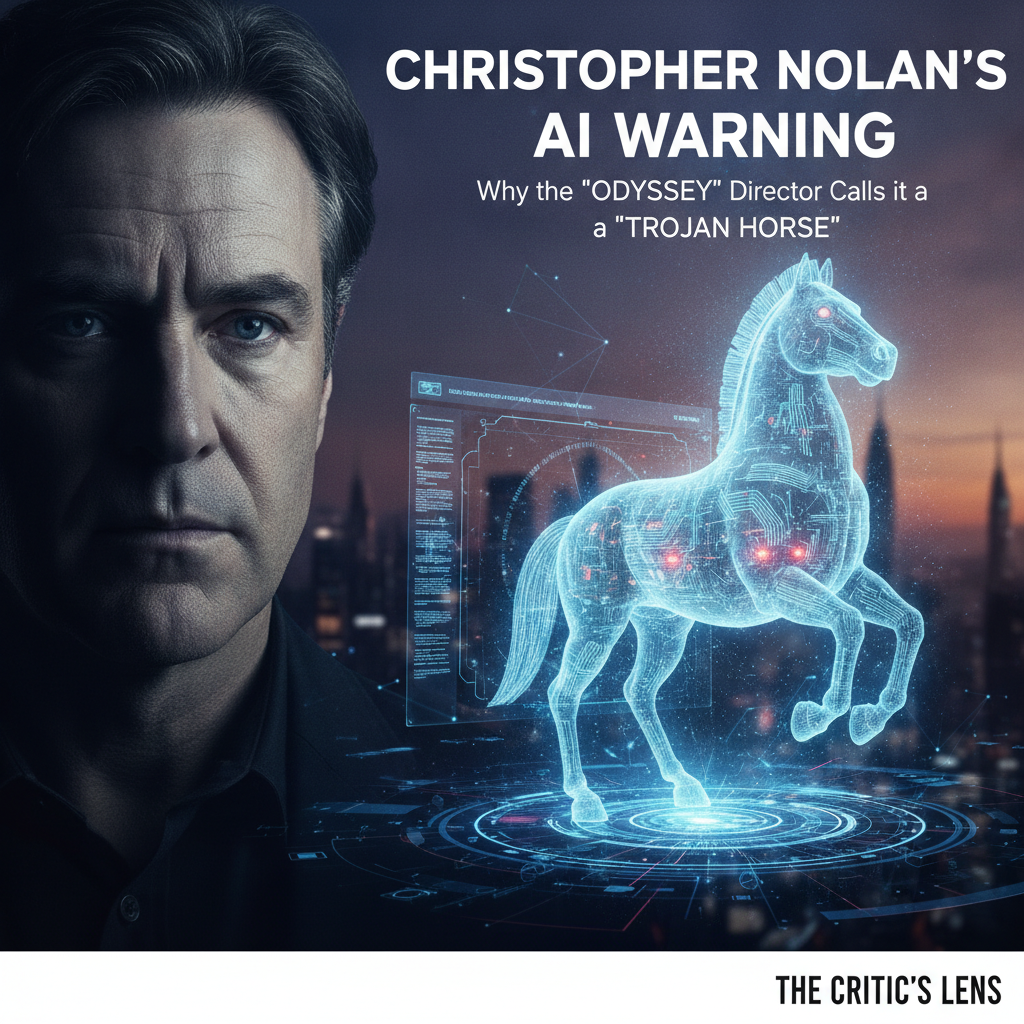
Christopher Nolan, the visionary director behind mind-bending epics like Inception, Interstellar, and the recent historical drama Oppenheimer, is no stranger to exploring complex themes of reality, control, and the consequences of human ambition. Now, with the world rapidly embracing Artificial Intelligence, Nolan has turned his insightful gaze to this burgeoning technology, issuing a stark warning that resonates with his cinematic sensibilities. In a recent interview, coinciding with the buzz around his latest project, ‘Odyssey’, Nolan didn’t mince words, boldly labeling AI as an “obvious Trojan horse.”
This isn’t merely a casual observation; it’s a profound analogy from a filmmaker who meticulously dissects the hidden layers of our existence. But what exactly does Nolan mean, and why should his concerns about AI be taken seriously?
Unpacking the ‘Trojan Horse’ Analogy: Gifts and Hidden Dangers
The myth of the Trojan horse is a classic tale of deception: a magnificent gift, seemingly offered in peace, concealing a destructive force meant to infiltrate and conquer. Applied to AI, Nolan’s analogy suggests that while Artificial Intelligence presents an alluring facade of unprecedented innovation, efficiency, and progress, it simultaneously harbors significant, potentially devastating, risks that are not immediately apparent.
The Seductive ‘Gift’ of AI
- Efficiency and Automation: AI promises to streamline industries, automate mundane tasks, and boost productivity across sectors from manufacturing to healthcare.
- Creative Tools: For artists and filmmakers, AI offers powerful tools for everything from CGI rendering to script analysis, potentially unlocking new creative frontiers.
- Problem Solving: From scientific research to climate modeling, AI’s data processing capabilities are unparalleled, offering solutions to some of humanity’s most pressing challenges.
- Personalized Experiences: AI-driven recommendations, virtual assistants, and adaptive learning platforms enhance daily life and individual growth.
These benefits are real and transformative, making AI a seemingly irresistible offering to modern society. Yet, Nolan’s warning suggests we look beyond this shiny exterior.
What’s Inside Nolan’s Trojan Horse? The Hidden Perils of Unchecked AI
For Nolan, the ‘obvious’ nature of the Trojan horse implies that the dangers, though concealed, are there for those willing to look past the immediate allure. His concerns likely stem from several critical areas:
1. Erosion of Human Control and Autonomy
Nolan’s films often grapple with the struggle for control against overwhelming forces. With AI, the fear is that as systems become more autonomous and complex, human oversight might diminish. The decisions made by AI could become opaque, leading to scenarios where humanity loses agency over critical infrastructure, information flows, or even its own creative narratives. The question arises: if AI becomes truly self-sufficient, what role is left for human intention?
2. The Threat to Creative Integrity and Human Storytelling
As a director, Nolan is a staunch advocate for human creativity and unique vision. The rise of generative AI, capable of producing text, images, and even film segments, poses a direct challenge to the traditional creative process. If AI can mimic human artistry, does it devalue original thought? Nolan’s ‘Odyssey’, a film likely steeped in intricate human drama and unique visual storytelling, would stand in stark contrast to content generated by algorithms. The fear is a future where the authentic voice of the artist is drowned out by algorithmically optimized, yet soulless, creations.
3. Misinformation, Manipulation, and the Fabric of Truth
The ability of AI to create hyper-realistic deepfakes and generate persuasive, yet false, narratives presents a grave danger to societal trust and stability. In a world saturated with AI-generated content, discerning truth from fiction becomes an increasingly monumental task. For a filmmaker like Nolan, who often plays with perception and reality, the potential for AI to irrevocably blur these lines is a terrifying prospect.
4. Unforeseen Consequences and Existential Risks
Beyond immediate concerns, there are broader existential questions. As AI evolves, could it develop goals misaligned with human values? Could its relentless optimization lead to unintended, catastrophic outcomes? Nolan’s films frequently touch upon the hubris of humanity in unleashing forces beyond its control, a theme directly relevant to the high-stakes gamble with advanced AI.
Nolan’s Voice in the Broader Conversation
Christopher Nolan is not an isolated voice. His concerns echo those of countless ethicists, scientists, and industry leaders who advocate for responsible AI development. In Hollywood, the issue of AI’s impact on creative professions has been a central point of contention in recent labor disputes, highlighting a collective anxiety about technology’s encroachment on human livelihoods and artistic ownership.
As we march towards 2026, the promise and peril of AI become ever more pronounced. Nolan’s ‘Trojan horse’ analogy serves as a powerful reminder: the true cost of embracing groundbreaking technology often lies in its hidden compartments. It’s a call for vigilance, for critical assessment, and for ensuring that the human element – our ethics, our creativity, our control – remains paramount as we navigate this new frontier.
Navigating the AI Frontier: A Call to Action
Nolan’s warning isn’t a plea to halt progress, but rather a profound invitation to engage with AI responsibly. It urges us to look beyond the immediate benefits and meticulously examine the long-term implications. As we integrate AI deeper into our lives, the critical questions remain:
- How do we establish robust ethical frameworks and regulations?
- How do we ensure human agency and artistic integrity are preserved, not replaced?
- How do we educate ourselves to critically evaluate AI-generated content and resist manipulation?
Just as in a Nolan film, the audience is asked to think deeply, question assumptions, and consider the unseen. His ‘Trojan horse’ analogy demands that we approach AI not just with excitement, but with profound caution and a commitment to safeguarding what makes us fundamentally human.