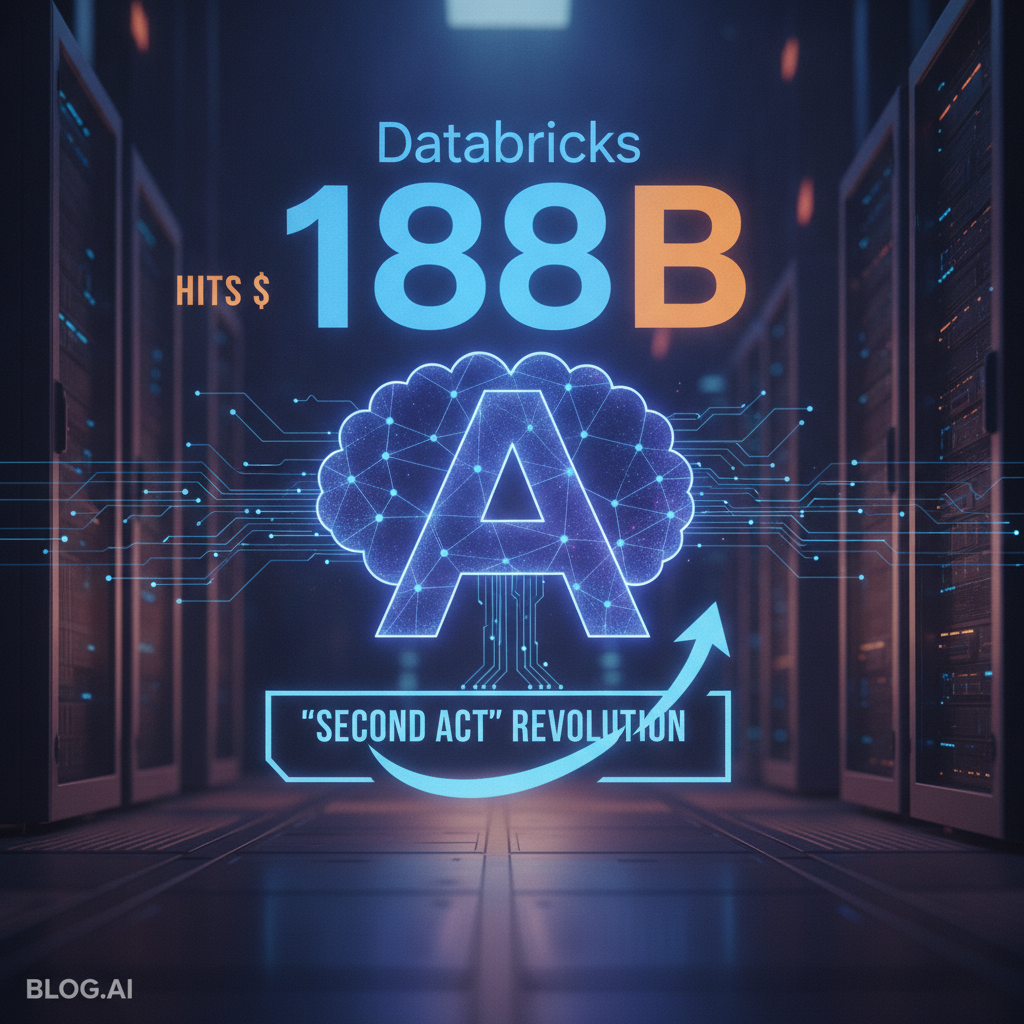
In a move that underscores the deepening value of robust data infrastructure in the age of artificial intelligence, Databricks has officially reached a staggering $188 billion valuation. This monumental milestone, reported on July 17, 2026, firmly establishes Databricks not just as a tech titan, but as the quintessential ‘second act’ in the unfolding drama of AI innovation. While generative AI models capture headlines, it’s the platforms that enable their creation, training, and deployment at scale that are proving to be the true bedrock of future economic growth.
The Ascent of a Data Powerhouse: A Valuation Milestone
The journey to a nearly $200 billion valuation reflects an unparalleled investor confidence in Databricks’ vision and execution. In an era where data is the new oil, and AI the advanced refinery, Databricks has positioned itself as the indispensable pipeline and processing plant. This latest valuation isn’t merely about current revenue; it’s a powerful forward-looking statement on the company’s critical role in the global AI ecosystem.
By 2026, the initial hype cycles surrounding foundational AI models have matured into a practical imperative for enterprises. Businesses globally are no longer asking if they should adopt AI, but how to do so effectively, securely, and at scale. This shift has catapulted companies like Databricks, which provide the underlying architecture and tooling, into stratospheric valuations.
AI’s Essential Second Act: Beyond the Models
What exactly does it mean to be AI’s ‘favorite second act’? It signifies moving beyond the initial excitement of groundbreaking algorithms and large language models (LLMs) to the complex, gritty, and profoundly valuable work of making AI operational and impactful. Databricks excels in this arena, offering a unified platform that addresses the entire AI lifecycle.
The Data Lakehouse Advantage: Unifying Data for AI
At the heart of Databricks’ success is the Data Lakehouse architecture. This innovative approach seamlessly merges the best features of data lakes (scalability, flexibility, raw data storage) and data warehouses (structure, performance, ACID transactions). For AI development, this is a game-changer:
- Eliminating Data Silos: Data scientists and engineers no longer wrestle with fragmented data across disparate systems. All data – structured, semi-structured, and unstructured – resides in one accessible location.
- Enhanced Data Quality: Features like Delta Lake provide reliability, governance, and versioning for data, crucial for training accurate and unbiased AI models.
- Real-time Analytics: The ability to ingest and process data in real-time empowers organizations to build more dynamic and responsive AI applications, from personalized recommendations to fraud detection.
Empowering the AI Lifecycle: From Experimentation to Production
Beyond the lakehouse, Databricks provides a comprehensive suite of tools vital for AI development and MLOps (Machine Learning Operations):
- Apache Spark: Its roots are in big data processing, and it remains the backbone for handling the massive datasets required for modern AI training.
- MLflow: This open-source platform is critical for managing the machine learning lifecycle, tracking experiments, packaging code, and deploying models reliably. It’s the standard for MLOps, ensuring models can be developed, deployed, and monitored efficiently.
- Photon Engine: Databricks’ vectorized query engine, Photon, provides blazing-fast performance, accelerating data processing for AI workloads.
- Generative AI Tools: By 2026, Databricks has further integrated capabilities for fine-tuning and deploying custom generative AI models on proprietary data, allowing enterprises to leverage LLMs securely and effectively without data leakage.
Driving Enterprise AI and Innovation Forward
The $188 billion valuation is a testament to how integral Databricks has become for enterprises across virtually every sector. From financial services and healthcare to manufacturing and retail, companies are relying on Databricks to:
- Democratize Data & AI: Making advanced analytics and machine learning accessible to more users within an organization.
- Accelerate Digital Transformation: Powering data-driven decision-making and automating complex processes.
- Foster Innovation: Providing the platform for data scientists and developers to experiment, build, and deploy next-generation AI applications.
- Ensure Data Governance & Security: Offering robust features like Unity Catalog to manage access, lineage, and compliance for sensitive data used in AI.
What This Means for the Future of AI
Databricks’ valuation underscores a crucial truth: the future of AI is deeply intertwined with the future of data infrastructure. As AI models become more sophisticated and data volumes explode, the demand for scalable, reliable, and performant data and AI platforms will only intensify. This trend suggests:
- Continued Investment in Infrastructure: Expect more capital to flow into companies building the foundational layers for AI.
- Focus on MLOps and Governance: Operationalizing AI responsibly and efficiently will remain a top priority.
- Hybrid and Multi-Cloud Strategies: Platforms that offer flexibility across various cloud environments will maintain a competitive edge.
The Road Ahead: Databricks and the AI Era
Databricks’ journey to a $188 billion valuation is more than just a financial success story; it’s a powerful indicator of where the real value in the AI revolution lies. By focusing on the crucial ‘second act’ – providing the robust, unified, and intelligent data foundation that AI models depend on – Databricks has solidified its position as an indispensable partner for enterprises navigating the complexities and opportunities of artificial intelligence.
As AI continues to evolve, the platforms that enable secure, scalable, and governed data and model management will only grow in strategic importance. Databricks, with its data lakehouse and comprehensive AI platform, is undoubtedly poised to continue extending its run as AI’s favorite second act for years to come.