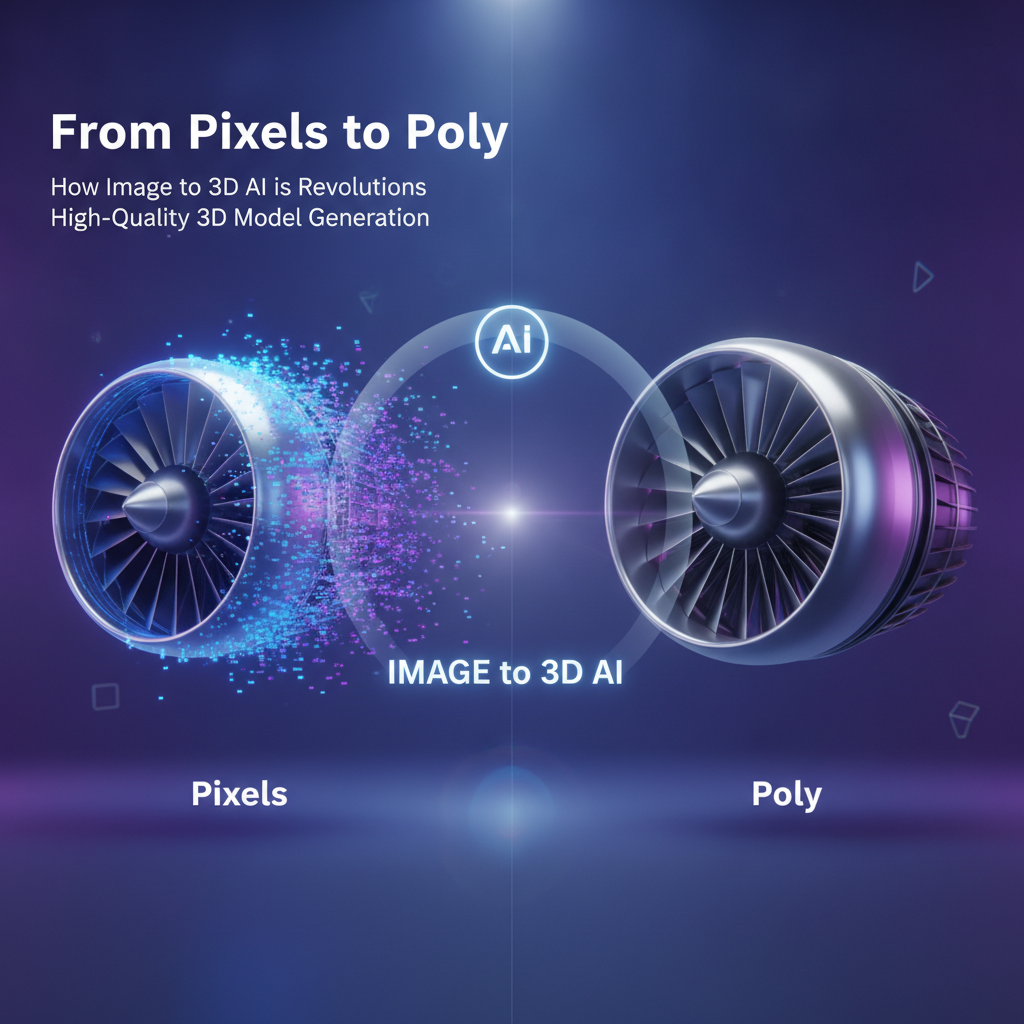
In the vast landscape of digital creation, generating detailed and realistic 3D models has historically been a labor-intensive, time-consuming, and often expensive endeavor. Artists, designers, and developers spend countless hours meticulously crafting every curve and texture. But what if you could bypass much of that complexity, transforming a simple 2D image into a vibrant, high-quality 3D model with unprecedented ease? Enter Image to 3D AI – a groundbreaking technology that’s not just a tool, but a paradigm shift in how we approach 3D design.
This revolutionary artificial intelligence is empowering creators to unlock new dimensions from existing imagery, promising to accelerate workflows and democratize 3D content creation across various industries. Gone are the days when sophisticated 3D modeling was exclusive to a select few; with Image to 3D AI, the power to generate high-quality 3D models is now more accessible than ever before.
What is Image to 3D AI?
At its core, Image to 3D AI refers to advanced artificial intelligence systems designed to interpret one or more 2D images and construct a three-dimensional representation from them. It leverages sophisticated machine learning algorithms, primarily deep learning and computer vision techniques, to understand the depth, form, texture, and spatial relationships within an image. Essentially, it takes a flat picture and intelligently infers how that object or scene would exist in a three-dimensional space.
Unlike traditional photogrammetry, which often requires multiple precisely positioned photos and significant processing, AI-powered solutions can often achieve impressive results from a single image or a small set of casual photos, making the process faster and more user-friendly.
The Magic Behind the Model: How Image to 3D AI Works
While the exact methodologies can vary between different AI models and tools, the general process of converting an image to a 3D model via AI typically involves several intricate steps:
- Input Interpretation: The AI first analyzes the provided 2D image(s), identifying key features, edges, and textures. It tries to understand the object or scene depicted.
- Depth Estimation: Using its trained knowledge base from vast datasets of 2D images and corresponding 3D models, the AI estimates the depth information for each pixel, effectively understanding how far away different parts of the object are.
- Geometric Reconstruction: Based on the estimated depth and learned object structures, the AI then reconstructs a geometric mesh (a network of vertices, edges, and faces) that forms the basic shape of the 3D model.
- Texture Mapping & Refinement: The original 2D image’s visual details, colors, and patterns are then projected onto the newly created 3D mesh, effectively ‘texturing’ the model. Advanced AI might also generate physically based rendering (PBR) materials to enhance realism.
- Output Generation: The final output is typically a standard 3D file format (e.g., OBJ, FBX, GLB), ready for use in various 3D software, game engines, or AR/VR applications.
The Unrivaled Benefits of Image to 3D AI Tools
The emergence of AI tools capable of generating high-quality 3D models from images brings a host of compelling advantages:
- Unprecedented Speed & Efficiency: Drastically reduces the time required for 3D asset creation, turning days or weeks of manual work into minutes or hours.
- Enhanced Accessibility: Lowers the barrier to entry for 3D content creation, enabling individuals without extensive 3D modeling expertise to create complex assets.
- Cost-Effectiveness: Minimizes the need for specialized 3D artists and expensive software licenses for basic model generation, leading to significant cost savings.
- Consistent High-Quality Output: Modern Image to 3D AI models are trained on vast, high-quality datasets, allowing them to produce detailed, realistic, and often production-ready 3D models.
- Scalability: Ideal for projects requiring the creation of numerous 3D assets, as AI can process large batches of images into models efficiently.
- Innovation & Creativity: Frees up designers and artists to focus on more complex creative tasks, using AI-generated models as a starting point or for rapid prototyping.
Game-Changing Applications Across Industries
The impact of Image to 3D AI extends far beyond niche applications, revolutionizing workflows across a multitude of sectors:
- Game Development & VR/AR: Rapidly generate assets for game environments, props, and even simple character models, significantly speeding up development cycles for virtual worlds.
- E-commerce & Product Visualization: Convert product photos into interactive 3D models, allowing customers to view items from all angles, enhancing online shopping experiences and reducing returns.
- Architecture & Real Estate: Transform architectural drawings, building photographs, or satellite imagery into detailed 3D models for planning, visualization, and virtual tours.
- Film & Animation: Accelerate the creation of digital sets, background elements, and props, cutting down production time and costs.
- Industrial Design & Prototyping: Quickly visualize design concepts in 3D directly from sketches or renders, streamlining the product development process.
- Education & Cultural Heritage: Create interactive 3D models of historical artifacts, anatomical structures, or complex machinery for engaging educational content.
The Road Ahead: Future of Image to 3D AI
The field of Image to 3D AI is still rapidly evolving. We can expect even more sophisticated capabilities in the near future:
- Improved Fidelity from Single Images: AI will become even better at inferring complex geometries and textures from just one input image.
- Real-time Generation: The ability to generate complex 3D models almost instantly, paving the way for dynamic content creation.
- Seamless Integration: Deeper integration with existing design software and pipelines, making these AI tools an indispensable part of every creative workflow.
- Advanced Material Generation: AI will automatically generate highly realistic PBR materials, mimicking how light interacts with surfaces with greater accuracy.
Conclusion
Image to 3D AI represents a monumental leap forward in digital creation. By automating the arduous process of 3D modeling from 2D inputs, it’s not only saving immense amounts of time and resources but also empowering a new generation of creators to bring their visions to life in three dimensions. The ability to generate high-quality 3D models with such efficiency is transforming industries and setting new benchmarks for innovation.
As this technology continues to mature, its impact will only grow, making 3D content creation more accessible, faster, and more imaginative than ever before. If you’re ready to explore the cutting-edge tools that are making this transformation possible, dive into the exciting world of Image to 3D AI and discover the future of 3D modeling today.
Leave a Reply