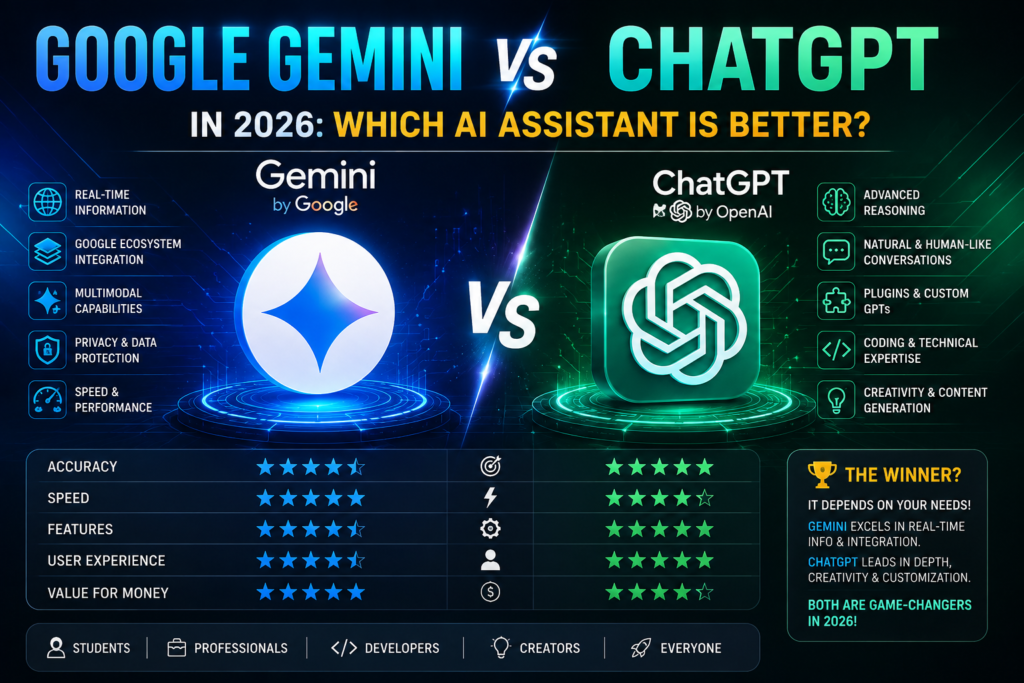
Ask ten people which AI assistant is “better” in 2026 and you’ll get ten different answers — and honestly, all ten could be right. The two platforms have converged in raw intelligence but diverged in personality and strength. So instead of another feature-by-feature scorecard, here’s the comparison that actually matters: which one wins depends on who you are and what a normal week looks like for you.
If you’re a student
Gemini has the edge. Its 1-million-token context window means you can drop an entire semester’s worth of lecture notes, a 300-page textbook PDF, or hours of recorded lectures into one conversation and ask questions across all of it at once. ChatGPT’s roughly 128K context window handles a single paper or chapter fine, but it starts losing the plot on anything approaching a full course load in one sitting. Add in Gemini’s native video and audio processing — feed it a recorded lecture and it can transcribe, summarize, and quiz you on it — and it’s built for exactly the kind of sprawling, multi-format material a student actually deals with.
If you’re a professional writer or content creator
ChatGPT has the edge. Across most head-to-head comparisons, ChatGPT maintains a measurable advantage in writing instruction-following, tone control, and creative output. If your job involves drafting, editing, or matching a specific voice consistently across a project, ChatGPT’s writing quality is the more reliable foundation to build on.
If you’re a software engineer
ChatGPT, with an asterisk. ChatGPT tends to generate cleaner, more idiomatic code across Python, TypeScript, and Rust in comparisons, and it posts stronger scores on coding benchmarks like HumanEval. It also offers computer use — the ability to directly control your desktop to complete tasks like navigating web apps or managing files — which has real utility for testing and automation workflows. The asterisk: if your codebase is enormous and you need an AI to reason across the whole thing at once rather than file-by-file, Gemini’s context window becomes relevant again.
If you live inside Google’s ecosystem
Gemini, decisively. If your day runs through Gmail, Docs, Calendar, Drive, and Maps, Gemini’s native access to that ecosystem is a real, practical advantage that has nothing to do with model intelligence — it’s integration. Pulling context from an email thread, summarizing your actual calendar, or organizing real files in Drive without extra setup or plugins is something ChatGPT simply can’t match unless you build the connections yourself.
If you need answers about current events or fast-moving information
Gemini has the edge. Because it leans heavily on Google’s search index, Gemini tends to hallucinate less on time-sensitive, factual queries — breaking news, current prices, who holds what position right now. ChatGPT holds up better on timeless, conceptual material, but is more prone to slip-ups when the ground truth changed last week.
If you want an assistant that remembers you
ChatGPT has the edge. Its memory system — referencing past conversations, uploaded files, and personal context — is generally considered the more mature and consistent of the two. If part of what you want from an AI assistant is continuity, a sense that it actually knows your ongoing projects and preferences, ChatGPT has invested more visibly here.
If you’re processing video, images, or huge documents
Gemini, without much competition. This is genuinely Gemini’s strongest category. It processes images, video, audio, and PDFs natively within a single prompt — including frame-by-frame video analysis with audio transcription if you paste in a video file or YouTube link. ChatGPT handles images and files competently, but this isn’t close to the same weight class.
If you’re building on the API rather than chatting
Gemini, on cost. Gemini’s API pricing runs roughly half of ChatGPT’s per token in several comparisons — a meaningful difference at scale, even if the two feel similarly priced as consumer subscriptions (both sit around $20/month for their main paid tier).
If you just want the smartest possible model for hard reasoning
Basically a coin flip. OpenAI’s GPT-5.6 Sol and Google’s Gemini 3.1 Deep Think trade the top spot depending on the benchmark, and by most measures the two are within single-digit percentage points of each other on general reasoning. The “which one is smarter” question mattered a lot more in 2024 than it does now — both are genuinely frontier-capable, and the gap that used to separate them has mostly closed.
The honest recommendation
If you can only pick one and you’re not sure which persona above fits you best, default to whichever ecosystem you’re already embedded in — Google Workspace user, pick Gemini; heavy ChatGPT habit already, stick with it — since the integration and continuity benefits compound the longer you use either one. And if your work genuinely spans both categories (say, you write code and also live in Gmail all day), a growing number of power users simply run both side by side rather than forcing a single winner. Neither company is going to begrudge you the $40/month if it means never hitting a wall either tool has.
Leave a Reply