Google has officially launched Gemini 4 Argon, a new flagship artificial intelligence model designed to handle complex coding tasks, advanced reasoning, scientific research, and multi-step workflows. Announced on October 13, 2026, the model represents Google’s latest effort to compete in the rapidly growing AI market.
Unlike AI assistants designed primarily for simple questions and short responses, Gemini 4 Argon focuses on tasks that require deeper analysis, multiple steps, and the ability to work with large amounts of information. Google is making the model available to developers, businesses, and eligible subscribers through its AI platforms.
The launch could be particularly important for software developers who want to build applications, understand large codebases, automate repetitive work, and solve challenging programming problems.
What Is Google Gemini 4 Argon?
Gemini 4 Argon is Google’s flagship reasoning model within its Gemini 4 generation of AI systems. It is designed to help users work through complicated problems rather than simply generate quick answers.
According to Google’s developer documentation, the model supports software engineering, mathematical and scientific problem-solving, and autonomous multi-step AI workflows.
The model is available through the Gemini API and Google AI Studio, with additional access through Google’s other AI products for eligible users.
Google is also positioning Argon for professional applications, including financial analysis, legal work, scientific research, and cybersecurity defense.
Key Features of Gemini 4 Argon
1. Advanced AI Coding Capabilities
One of the main highlights of Gemini 4 Argon is its focus on software development.
Developers can use the model to understand existing code, investigate programming problems, suggest improvements, and help implement changes across software projects.
For example, a developer working on a large web application could ask the AI to examine a particular feature, identify possible performance issues, and propose a structured solution.
The model is also available through Google Antigravity, Google’s agent-oriented development environment, where AI agents can assist with more complex engineering workflows.
However, developers should still review generated code, test changes, and check for security issues before deploying software.
2. A Large Context Window
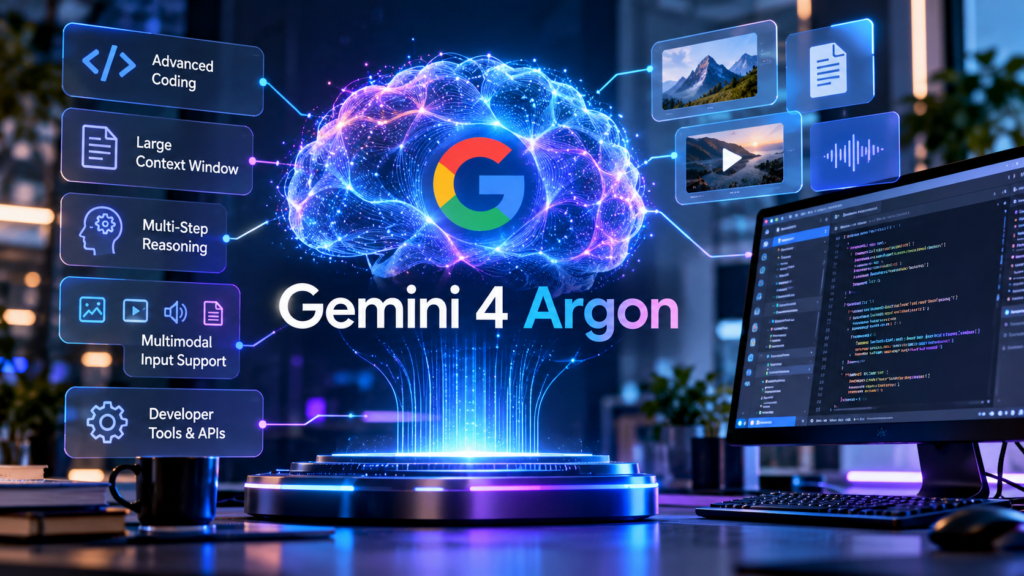
Gemini 4 Argon supports a unified context limit of up to 1,048,576 tokens, or approximately one million tokens, according to Google’s developer documentation.
A large context window allows the model to process substantial amounts of information in a single workflow. This can be useful when working with lengthy documents, extensive codebases, research materials, and technical specifications.
For example, a software engineer could provide relevant sections of a project and ask the model to explain how different components interact.
A larger context window does not guarantee perfect recall or accuracy, and the amount of information a particular application can process depends on the task and implementation.
3. Multi-Step Reasoning
Many professional tasks involve several connected stages. A software migration, for instance, may require examining dependencies, planning changes, updating code, and checking whether the result works correctly.
Gemini 4 Argon is designed to handle these kinds of extended workflows.
Its configurable reasoning levels allow developers to choose between low, medium, and high thinking settings. The appropriate setting may depend on the complexity of the task, the required response time, and the available budget.
This makes the model relevant to developers building AI-powered applications that need more than basic text generation.
4. Support for Multiple Input Formats
Google’s developer documentation lists support for text, images, video, audio, and PDF inputs.
This gives developers flexibility when building applications that combine different types of information.
Potential applications include analyzing technical documents, extracting information from reports, understanding visual references, and processing multimedia content.
The model’s supported input formats can help developers build tools for research, education, business analysis, and productivity.
5. Tool Use and AI Agents
Gemini 4 Argon supports capabilities such as function calling, code execution, file search, structured outputs, and search grounding.
These features allow developers to connect the model with external tools and application workflows.
For example, an application could use function calling to request information from a permitted business database, then ask the model to summarize the results in a structured format.
Tool access depends on the application, configuration, permissions, and supported features. Developers should use appropriate safeguards before allowing an AI agent to perform actions that affect real systems.
Gemini 4 Argon Availability
Google announced the wider release of Gemini 4 Argon on October 13, 2026.
Developers and businesses can access the model through supported Google AI development platforms. Eligible subscribers can also use it through selected Google products.
Here are the main access options:
- Google AI Studio: Build and experiment with AI-powered applications.
- Gemini API: Integrate the model into software and developer projects.
- Google Antigravity: Use AI-assisted development workflows, subject to subscription eligibility.
- Gemini app and AI Mode in Search: Access the model through eligible Google AI Pro and Ultra subscriptions.
- Google Cloud: Explore supported enterprise AI integrations.
Availability and access limits can vary by product and subscription. Developers should check Google’s official documentation for the latest requirements.
Gemini 4 Argon API Pricing
Google has announced introductory API pricing for Gemini 4 Argon. The cost depends on how many input and output tokens an application processes.
| Pricing component | Introductory price |
|---|---|
| Input tokens | $2 per million |
| Output tokens | $10 per million |
These introductory rates are scheduled to apply through November 30, 2026. Google lists standard rates of $4 per million input tokens and $20 per million output tokens after the introductory period.
Actual API expenses depend on the amount of information processed, the length of the model’s responses, and the application’s usage patterns.
Developers should review the official Gemini 4 Argon documentation before estimating project costs.
How Gemini 4 Argon Could Help Developers
The model’s capabilities may be useful in several areas.
Web Development
Developers can explore using Gemini 4 Argon to plan website features, troubleshoot code, explain errors, and improve existing applications.
Business Automation
Companies can investigate using AI agents to process documents, organize information, and assist with repetitive knowledge-work tasks.
Scientific Research
Researchers may use the model to help understand technical literature, explore mathematical problems, and support scientific computing workflows.
Code Maintenance
Teams maintaining older software may find large-context processing and multi-step reasoning useful when analyzing dependencies and planning migrations.
These are potential applications rather than guarantees. Results will depend on the quality of the inputs, the task, the surrounding software, and human review.
Gemini 4 Argon vs. Other AI Models
The advanced AI market includes models from Google, OpenAI, Anthropic, and other companies. These systems compete on reasoning, programming, reliability, speed, cost, and integration with existing tools.
Gemini 4 Argon’s main points of interest include its large context window, developer-oriented capabilities, and integration with Google’s AI ecosystem.
However, selecting the best model for a project requires more than looking at a single benchmark or announcement. Developers should compare models using their own representative tasks, including code quality, error rates, latency, security, and total cost.
No model should be considered the best for every programming language, application, or business workflow without supporting evidence.
Security and Limitations
Powerful AI tools also introduce risks that developers must consider.
AI-generated code can contain bugs or security vulnerabilities. Models can misunderstand instructions, produce inaccurate information, or make mistakes when interpreting lengthy documents.
Applications that connect AI to external tools should use permission controls, validation, logging, and appropriate human approval for sensitive actions.
Google has also highlighted cybersecurity safeguards and a restricted-access program for vetted defenders. Access to specialized capabilities may differ from ordinary public access.
For developers, responsible implementation and thorough testing remain essential even when using an advanced AI model.
What Does Gemini 4 Argon Mean for the Future of AI?
Gemini 4 Argon reflects a broader shift in artificial intelligence from answering individual questions toward helping users complete complex, connected tasks.
For developers, this could mean spending less time on repetitive coding and more time designing, testing, and improving software. For businesses, AI-assisted workflows may help teams analyze information and automate selected processes.
Nevertheless, the practical value of these systems will depend on reliability, cost, security, and how well they fit into existing workflows.
As more developers experiment with Gemini 4 Argon, real-world results will provide a clearer picture of where the model delivers the greatest benefits.
Conclusion
Google Gemini 4 Argon is a significant new addition to Google’s AI ecosystem, with features aimed at advanced coding, multi-step reasoning, large-context processing, and AI-powered workflows.
Its availability through the Gemini API, AI Studio, Google Cloud, and selected Google products gives developers several ways to explore its capabilities.
For software engineers and businesses considering AI automation, Gemini 4 Argon is worth evaluating against their specific needs. Careful testing, cost monitoring, and security reviews will be important when moving from experimentation to production.
As competition in the AI industry continues, models that can reliably help users complete complex tasks may play an increasingly important role in software development and business productivity.
Frequently Asked Questions (FAQs)
1. What is Gemini 4 Argon?
Gemini 4 Argon is Google’s flagship AI reasoning model designed for complex software engineering, scientific and mathematical problem-solving, and multi-step workflows.
2. When was Gemini 4 Argon launched?
Google announced its wider release on October 13, 2026.
3. Is Gemini 4 Argon available to developers?
Yes. Developers can access it through supported Google AI development platforms, including Google AI Studio and the Gemini API, subject to applicable access requirements.
4. What is the context window of Gemini 4 Argon?
Google’s developer documentation lists a unified context limit of up to 1,048,576 tokens.
5. How much does Gemini 4 Argon cost?
Introductory API pricing is $2 per million input tokens and $10 per million output tokens through November 30, 2026. Standard pricing is scheduled to increase to $4 and $20, respectively, after that date.
6. Can Gemini 4 Argon write code?
It can assist with coding, code analysis, debugging, and software engineering workflows. Generated code should always be reviewed and tested.
7. Is Gemini 4 Argon free?
Access depends on the product and subscription. API usage is billed according to applicable pricing, while access through some Google products requires an eligible paid subscription.
8. Where can I learn more about Gemini 4 Argon?
Visit the official Google AI developer documentation for technical details, supported features, and access information.
Leave a Reply