
Google made it official on August 12, unveiling the full Pixel 11 lineup at a celebrity-packed Made by Google event in New York, hosted by Trevor Noah with appearances from Steph Curry, Shubman Gill, PinkPantheress, and Ayami Nakajo. The lineup includes the Pixel 11, Pixel 11 Pro, Pixel 11 Pro XL, and Pixel 11 Pro Fold — alongside the Pixel Watch 5 and a genuine surprise, Google’s first AirTag rival, the Pixel Tag.
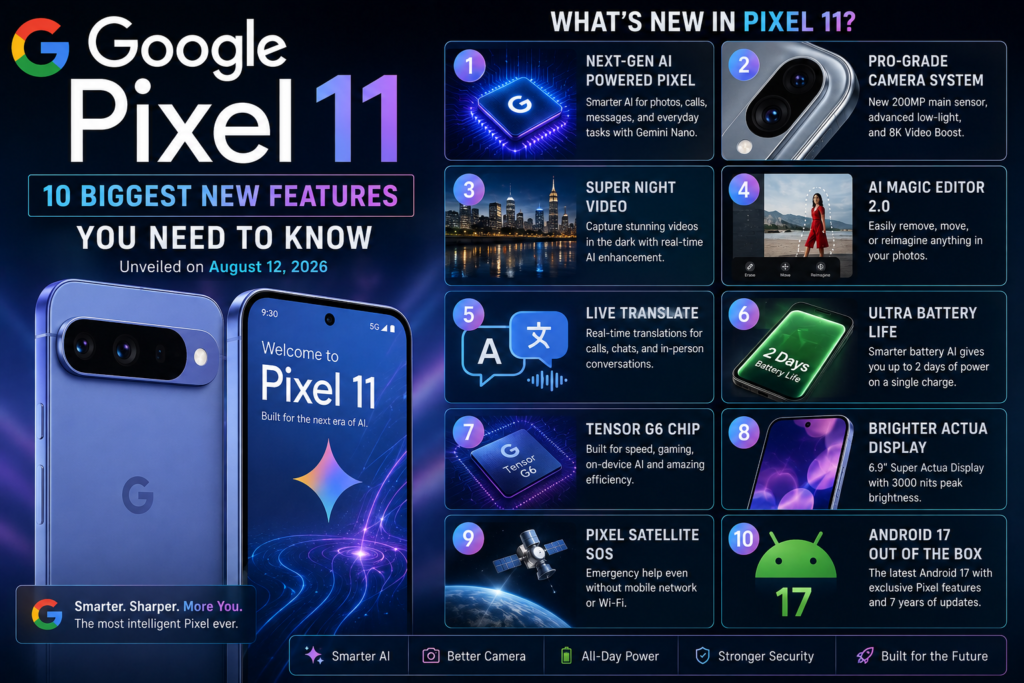
Here are the 10 biggest things actually announced.
1. HiLight — a new glowing LED that replaces the temperature sensor
The most visible design change on the Pro models is HiLight: a circular cluster of LEDs on the back of the phone that glows when you talk to Gemini, receive a notification, or hit a handful of other trigger scenarios — including color-coded visual alerts when the phone is resting face down. It replaces the temperature sensor from the Pixel 9 and 10 generations, and Google’s framing is deliberate: it’s designed to give you glanceable status updates without needing to actually pick up and unlock your phone.
2. A redesigned, edge-to-edge glass camera bar
Every phone in the lineup gets a new camera bar design that spans edge to edge across the back of the phone. The base Pixel 11 gets a version that’s roughly 40% thinner than the Pro models — though only the Pro models get the HiLight LED cluster built into theirs.
3. Up to 120x zoom on the Pro models
Camera hardware got a real jump this year, headlined by up to 120x zoom on the Pixel 11 Pro and Pro XL. Alongside the zoom increase, Google highlighted faster Night Sight processing, improved portrait shots, and better low-light performance across the board.
4. Magic Capture
Google introduced Magic Capture as one of the marquee new camera software features across the entire lineup — an AI-assisted capture tool Google is positioning as one of this generation’s standout additions, alongside the hardware zoom and low-light gains.
5. Tensor G6 across the board
Every phone in the Pixel 11 series — the base model, Pro, Pro XL, and Pro Fold — runs on Google’s new Tensor G6 chip. The base Pixel 11 also gains a brighter M16 OLED display and steps up to Qi2 25W wireless charging.
6. The Pixel 11 Pro Fold gets a genuinely reworked hinge
Google’s foldable saw meaningful structural changes: a slimmer profile, a noticeably less visible crease, and a new hinge Google says it stress-tested with more than 80 million open-close cycles — a specific durability claim aimed directly at the biggest lingering trust issue with foldable phones.
7. Gemini gets pushed deeper into everyday features
Google spent a substantial portion of the event on Gemini and AI capabilities spreading across its devices, rather than confining them to a single flagship feature. Two specific additions stood out: an expansion of Live Transcribe to support American Sign Language, using the Pixel Camera to translate sign language into text in real time, and “Rambler,” a new voice-input feature built to better understand the way people actually speak — casually, with pauses and corrections — rather than requiring cleaner, more deliberate phrasing.
8. No more 128GB base models — and a real price shift
Google quietly discontinued the 128GB storage tier across the lineup this year, meaning the cheapest version of any Pixel 11 model no longer exists at last year’s entry price. Every phone now starts at 256GB. The result: the Pixel 11 starts at $899, technically a price increase since there’s no longer a $799 option, even though $899 buys the same 256GB last year’s equivalent tier cost. Pixel 11 Pro starts at $1,099, Pro XL at $1,299, and the Pro Fold at $1,899.
9. The Pixel Watch 5 launches alongside the phones, not months later
Unlike past years, where the Pixel Watch often trailed the phone launch, the Pixel Watch 5 arrived in the same event and ships the same day as the phones. It starts at $400 and, per Google’s own framing, leans heavily into Gemini-powered features as its central pitch.
10. Pixel Tag — Google’s first real AirTag competitor
The genuine surprise of the event: Pixel Tag, Google’s first-party Bluetooth item tracker and direct answer to Apple’s AirTag and Samsung’s SmartTag. Unlike the rest of the lineup, it isn’t shipping right away — pre-orders open in the coming months, with a confirmed ship date of November 11.
Release date and where to buy
Pre-orders opened the same day as the announcement, August 12. Most of the lineup — all four phones, the Pixel Watch 5, and the Pixel Buds Pro 2 (which also got a new olive colorway, priced at $229) — ships August 20, 2026. The Pixel Tag is the lone exception, arriving November 11.
The bottom line
This year’s Pixel 11 launch reads less like a single headline feature and more like Google spreading its bets: a genuinely new design language with HiLight, real camera hardware gains, Gemini pushed into accessibility and voice input rather than treated as a bolt-on gimmick, and an actual new product category with Pixel Tag. The trade-off is a real one, though — with the 128GB tier gone, every buyer is paying more for storage they may not have wanted, dressed up as “the same price as last year.”
Leave a Reply