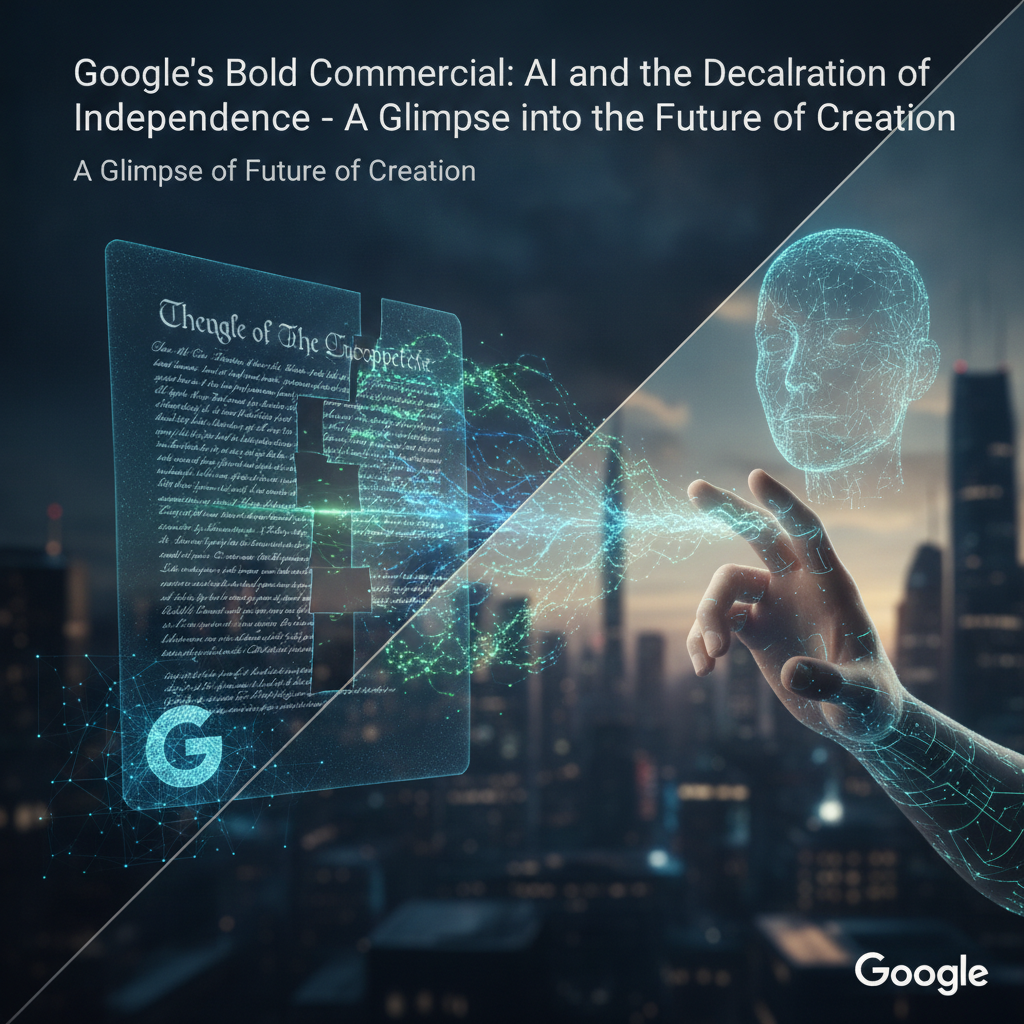
Imagine the stifling summer of 1776, Philadelphia. Thomas Jefferson, Benjamin Franklin, and John Adams are deep in debate, quill pens scratching, drafting the most pivotal document in American history. Now, imagine a subtle, almost imperceptible digital interface hovering nearby, an artificial intelligence silently suggesting phrases, refining arguments, and ensuring linguistic precision. This isn’t a historical revisionist’s fever dream; it’s the captivating premise of Google’s latest commercial, which has sparked widespread discussion by asking: What if the Declaration of Independence had been written with the help of AI?
Released strategically on Independence Day, this groundbreaking commercial isn’t just an advertisement for Google’s advanced AI capabilities; it’s a profound statement about the future of human creativity, collaboration, and even our understanding of historical authorship. It forces us to confront the accelerating integration of generative AI into every facet of our lives, from mundane tasks to monumental creations.
The Commercial’s Vision: Rewriting History with AI Assistance
The commercial opens with familiar scenes: flickering candlelight, period costumes, and the intense focus of the Founding Fathers. The genius lies in its delicate introduction of AI assistance. We see Jefferson hesitating over a phrase, only for a glowing, ethereal prompt to appear, offering a more impactful synonym or a structurally stronger sentence. Franklin nods approvingly, and Adams, ever the pragmatist, seems to appreciate the speed and clarity the AI brings to complex legal and philosophical arguments.
This isn’t an AI dictating; it’s an AI collaborating. It acts as a tireless research assistant, an infinitely patient editor, and a boundless lexicon, empowering the human mind to focus on the core ideas and intent. The visual juxtaposition of 18th-century revolutionary fervor with 21st-century technological prowess creates a powerful, thought-provoking narrative that resonates deeply with viewers.
Google’s Message: AI as a Collaborative Partner, Not a Replacement
At its heart, Google’s commercial aims to dispel the fear that AI will replace human ingenuity. Instead, it champions AI as an invaluable partner, enhancing human capabilities and accelerating the creative process. By choosing a document as hallowed and complex as the Declaration of Independence, Google boldly illustrates that even the most profound human endeavors can benefit from intelligent augmentation.
This aligns perfectly with Google’s broader strategy for its AI tools, such as Gemini and its various integrated services. The message is clear: Google AI isn’t here to write your history for you, but to help you write your history better, faster, and with greater impact. It’s about leveraging technology to unlock new levels of human potential, whether you’re a student drafting an essay, a marketer crafting copy, or, hypothetically, a revolutionary penning a declaration.
Beyond the Hype: The Real Implications for Content Creation and Writing
While the commercial offers a fictional historical scenario, its implications for contemporary AI content generation are very real. We are already seeing AI tools transform industries:
- Marketing & SEO: AI generates blog posts, social media captions, ad copy, and keyword strategies, freeing marketers to focus on strategy and creativity.
- Journalism: AI assists in drafting reports, summarizing data, and even generating initial drafts of news articles.
- Academic Writing: AI helps with research, structuring arguments, and refining language for clarity and conciseness.
- Creative Writing: AI can provide plot ideas, character descriptions, and help overcome writer’s block, serving as a brainstorming partner.
The commercial eloquently demonstrates AI’s potential to streamline processes, enhance clarity, and elevate the overall quality of written output, proving that the future of writing is inherently collaborative.
Ethical Quandaries and the Question of Authenticity
Of course, a commercial imagining AI’s hand in the Declaration of Independence also inevitably sparks critical questions. Could AI truly capture the passion, the political fervor, the deeply human spirit of revolution? What about originality and authenticity? These are vital ethical considerations that Google’s ad implicitly raises.
While AI can mimic style and generate coherent text, the profound human experience, the lived struggles, and the unique perspectives that imbue documents like the Declaration with their power are inherently human. The commercial cleverly sidesteps this by portraying AI as an assistant, a tool in the human hand, rather than the primary author. It highlights the delicate balance between leveraging AI for efficiency and preserving the indispensable human element of creativity, intent, and emotional resonance. The future will demand clear guidelines around AI attribution and the preservation of human authorship in historically significant or highly personal works.
Google’s Strategic Play in the AI Landscape
This commercial is a masterclass in AI marketing. By anchoring its message to a universally recognized and revered historical document, Google positions its Google AI technologies as not just useful, but profoundly impactful. It elevates the conversation around AI beyond mere task automation to truly transformative collaboration.
In an increasingly competitive AI market, this ad serves to differentiate Google, showcasing its commitment to developing AI that empowers rather than overwrites. It’s a bold assertion of leadership, demonstrating how Google envisions its AI playing a fundamental, symbiotic role in human innovation and progress.
Conclusion: A Future Forged by Human and AI Collaboration
Google’s latest commercial isn’t just a clever advertisement; it’s a cinematic thought experiment that challenges our perceptions of history, creativity, and the burgeoning role of artificial intelligence. By envisioning a Declaration of Independence shaped by AI assistance, Google invites us to consider a future where human ingenuity, amplified by powerful intelligent tools, can achieve even greater heights.
As we navigate this new era of human-AI collaboration, the commercial serves as a timely reminder: the tools may evolve, but the fundamental drive to create, to declare, and to define our future remains uniquely, powerfully human. The question is no longer if AI will assist us, but how wisely we choose to wield its immense potential.
Leave a Reply