The promise of AI glasses—smart eyewear that seamlessly blends digital information with our physical world, powered by artificial intelligence—has long captivated our imaginations. From science fiction to cutting-edge prototypes, the vision of lightweight, fashionable glasses that augment our reality with real-time data, navigation, and interactive experiences seems perpetually just around the corner. But what’s holding them back from mainstream adoption?
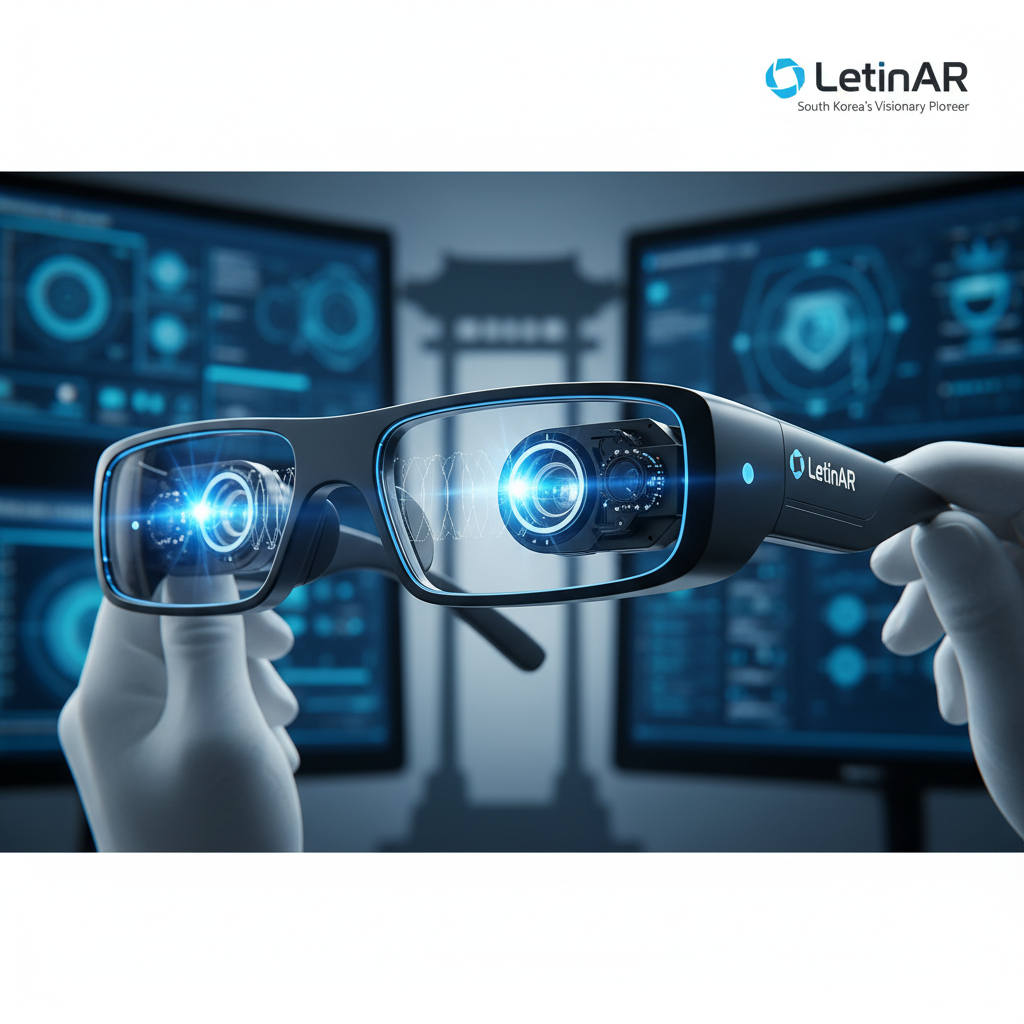
The answer, often unseen yet critically important, lies in the optics. This is where South Korea’s innovative deep-tech company, LetinAR, is making groundbreaking strides. As highlighted in recent industry reports, LetinAR is not just building components; they are crafting the very lenses and display systems that will define the user experience of future AI glasses, pushing the boundaries of what’s possible in augmented reality (AR) and extended reality (XR).
The Unseen Challenge: Why Optics Are Key to True AI Glasses
Imagine trying to fit a high-resolution projector, a transparent display, and complex sensors into a frame no thicker than a pair of regular spectacles. This is the monumental challenge facing developers of AI glasses. Traditional display technologies are often too bulky, too power-hungry, and typically compromise either the field of view (FOV), brightness, or transparency—making the digital overlay feel intrusive rather than integrated.
Effective AI glasses require optics that are:
- Ultra-compact and Lightweight: For comfort and style, indistinguishable from regular glasses.
- High Transparency: Allowing a crystal-clear view of the real world without obstruction.
- Wide Field of View (FOV): To immerse users without feeling like looking through a keyhole.
- Bright and Clear Display: Visible in various lighting conditions, both indoors and outdoors.
- Energy Efficient: To ensure all-day battery life.
- Cost-Effective: For mass market adoption.
Solving these challenges is paramount for AI glasses to transition from niche gadgets to essential everyday companions that truly augment our intelligence and perception.
LetinAR’s Breakthrough: The Pin Mirror Waveguide Technology
At the heart of LetinAR’s innovation is their patented "Pin Mirror" waveguide technology. Unlike conventional AR optics that often suffer from limited FOV, low transparency, or bulkiness, LetinAR’s approach offers a compelling solution that addresses these critical pain points.
Their technology works by embedding tiny "pin mirrors" (micro-optical elements) within the lens itself. These precisely engineered mirrors reflect the image from a micro-display directly into the user’s eye, creating a virtual image that appears to float seamlessly in the real world. This intelligent design allows for:
- Exceptional Brightness: Making virtual content clearly visible even under direct sunlight, a common hurdle for AR displays.
- Expanded Field of View: Offering a more immersive and natural AR experience that aligns with human vision.
- Slim and Lightweight Design: Contributing to glasses that look and feel like regular eyewear, fostering user acceptance.
- High Resolution and Clarity: Ensuring crisp, detailed digital overlays that are easy to read and interact with.
By effectively managing light paths and maximizing optical efficiency, LetinAR is setting a new standard for AR waveguide technology, crucial for the successful integration of powerful AI capabilities.
Shaping the Future of Augmented and Artificial Intelligence
The implications of LetinAR’s advancements extend far beyond just better displays. Superior optics are the invisible yet indispensable foundation upon which truly intelligent AI glasses can be built. When the display is seamless and unobtrusive, the focus shifts to the AI itself: context awareness, real-time data processing, gesture recognition, and natural language interaction.
Imagine a future where:
- Your AI glasses provide discreet navigation cues overlaid on your path, powered by real-time spatial awareness.
- A foreign language speaker’s words are instantly translated and displayed as subtitles hovering above them.
- Complex machinery instructions appear precisely where you need them for repair, guided by AI, making tasks simpler and safer.
- Your personal AI assistant can highlight key details in your environment, enhancing your perception without distraction.
LetinAR’s technology is a critical enabler for these futuristic scenarios, paving the way for AI to truly augment human intelligence and perception in an intuitive, wearable form factor that doesn’t compromise on aesthetics or comfort.
South Korea: A Hotbed for Deep Tech Innovation
LetinAR’s emergence as a leader in AR optics further solidifies South Korea’s reputation as a global powerhouse for deep tech and hardware innovation. From semiconductors to advanced display technology and robotics, the nation consistently fosters companies pushing the envelope in complex engineering fields. LetinAR is a testament to this vibrant ecosystem, leveraging cutting-edge research and development to address some of the most challenging problems in consumer electronics and the broader XR landscape.
The Road Ahead for AI Glasses
While LetinAR has made significant strides, the journey to ubiquitous AI glasses is ongoing. Challenges remain in areas like battery technology, efficient AI processing at the edge, and robust software ecosystems that can truly harness the power of such advanced optics. However, with companies like LetinAR tackling the fundamental hurdle of display optics, the path forward becomes significantly clearer and more achievable.
Their commitment to developing high-performance, compact, and potentially affordable optical solutions positions them as a pivotal player in the race to bring truly functional and desirable AI glasses to the masses. The vision for AI glasses is becoming less of a distant dream and more of a tangible reality, thanks in large part to the invisible work happening behind the lenses, pioneered by companies like LetinAR.