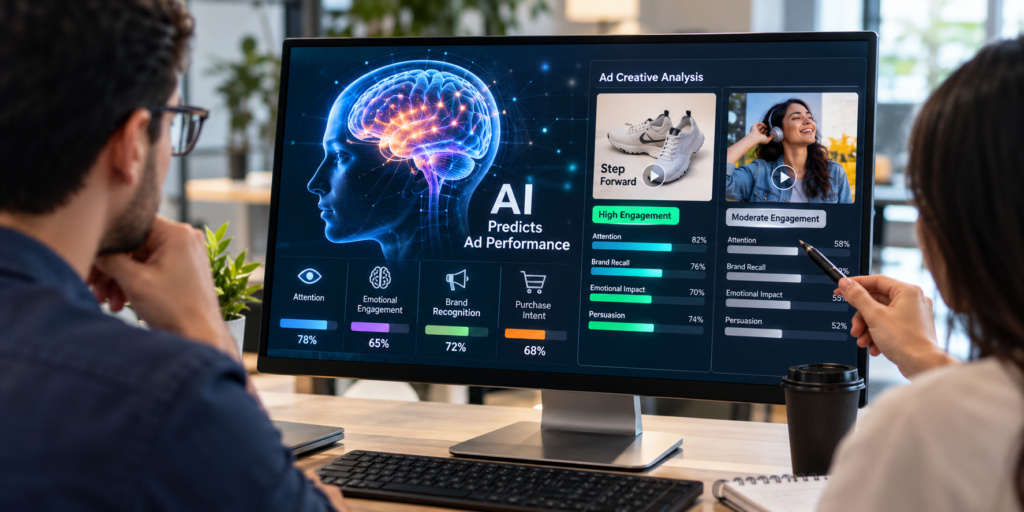
Artificial intelligence (AI) is changing the way businesses create and evaluate digital advertising. A new approach combining neuroscience and AI is helping marketers predict how audiences might respond to advertisements before spending money on large media campaigns.
Traditionally, companies have invested in advertising and then measured results through clicks, views, conversions, and sales. However, predictive AI tools are making it possible to assess creative content before it goes live, helping businesses identify potential problems and improve their campaigns in advance.
According to a report by Marketing Tech News, neuroscience-based AI platforms are being used to evaluate advertising based on attention, brand recognition, emotional engagement, and persuasion.
How AI and Neuroscience Work Together
Neuroscience studies how the human brain and body respond to different experiences. When combined with artificial intelligence and machine learning, it can help researchers better understand how people react to advertising content.
AI systems can analyse advertising assets and use patterns learned from previous data to estimate how viewers might respond to new content.
For example, a company preparing to launch a product advertisement could use predictive AI to assess whether the video is likely to attract attention, communicate its brand message, and encourage viewers to take action.
This approach gives marketing teams an additional source of information before committing significant advertising budgets.
BrainSuite AI Brings Predictive Testing to Advertising
One example highlighted in the report is BrainSuite AI, a platform designed to help marketers assess advertising effectiveness before campaigns launch.
The platform evaluates several important factors, including:
- Audience attention: Whether an advertisement is likely to capture viewers’ interest.
- Brand recognition: Whether the brand is noticeable and memorable within the content.
- Emotional engagement: Whether the creative content is likely to generate an emotional response.
- Persuasion: Whether the advertisement may influence audience attitudes.
- Campaign performance: How pre-launch assessments relate to real-world metrics such as click-through rates and purchases.
By combining pre-launch assessments with post-campaign performance data, marketers can learn which creative approaches are associated with better results and apply those insights to future campaigns.
Why Audience Attention Matters in Digital Marketing
Attention has become particularly important on social media platforms, where users scroll through large amounts of content every day.
Even a well-produced advertisement can struggle if viewers ignore it before understanding the message. Businesses therefore need to consider not only the quality of their advertisements but also how quickly they communicate their value.
Predictive AI can help marketing teams evaluate different creative approaches before publication.
For example, a brand might compare two versions of a short video. One introduces the product immediately, while the other begins with a longer introduction. Predictive testing may help identify which version is more likely to capture attention and communicate the brand effectively.
These insights can help teams improve their content before spending money on distribution.
AI Helps Marketers Understand Emotional Responses
Emotions can influence how people respond to advertising. An engaging story, entertaining video, or relatable message may create a stronger connection with viewers than a purely informational advertisement.
The Marketing Tech News report also discusses research that combined neuroscience measurements with machine learning to predict advertising preferences.
In that study, researchers recorded participants’ facial expressions and electrodermal activity while they watched videos. These measurements were then analysed using machine learning.
A Random Forest model achieved 81% accuracy in predicting consumer preferences within the study.
However, this result should be interpreted carefully. The research focused on a specific sector and used a relatively small sample. It does not mean that AI can predict every consumer’s preferences with 81% accuracy across all advertisements or industries.
Further research and testing are needed to determine how well such models perform in different real-world situations.
Why Brand Visibility Is Still Important
Capturing attention is only one part of a successful advertising campaign. Viewers also need to recognise which company or product the advertisement promotes.
This can be challenging with influencer and creator content, where brands sometimes appear only after a long introduction.
Predictive advertising tools can help marketers examine whether the brand appears early enough to be noticed without making the content feel overly promotional.
For example, a creator could introduce a product naturally near the beginning of a video rather than waiting until the final moments. The goal is to maintain the video’s authenticity while ensuring viewers understand which brand is being promoted.
Finding this balance can be especially valuable for businesses investing in influencer marketing and short-form video advertising.
Benefits of Predictive AI for Businesses
Combining neuroscience and AI could provide several advantages for marketing teams.
1. Better Advertising Decisions
Businesses can use predictive assessments to compare creative concepts and identify potential weaknesses before campaigns launch.
2. More Efficient Media Spending
Testing advertisements in advance may help companies avoid investing heavily in content that is unlikely to meet their campaign objectives.
3. Improved Creative Content
Insights into attention, brand visibility, and emotional engagement can help teams refine their messaging, video structure, and calls to action.
4. Data-Driven Marketing Strategies
Instead of relying entirely on personal opinions, marketers can combine predictive scores with historical campaign results and real-world performance data.
5. Continuous Campaign Improvement
After an advertisement goes live, businesses can compare predictions with actual results. This feedback can help improve future advertising decisions.
Limitations of AI-Powered Advertising Predictions
Although predictive AI offers promising opportunities, it cannot guarantee that an advertisement will become successful or go viral.
Consumer behaviour is influenced by many factors, including cultural differences, current trends, product quality, competition, pricing, and the context in which an advertisement appears.
A model that performs well on one category of advertisements may not produce equally reliable results in another.
The quality and diversity of training data also matter. Marketers should understand how a platform generates its scores and whether those scores have been validated against meaningful campaign outcomes.
AI should therefore support human judgement rather than replace creative thinking, audience research, or real-world testing.
The Future of AI in Digital Marketing
The combination of neuroscience, machine learning, and advertising analytics could make campaign planning more evidence-based.
In the future, marketing teams may increasingly use predictive tools to compare videos, evaluate brand visibility, test creative variations, and estimate potential audience engagement before launching campaigns.
However, the most useful systems will need to demonstrate that their predictions translate into measurable results, rather than simply generating impressive-looking scores.
Businesses that combine AI insights with creative expertise, responsible data practices, and real-world campaign testing may be better positioned to make informed marketing decisions.
Conclusion
Neuroscience and AI are creating new possibilities for understanding audience responses before advertising campaigns go live. Platforms such as BrainSuite AI illustrate how predictive tools can help marketers assess attention, emotional engagement, brand recognition, and potential campaign effectiveness.
While these technologies cannot guarantee advertising success, they can provide useful insights that help businesses refine creative content and make more informed decisions about media spending.
As AI continues to evolve, predictive advertising could become an increasingly important part of digital marketing. The key will be combining technological predictions with human creativity and measurable campaign results.
Leave a Reply