
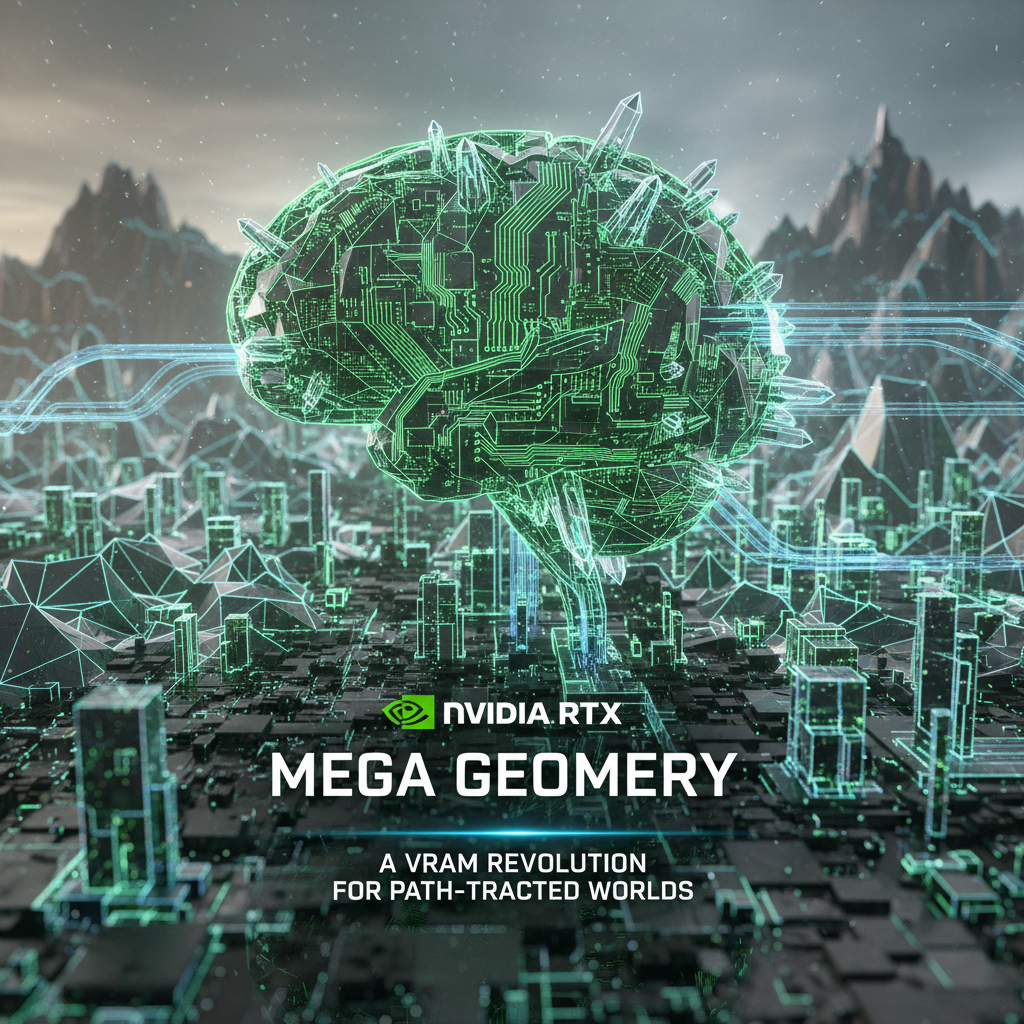
The quest for photorealistic graphics in real-time has long been a demanding endeavor, pushing the limits of even the most powerful GPUs. One of the biggest bottlenecks? Video RAM (VRAM). As game worlds grow infinitely more detailed and rendering techniques like path tracing become the gold standard, the need for efficient memory management becomes paramount. Enter Nvidia’s RTX Mega Geometry technology – a groundbreaking innovation poised to dramatically reduce VRAM usage and unlock unprecedented levels of visual fidelity, especially for the most demanding path-traced scenes.
Understanding Nvidia’s RTX Mega Geometry
At its core, Nvidia’s Mega Geometry is an advanced system designed to virtualize and stream geometric data on demand. Traditionally, a GPU would need to load significant portions, if not all, of a scene’s geometry into its VRAM to render it. This approach quickly becomes unsustainable in vast, highly detailed environments, leading to performance issues, texture pop-in, or simply an inability to render such complexity.
How it Works: Virtualized Geometry and On-Demand Streaming
Mega Geometry tackles this challenge by intelligently managing geometric data. Instead of loading everything at once, it breaks down the vast amount of geometric information (think billions of triangles) into manageable, smaller chunks. These chunks are then streamed to the GPU’s VRAM only when they are needed and relevant to the current view or rendering process. This ‘on-demand’ approach means that only the necessary data resides in VRAM at any given moment, freeing up precious memory for other tasks.
This isn’t just about simple ‘level of detail’ (LOD) systems; it’s a far more sophisticated, dynamic, and seamless process that operates across the entire scene, irrespective of object boundaries or traditional asset loading zones.
The VRAM Revolution: Unlocking Unprecedented Detail
The most immediate and impactful benefit of Mega Geometry is its ability to drastically reduce the VRAM footprint of complex scenes. This reduction has profound implications for both developers and end-users.
Empowering Developers to Create Richer Worlds
For game developers and 3D artists, Mega Geometry removes a significant constraint. They can now design environments with far greater geometric complexity and detail than ever before, without constantly worrying about hitting VRAM limits. Imagine entire cities, sprawling landscapes, or intricate interiors rendered with individual pebbles, leaves, or tiny architectural details, all streamed seamlessly without performance penalties.
More Accessible High-Fidelity Graphics for Gamers
For gamers, this translates directly into more immersive and visually stunning experiences. Games can feature incredibly rich, dense environments with higher fidelity assets across the board, potentially even on GPUs with more modest VRAM capacities (compared to what would typically be required for such detail). It lessens the burden on hardware, allowing more systems to enjoy the pinnacle of visual quality.
A New Era for Path-Traced Rendering
While beneficial for all forms of rendering, Mega Geometry is particularly transformative for path-traced rendering – the holy grail of real-time graphics that simulates light’s physical behavior for ultimate realism.
The Demands of Path Tracing
Path tracing, by its very nature, is incredibly VRAM-intensive. It requires the GPU to trace billions of light rays through a scene, interacting with every surface and object to accurately simulate global illumination, reflections, refractions, and shadows. The more complex the scene geometry, the more data needs to be accessible for these ray calculations, quickly overwhelming even top-tier GPU memory banks.
Mega Geometry’s Direct Impact on Path Tracing
With Mega Geometry, the path tracer can access geometric data on demand, only pulling in the necessary information for the rays currently being traced in a specific area. This dramatically reduces the amount of geometry that needs to reside in VRAM simultaneously, making incredibly complex, fully path-traced scenes a tangible reality. It allows for:
- Unprecedented Detail: Billions of triangles can be rendered, enabling hyper-realistic environments where every surface contributes to the lighting simulation.
- Enhanced Performance: By reducing VRAM pressure, the GPU can dedicate more resources to actual ray tracing calculations, potentially leading to smoother frame rates or enabling higher quality rendering settings.
- More Complex Interactions: Enables richer, more nuanced light interactions with highly detailed surfaces, leading to truly cinematic visuals.
This tech effectively removes a major barrier to entry for widespread adoption of full path tracing in real-time applications.
Why This is a ‘Leap Forward’
Nvidia’s RTX Mega Geometry is more than just an incremental improvement; it represents a fundamental shift in how GPUs manage and render complex scenes. It’s a leap forward because it:
- Breaks VRAM Barriers: It effectively virtualizes an almost infinite amount of geometry, decoupling scene complexity from physical VRAM size.
- Enables Next-Gen Realism: It makes previously impossible levels of geometric detail and full path-traced rendering viable for real-time applications, moving closer to offline rendering quality.
- Streamlines Development: Developers can focus on artistic vision and detail without being constantly constrained by memory budgets.
- Future-Proofs Graphics: As resolutions increase and demand for realism intensifies, technologies like Mega Geometry become indispensable for future titles and professional applications like architectural visualization, digital twins, and virtual production.
Conclusion
Nvidia’s RTX Mega Geometry is a pivotal innovation that addresses one of the most persistent challenges in real-time graphics: VRAM limitations. By enabling efficient, on-demand streaming of vast geometric data, it promises a future where virtual worlds are limited only by imagination, not memory. For path-traced rendering, it is nothing short of a revolution, paving the way for truly photorealistic interactive experiences that were once confined to the realm of offline rendering. This technology isn’t just an upgrade; it’s a fundamental change that will shape the visual landscape of gaming and professional visualization for years to come.
Leave a Reply