
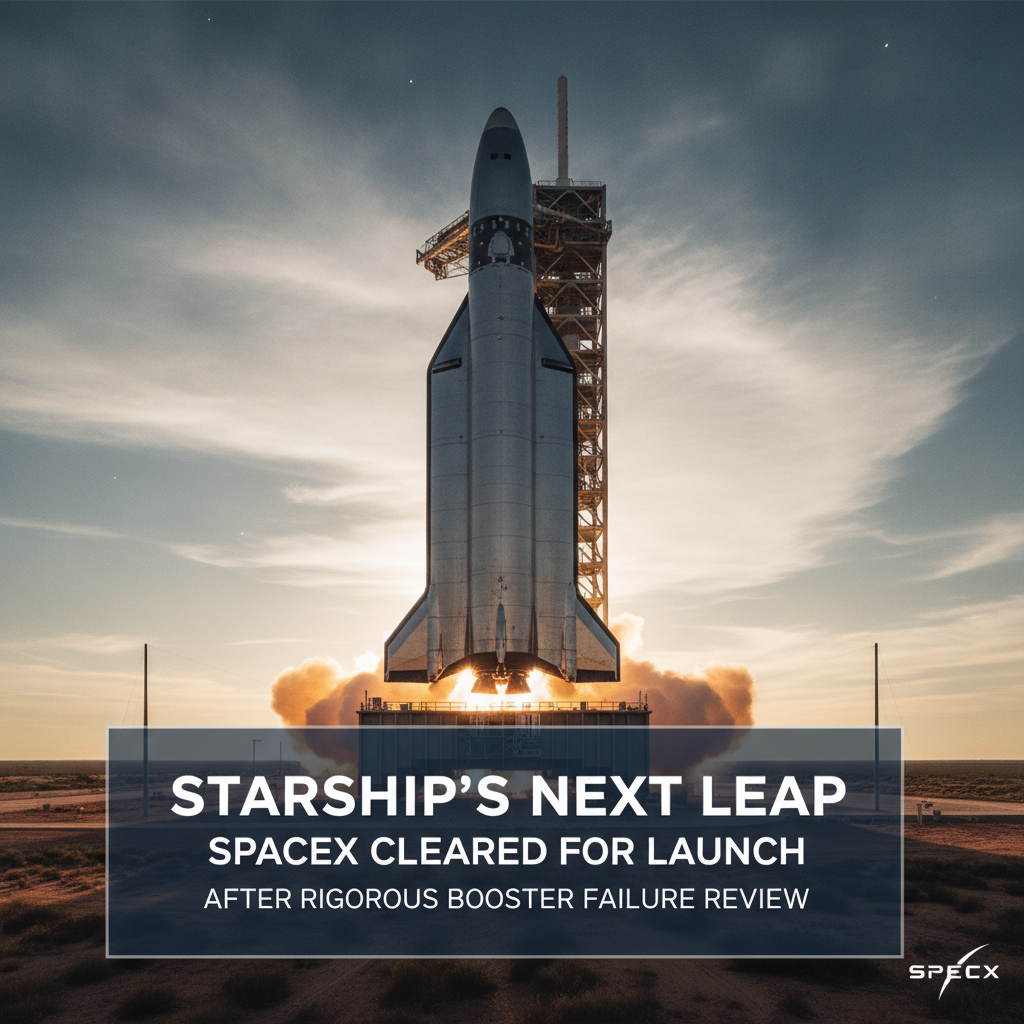
After months of intense scrutiny and corrective actions, SpaceX has received the green light from the Federal Aviation Administration (FAA) to proceed with its next orbital test flight of the Starship mega-rocket. This pivotal announcement, arriving following a booster failure during a test launch in May, marks a significant milestone for Elon Musk’s ambitious space company and the future of human space exploration.
The May incident, which saw the Super Heavy booster fail to achieve its intended trajectory shortly after liftoff from Starbase in Boca Chica, Texas, triggered a comprehensive investigation by both SpaceX and the FAA. The clearance signifies that all identified issues have been addressed, and the necessary safety protocols are in place for Starship’s grand return to the launchpad.
The Path to Re-Flight: A Rigorous Review Process
The journey back to flight clearance was no small feat. Following the booster failure in May, the FAA grounded Starship, initiating a detailed anomaly investigation in collaboration with SpaceX. This process involved a thorough analysis of telemetry data, hardware inspections, and operational procedures to pinpoint the root causes of the failure. Experts from various fields scrutinized every aspect, from engine performance to structural integrity and flight software.
SpaceX was required to implement a series of corrective actions, which reportedly included hardware modifications to the Super Heavy booster, software updates to enhance flight control, and strengthened operational procedures. The FAA’s approval confirms that these measures have satisfied all safety, environmental, and regulatory requirements, paving the way for the mighty Starship to once again attempt its orbital journey.
What This Means for Starship’s Ambitious Future
The Starship program is not just another rocket; it’s designed to be a fully reusable transportation system capable of carrying humans and cargo to Earth orbit, the Moon, Mars, and beyond. This FAA clearance is crucial for maintaining the aggressive development timeline that SpaceX has set for itself.
- Lunar Missions: Starship is central to NASA’s Artemis program, specifically as the Human Landing System (HLS) that will return astronauts to the lunar surface. Further successful test flights are critical for meeting NASA’s stringent deadlines.
- Mars Exploration: Elon Musk’s long-term vision for Starship is to enable the colonization of Mars. Each test flight brings SpaceX closer to validating the complex systems required for interplanetary travel.
- Satellite Deployment: Starship’s massive payload capacity (up to 100-150 metric tons to low Earth orbit) is essential for deploying the next generation of Starlink satellites (Starlink V2), which are larger and more powerful, promising enhanced global internet connectivity.
- Rapid Reusability: The ultimate goal is rapid and full reusability of both the Starship spacecraft and the Super Heavy booster, drastically reducing the cost of space access. Subsequent test flights will continue to refine landing and re-flight procedures.
SpaceX’s Momentum in the Commercial Space Race
This clearance underscores SpaceX’s relentless drive and its ability to adapt and overcome significant technical challenges. In an increasingly competitive commercial space industry, maintaining momentum is key. Competitors globally are developing their own heavy-lift rockets, but Starship, with its unparalleled scale and reusability goals, remains at the forefront of innovation.
The success of the Starship program has profound implications beyond SpaceX itself. It fuels technological advancement, creates thousands of jobs, and inspires a new generation to pursue careers in STEM. With the next flight on the horizon, the world watches with bated breath, anticipating another spectacular chapter in humanity’s quest to become a multi-planetary species.
Preparing for Launch: The Next Steps
While the FAA clearance is a major hurdle overcome, final preparations for the next orbital flight are still underway. SpaceX will now finalize its launch window, inform the public, and conduct last-minute checks on the Starship and Super Heavy stack at Starbase. The company is expected to release details on the exact launch date and mission profile in the coming weeks.
The aerospace community and space enthusiasts worldwide are eagerly awaiting the sight of the towering Starship once again attempting to reach orbit. This next flight is not just another test; it’s a testament to engineering resilience, regulatory thoroughness, and humanity’s unwavering ambition to push the boundaries of what’s possible in the cosmos.
Stay tuned for updates as SpaceX prepares to write the next chapter in the Starship saga.
Leave a Reply