
Cash is quietly becoming the exception, not the rule. The global digital payments market is projected to process $37.45 trillion in transaction value in 2026, and that number is expected to keep growing at a 4.31% annual rate through at least 2031. But the more interesting story isn’t the size of the number — it’s what’s happening underneath it. Payments are becoming faster, more autonomous, more personalized, and in some genuinely new ways, more invisible than they’ve ever been.
Here’s where the industry’s own trend reports — from Mastercard, Visa, JPMorgan, and Deloitte — actually agree on where this is headed.
Payments are becoming invisible
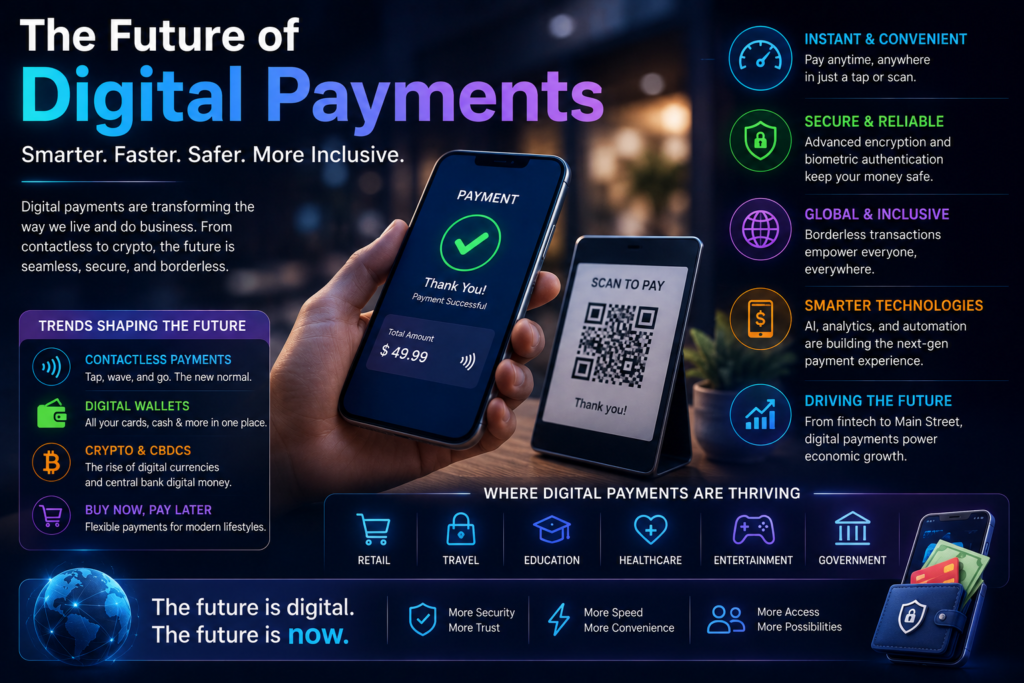
The clearest throughline across nearly every major industry forecast is a shift away from the payment itself being a distinct, noticeable moment. Instead, the goal increasingly is frictionless, embedded transactions that happen in the background of some other activity — a ride ending, a subscription renewing, an AI agent completing a purchase on your behalf — rather than a deliberate, separate “now I am paying” action. Speed has become an expectation rather than a differentiator: consumers increasingly treat instant confirmation and zero friction as the baseline, not a premium feature, and any delay reads as poor service.
AI is moving from fraud detection to actually making purchases
Artificial intelligence’s role in payments is expanding well past its original job of flagging suspicious transactions. Mastercard describes fraud prevention entering a new era powered by autonomous intelligence and foundational models that optimize approvals and combat threats largely without manual intervention — but the more significant shift is the rise of agentic commerce: AI agents that can browse, select, and complete purchases on a person’s behalf, with payment infrastructure being rebuilt specifically to support that kind of autonomous transaction rather than always assuming a human is the one clicking “buy.”
Deloitte’s 2026 outlook names agentic AI directly as one of the five core trends reshaping the industry, alongside AI-driven fraud defense — signaling that payment networks are building the rails for AI-initiated transactions now, not waiting for the behavior to become mainstream first.
Digital wallets are closing in on becoming the default
Digital wallets — Apple Pay, Google Pay, Samsung Pay, and a long list of regional and local equivalents — are projected to be used by over 60% of the global population by 2026, and are increasingly showing up as the preferred checkout option even on desktop, not just mobile. Contactless payments are following the same curve: in the eurozone alone, contactless card payments reached 29.6 billion transactions in the first half of 2025, up nearly 13% year-over-year, representing 83% of all in-person card payments. Juniper Research projects the value of contactless transactions globally could reach $11 trillion by 2027.
Real-time payment networks are going global
Instant, account-to-account payment infrastructure — the kind popularized by Brazil’s Pix system — is spreading well beyond its country of origin. Industry analysts project instant payment systems could generate nearly $200 billion in global revenue by 2030, and open banking maturity is making real-time bank transfers a genuinely competitive alternative to card networks in more markets each year, rather than a niche feature.
Stablecoins and tokenized money are moving from experimental to institutional
This is one of the more significant regulatory and structural shifts underway. Following the passage of the GENIUS Act, US federal regulators are actively building a formal framework for stablecoins, while blockchain-powered tokenized money — deposit tokens, Blockchain Deposit Accounts, and central bank digital currencies — is gaining real institutional interest specifically for its ability to move funds across borders 24/7, sidestepping banking-hours delays and foreign exchange friction. JPMorgan reports that 60% of institutions are looking to increase their exposure to digital assets, even though the tokenized asset market remains relatively small today, at roughly $25 billion in total market cap.
That said, this isn’t a uniformly rosy picture — some industry voices are notably more skeptical, pointing out that stablecoins currently offer a genuinely rough user experience, with real friction around onboarding and offboarding between traditional and crypto-based systems. The institutional enthusiasm and the practical, everyday usability gap haven’t fully closed yet.
Digital identity is becoming as important as the payment itself
A recurring theme across multiple 2026 forecasts is the idea that secure, seamless digital identity verification is becoming inseparable from the payment experience itself — the goal being digital identity that feels as natural and reliable as making the payment does. This is being driven partly by necessity: fraud, identity theft, and deepfake-enabled attacks are rising fast enough that one industry report noted deepfake-based attacks now occur roughly every five minutes. Trust, in that environment, is increasingly treated as a second currency — companies that visibly protect customer data and verify identity smoothly are being rewarded with loyalty; those that don’t are bleeding customers to competitors who do it better.
Payments are becoming a values statement, not just a transaction
A more unexpected trend showing up in Mastercard’s research: a growing wave of consumers, led by Gen Z, are embracing circular-economy behavior — reuse, resale, and repair — creating demand for what’s being called regenerative payment loops. Think refill programs, take-back schemes, and deposit-and-return systems for reusable items, all enabled by simple, secure micro-transactions and peer-to-peer payments. For consumers, it turns returning something as easy as using it once and throwing it away. For retailers, it’s a genuine business case: lower packaging costs and deeper customer loyalty, not just an environmental gesture.
The regulatory backdrop is intensifying, not fading
Regulation isn’t a side note to this transformation — several major forecasts explicitly frame it as one of the primary forces actively shaping how payments evolve. In the US, expect continued action on stablecoin frameworks, state-level scrutiny of buy-now-pay-later and earned wage access products, and ongoing legal and Federal Reserve activity around card interchange fees. Standardization efforts like ISO 20022 are enabling richer transaction data, which in turn is what makes a lot of the AI-driven fraud detection and personalization trends technically possible in the first place — better data in, better automated decisions out.
What this means for businesses and everyday users
For businesses, the throughline across nearly every industry report is the same: the winners will be the ones who combine speed, security, personalization, and flexibility into one coherent payment experience, rather than treating each as a separate initiative. Notably, one merchant survey found that despite all this innovation, nearly half of businesses have no immediate plans for major payment system changes — suggesting the shift, while real and fast-moving at the infrastructure level, is landing unevenly, with larger and more digitally mature businesses moving first.
For everyday users, the practical experience of paying for things is quietly becoming less visible, more automated, and more identity-verified than it’s ever been — a checkout process that increasingly disappears into whatever you were actually trying to do, rather than standing out as its own separate step.
The bottom line
Digital payments in 2026 aren’t defined by one single breakthrough technology — they’re defined by convergence: AI, real-time infrastructure, tokenized money, digital identity, and evolving regulation are all advancing simultaneously and reinforcing each other. The common destination across nearly every major forecast is the same: payments becoming faster, smarter, more automated, and increasingly something that happens around you rather than something you consciously do. Whether that’s a genuinely better experience or simply a less visible one — with fewer moments to notice, question, or opt out — is likely to be the more interesting conversation as this future actually arrives.
Leave a Reply