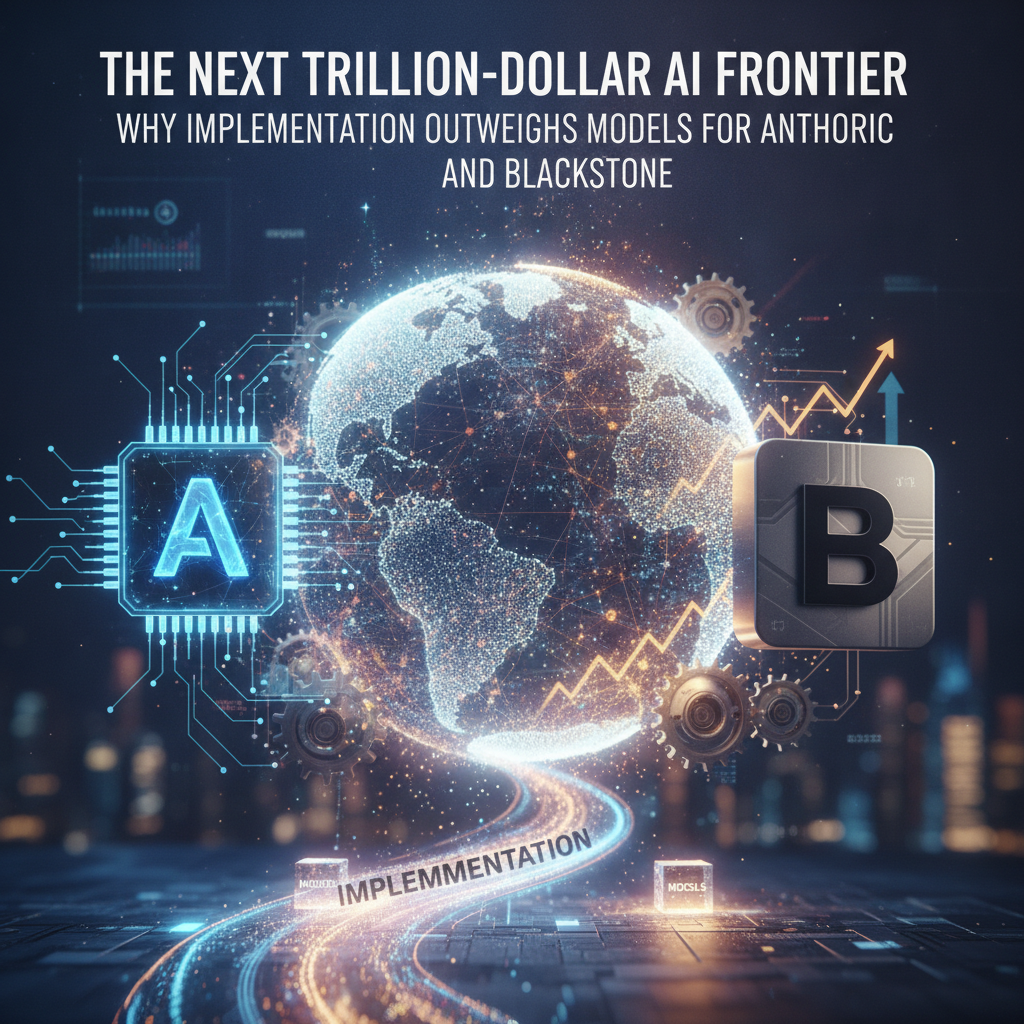
For years, the AI landscape has been dominated by a breathless race to build bigger, smarter, and more capable foundational models. From large language models (LLMs) to advanced generative AI, the focus has largely been on the *creation* of these incredible digital brains. But a significant shift is underway, one that prominent players like AI research powerhouse Anthropic and investment giant Blackstone are keenly observing – and betting on. Their collective insight points to a powerful new truth: the next trillion-dollar opportunity in AI lies not just in the models themselves, but in their effective implementation.
This isn’t to say that groundbreaking AI models aren’t crucial. They are the engine, the raw power. However, as the industry matures, the spotlight is moving from pure technological prowess to the ability to translate that power into tangible, real-world value. It’s about bridging the gap between cutting-edge algorithms and operational impact.
From Foundational Models to Functional Solutions: The Paradigm Shift
The journey of AI has seen remarkable advancements. We’ve witnessed the birth of models capable of understanding and generating human-like text, images, and code. These foundational models have opened up a universe of possibilities. Yet, a powerful model sitting in isolation is like a super-efficient engine without a car to put it in. It has immense potential, but no direct utility.
Implementation is the critical bridge. It encompasses:
- Integration: Seamlessly embedding AI into existing enterprise systems and workflows.
- Customization & Fine-tuning: Adapting general-purpose models to specific industry needs, proprietary data, and unique business processes.
- Data Management: Ensuring high-quality data input and output for optimal AI performance.
- Operationalization: Turning AI prototypes into robust, scalable, and reliable production systems.
- User Experience: Designing intuitive interfaces that make AI tools accessible and effective for human operators.
- Governance & Ethics: Establishing frameworks for responsible, fair, and secure AI deployment.
The shift highlights that while inventing an incredible AI model might get you headlines, *making that model solve specific, complex business problems* is what generates sustainable revenue and profound impact.
Anthropic and Blackstone: Two Sides of the Same Trillion-Dollar Bet
The convergence of Anthropic, a leader in AI research and safety, and Blackstone, a global private equity firm managing vast assets, on this vision is particularly telling.
Anthropic’s Strategic Pivot
As a developer of advanced AI models like Claude, Anthropic understands the intricacies and limitations of foundational AI better than most. Their investment in implementation suggests a recognition that the market for raw model power alone is becoming saturated or commoditized. To maintain a competitive edge and drive adoption, their models must be demonstrably useful, integrated, and impactful within diverse organizational contexts. This means moving beyond just building a better brain to helping enterprises effectively *use* that brain.
Blackstone’s Investment Acumen
Blackstone, with its extensive portfolio spanning various industries from logistics to healthcare, has a unique vantage point on the pain points and operational inefficiencies across the global economy. Their interest in AI implementation signals a strong belief that the highest returns on investment will come from companies that excel at leveraging AI to streamline operations, enhance decision-making, and create new value streams. For Blackstone, the ‘trillion-dollar’ potential isn’t in speculative AI startups focused solely on model creation, but in the companies that master the art of applying AI effectively at scale across their vast enterprise network.
Together, their shared perspective underscores a fundamental truth: the gold rush isn’t just about finding the raw gold (the models); it’s about building the infrastructure, tools, and services to extract, refine, and utilize it effectively.
Unlocking the Trillion-Dollar Value: Where Implementation Shines
The true economic potential of AI implementation will manifest in various sectors:
- Enterprise Solutions: AI agents customized for specific customer service scenarios, predictive maintenance in manufacturing, personalized marketing engines, and automated financial analysis.
- Industry-Specific Verticals: Tailored AI applications for drug discovery in pharmaceuticals, dynamic supply chain optimization in logistics, personalized learning paths in education, and intelligent grid management in energy.
- Operational Efficiency & Cost Reduction: AI driving process automation, reducing human error, optimizing resource allocation, and significantly cutting operational costs across every function.
- Innovation & New Business Models: Companies emerging solely to provide AI integration, customization, and managed services, effectively becoming the ‘AI plumbers’ and ‘architects’ for the digital age.
The value here isn’t just in marginal improvements but in fundamental transformations of how businesses operate, innovate, and compete. It’s about moving from potential to profit.
The Road Ahead: Challenges and Opportunities
While the opportunity is immense, the path to successful AI implementation is not without its hurdles. Challenges include:
- Data Silos and Quality: Integrating disparate data sources and ensuring data integrity.
- Talent Gap: A shortage of skilled professionals who can bridge the divide between AI expertise and domain-specific business knowledge.
- Legacy Systems: Integrating cutting-edge AI into existing, often outdated, technological infrastructures.
- Change Management: Overcoming organizational inertia and ensuring user adoption of new AI-driven workflows.
- Ethical Deployment: Navigating complex questions around bias, privacy, and accountability in AI applications.
However, for businesses and innovators who can effectively navigate these challenges, the rewards are monumental. The companies that master AI implementation will not only capture significant market share but will also redefine efficiency and innovation in their respective industries.
Conclusion: The Future is Applied AI
The pronouncement from Anthropic and Blackstone serves as a powerful signal to the entire tech and business world: the era of simply marveling at AI’s capabilities is evolving into an era of actively harnessing them. The next trillion-dollar valuation won’t be achieved by merely developing the smartest model, but by demonstrating unparalleled excellence in making that model work seamlessly, ethically, and profitably within the complex tapestry of global commerce.
For businesses, this means shifting focus from merely ‘adopting AI’ to ‘implementing AI strategically.’ For investors, it means looking beyond the hype of foundational models to the demonstrable impact of their real-world applications. The future of AI, it seems, is not just about intelligence, but about intelligent application.