
Wearable tech spent the last decade being mostly about counting steps. In 2026, that framing has quietly become outdated. The category is splitting into two genuinely different products wearing the same label — one turning your body into a continuously monitored health dashboard, the other turning your face into an always-available AI interface — and both are growing faster than almost anything else in consumer tech right now.
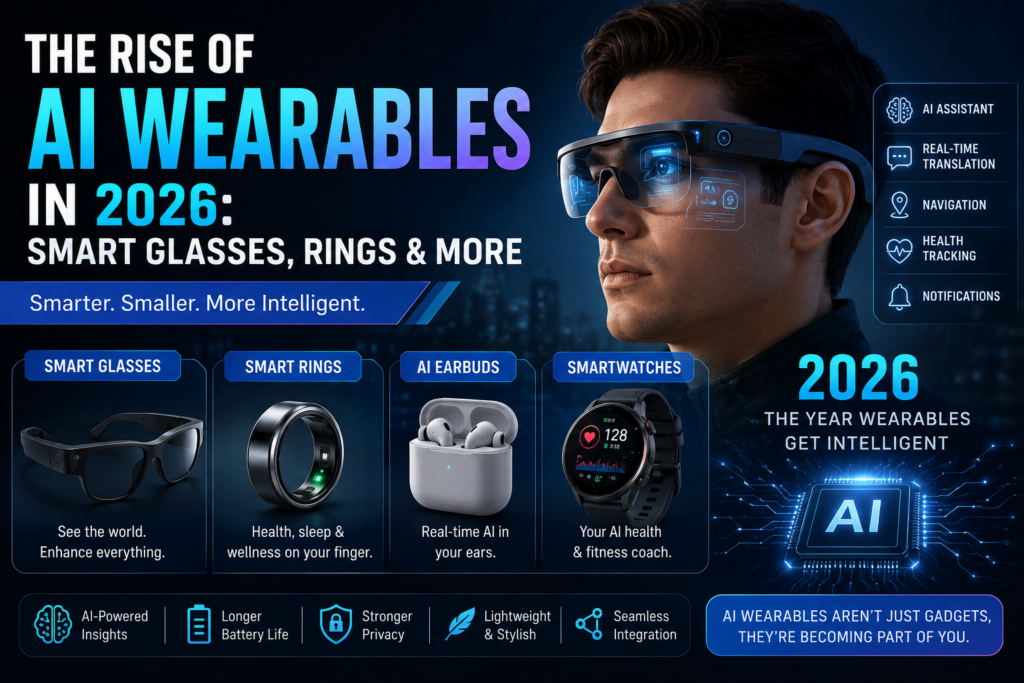
The numbers behind the moment
The global wearable technology market hit roughly $92.9 billion in 2025 and is projected to reach $96.44 billion in 2026. But the more interesting numbers are underneath that headline figure: smart ring shipments grew a stunning 88% in 2024 — the fastest growth of any wearable category — while roughly two in five new wearables shipped in 2026 now include built-in AI features. The wearable AI market specifically is projected to add $65 billion in incremental growth by 2030, and analysts increasingly frame that growth as coming from healthcare integration rather than new form factors alone.
Smartwatches remain the volume leader — 562.86 million users worldwide in 2025, up nearly 24% year over year — but they’re no longer the interesting part of the story. Smart rings and smart glasses are.
Smart rings: the quiet health-tracking takeover
Smart rings have become the wearable of choice for anyone who wants continuous health data without a screen on their wrist. Oura remains the category anchor — the company shipped Oura Ring 5 with new health-monitoring software in May 2026 — but competition has broadened the field meaningfully. Ultrahuman’s revenue jumped 5.4x to $64 million in 2025, and IDC projects smart ring shipments will reach 4.9 million units in 2026, up nearly 13% year over year.
The appeal is straightforward: continuous ECG, blood oxygen, and stress tracking in a form factor most people forget they’re wearing. Nearly 52% of newly launched wearables in 2025 included this kind of advanced biosensor suite, and AI-powered health recommendations built into these devices reportedly improved user engagement by roughly 37% — a sign that the AI layer, not just the sensor hardware, is what’s actually driving adoption.
Smart glasses: the platform war nobody expected this fast
If smart rings are about quiet, continuous data, smart glasses are the loud, visible battle for who controls how AI reaches your face. And in 2026, that fight has genuinely intensified.
Meta still holds the head start advantage, and it’s defending it aggressively. The Ray-Ban Meta Display, launched in September 2025 at $799, packed the first full-color waveguide display into a normal-looking Ray-Ban frame — notable for what it didn’t try to be: a full AR headset, just genuinely wearable glasses with real functionality. Meta followed with the Oakley Meta Vanguard for athletes in October 2025, then a prescription-forward Ray-Ban Meta line that hit optical retail in April 2026. Two new Gen 3 models, reportedly codenamed “Aperol” and “Bellini,” are expected at Meta Connect this September, with faster chips and Live AI sessions reportedly stretching from 30 minutes to multiple hours of continuous use.
Google and Samsung are running the counter-play, and they’re doing it together. At Galaxy Unpacked in London this July, Samsung revealed its first Android XR smart glasses — display-free, audio-first models built around Gemini, a built-in camera, open-ear audio, and Qualcomm’s Snapdragon AR1 Gen 1 chip, targeting a fall 2026 launch with rumored pricing around $379–$499. Partners Warby Parker and Gentle Monster are along for the ride, giving Google’s push both an accessible mainstream option and a fashion-forward one under the same platform umbrella. Samsung’s own VP of Mobile Product Management described the glasses as “nearing the execution phase” rather than a distant concept.
Apple, notably, is playing the long game here — reportedly targeting a smart glasses release around 2027 under the codename Project N50, putting it a full generation behind where Meta and the Google/Samsung alliance already are.
Why the design choices actually matter
The most telling detail across this entire product category isn’t the specs — it’s who each company is choosing to partner with. Meta built its advantage by making smart glasses look like ordinary, desirable eyewear first and tech second. Google and Samsung are explicitly copying that playbook: leading their glasses reveals with the eyewear brand name (Warby Parker, Gentle Monster) rather than sensor counts or chip specs. When two of the largest hardware companies on Earth choose to lead with fashion partnerships instead of silicon, it’s a clear signal about where the real adoption bottleneck sits — it’s not capability anymore, it’s whether people are actually willing to wear the thing.
Samsung’s audio-first strategy reflects the same logic: launching without a display keeps the entry price lower and the frame closer to a normal pair of glasses, letting the company build a customer base before shipping the harder, more expensive display hardware later.
What the AI actually does once you’re wearing it
Beyond the hardware race, the software layer is where these devices are starting to differentiate. Gemini-powered glasses from Samsung and Google demonstrate tone-matched translation, photo editing through Google’s Nano Banana tool, and multi-step actions — like preparing an order and then pausing for the wearer’s final confirmation before completing it. Samsung’s version adds Galaxy-specific workflows: capturing a whiteboard or meeting and organizing it automatically in Samsung Notes, with gesture input available through a connected Galaxy Watch.
The mechanism underlying all of it is largely the same across brands: a camera supplies visual context, an AI model interprets the scene, and a connected phone provides the processing power and app access to actually act on it. The assistant’s name changes; the basic architecture doesn’t.
Beyond glasses and rings: what else is coming
A few adjacent trends are worth watching heading into 2027:
- Neurotech is edging toward mainstream. Multiple companies showed EEG-enabled earbuds and headbands for brain-activity tracking at CES 2026 — still early, but no longer a novelty category.
- Hearables keep growing quietly. IDC forecasts 407.6 million hearable shipments in 2026, increasingly built around AI assistant features, real-time translation, and biometric monitoring baked directly into earbuds.
- Privacy indicators are becoming standard, not optional. Leading smart glasses now ship with hardware LED lights that illuminate during recording and can’t be disabled — a direct response to the “are these things secretly filming me” anxiety that’s dogged the category since it launched.
So which one should you actually get?
If budget or attention is limited, the practical advice circulating among reviewers is consistent: prioritize a smart ring over smart glasses for most people. The health insights from a ring provide more consistent daily value than the occasional utility most people currently get out of AI glasses. Athletes in particular are increasingly pairing a fitness watch for workouts with a smart ring for sleep and recovery tracking, rather than picking just one wearable to do everything.
Smart glasses remain the more exciting, more visible bet — but exciting and essential aren’t the same thing yet, especially with genuinely major releases from Meta, Samsung, and Google all landing within the same twelve-month window. If nothing currently on the market solves a real problem for you, waiting for the next generation isn’t a bad instinct — devices launching later in 2026 are widely expected to outperform what’s available today by a meaningful margin.
The bigger picture
What’s actually happening in 2026 isn’t just “more wearables” — it’s wearables splitting cleanly into two distinct value propositions. Rings and health-focused devices are becoming clinical-grade companions, quietly measuring your body better than ever. Glasses are becoming the next real battleground for who owns your primary AI interface, with Meta, Google, Samsung, and eventually Apple all betting that the winning form factor isn’t a phone screen — it’s whatever you’re already wearing on your face.
Leave a Reply