
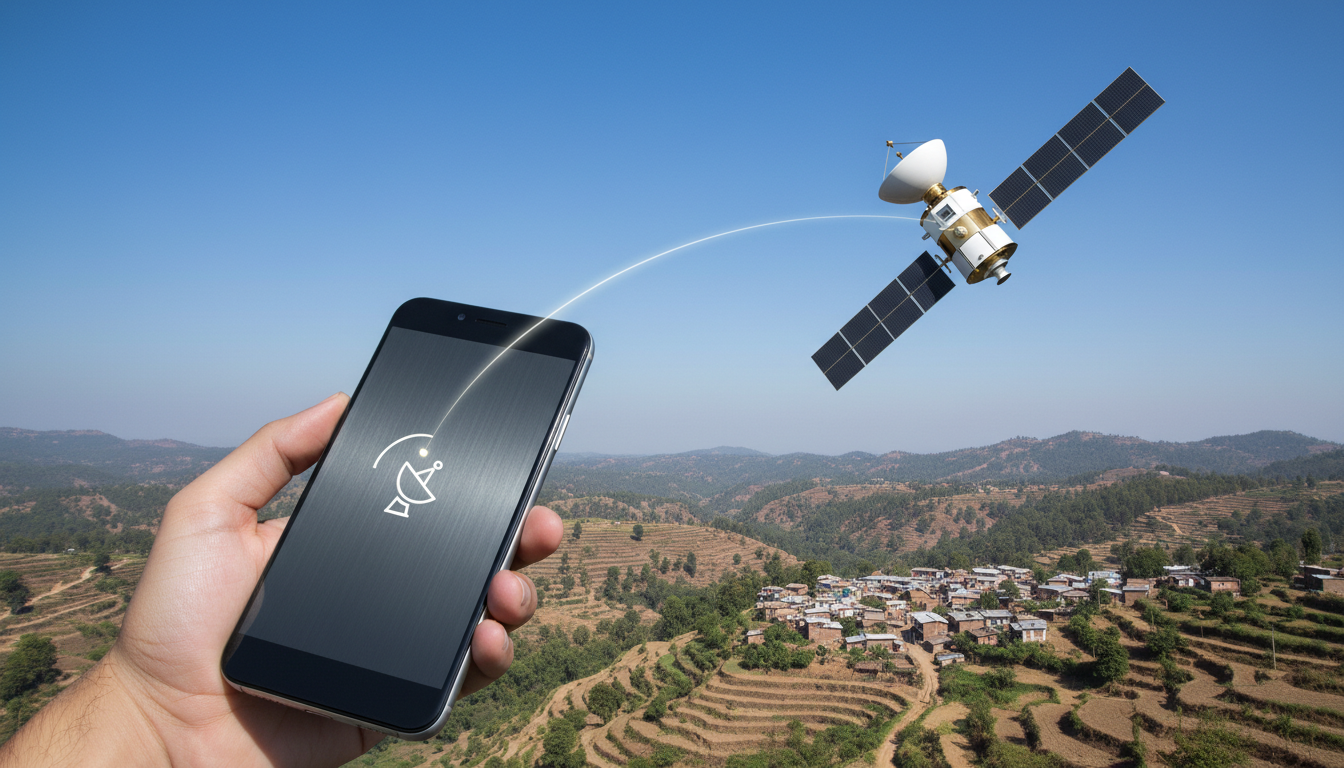
Smartphones in India could become more useful in places where ordinary mobile networks are unavailable. The Telecom Regulatory Authority of India (TRAI) has proposed encouraging phone makers to include support for satellite communication frequency bands in future smartphones sold in the country. If the proposal moves forward, it could help create the foundation for direct-to-device satellite services.

What has TRAI proposed?
In recommendations released on November 5, 2026, TRAI suggested that the government encourage smartphone manufacturers to build support for relevant Mobile Satellite Service (MSS) frequency bands into future handsets. The proposal is part of a wider framework for direct-to-device (D2D) satellite connectivity.
The idea is straightforward: a compatible smartphone could communicate directly with a satellite instead of depending entirely on a nearby mobile tower. This could be useful in remote locations, rural areas, mountainous regions and during situations when terrestrial networks are unavailable.
How could satellite connectivity work?
TRAI’s recommendations describe two possible approaches. One would use Mobile Satellite Service spectrum, including the L-band and S-band. The other could use selected frequency bands already assigned to mobile operators for conventional cellular services.
For the MSS approach, phones would need compatible radio-frequency hardware and antenna systems. Satellite operators and telecom companies would also need suitable network arrangements. Simply having a 4G or 5G phone does not automatically mean it can connect to a satellite.
What features might users get?
If compatible devices and services become available, direct-to-device connectivity could support features such as basic satellite messaging and emergency communication in places without normal cellular coverage. The exact features would depend on the satellite network, phone hardware, service provider and government approvals.
Satellite connectivity should not be confused with a replacement for everyday mobile broadband. Satellite links have different technical limits, and the first services may focus on essential communication rather than fast internet access.
Will existing smartphones support it?
Not necessarily. Existing phones were designed around the frequency bands and satellite systems supported when they were manufactured. A software update cannot add radio hardware that a device does not contain.
Some smartphone makers already offer satellite-related features in selected countries and on specific models. However, availability depends on supported hardware, local regulations and partnerships with satellite providers. TRAI’s recommendation does not mean that all current smartphones in India will suddenly gain satellite connectivity.
What happens next?
TRAI has sent its recommendations to the Department of Telecommunications for consideration. The government will need to decide whether to accept the proposals and what policy or regulatory changes may be required. Manufacturers and service providers would then need to develop compatible devices and networks.
There is no confirmed deadline for smartphone makers to add the proposed support, and the recommendation is not a mandate requiring every phone sold in India to include satellite hardware.
Why this proposal matters
India has a wide range of geographical conditions, and reliable mobile coverage can be difficult to maintain in some remote areas. Direct-to-device satellite technology could eventually provide another way to stay connected, especially for essential communication when conventional networks are out of reach.
For now, the proposal is an important policy step rather than a ready-to-use consumer feature. Buyers should check the official specifications and supported services of a phone instead of assuming that every new 5G device will work with satellites.
Final thoughts
TRAI’s satellite-ready smartphone proposal could influence how future phones are designed for the Indian market. If the framework is approved and supported by device makers and telecom providers, satellite messaging and emergency connectivity may become more accessible over time. The next key step is the government’s decision on the recommendations.
Leave a Reply